AI agents for business finance: what they can and can't do
What AI agents can do in bookkeeping, close, collections and compliance today, where a person must stay in charge, and how to judge a product.
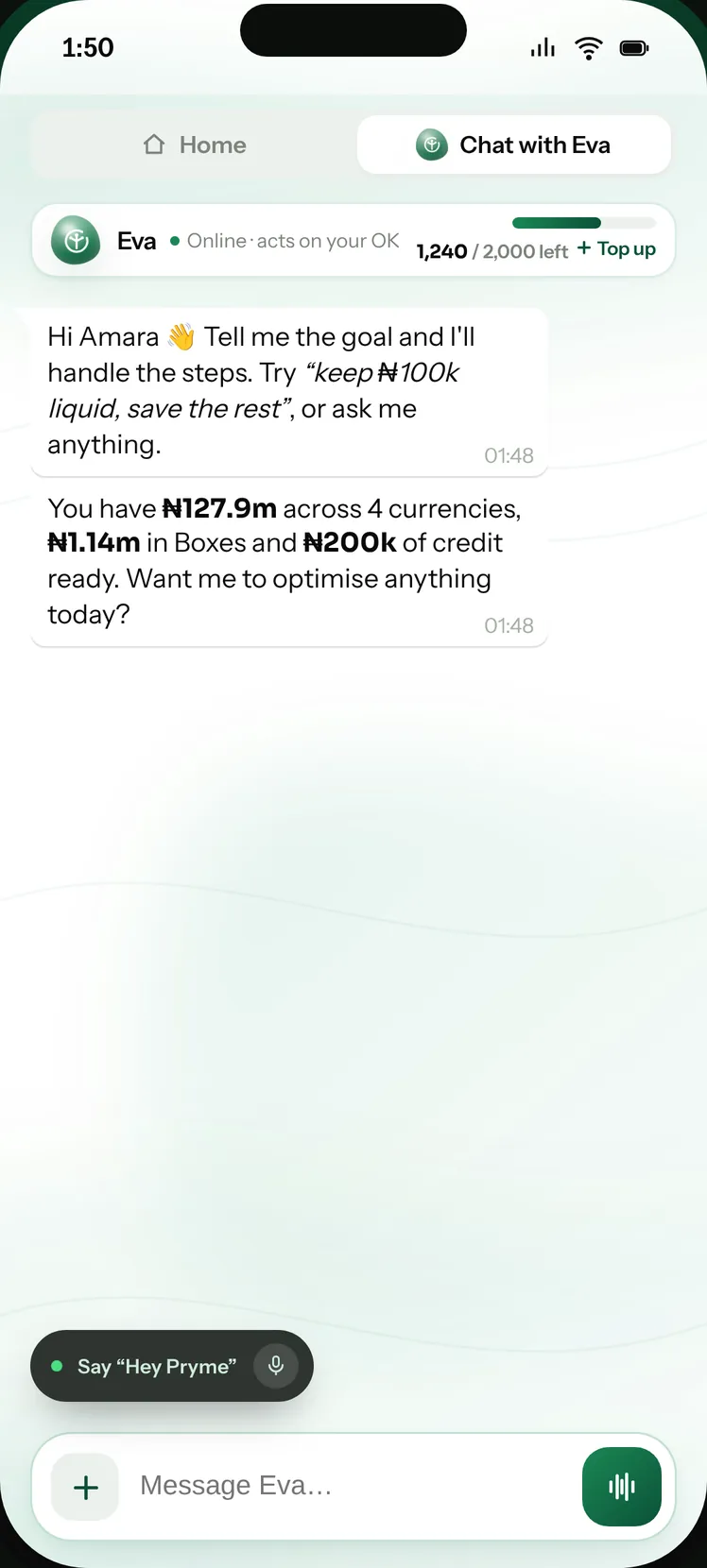
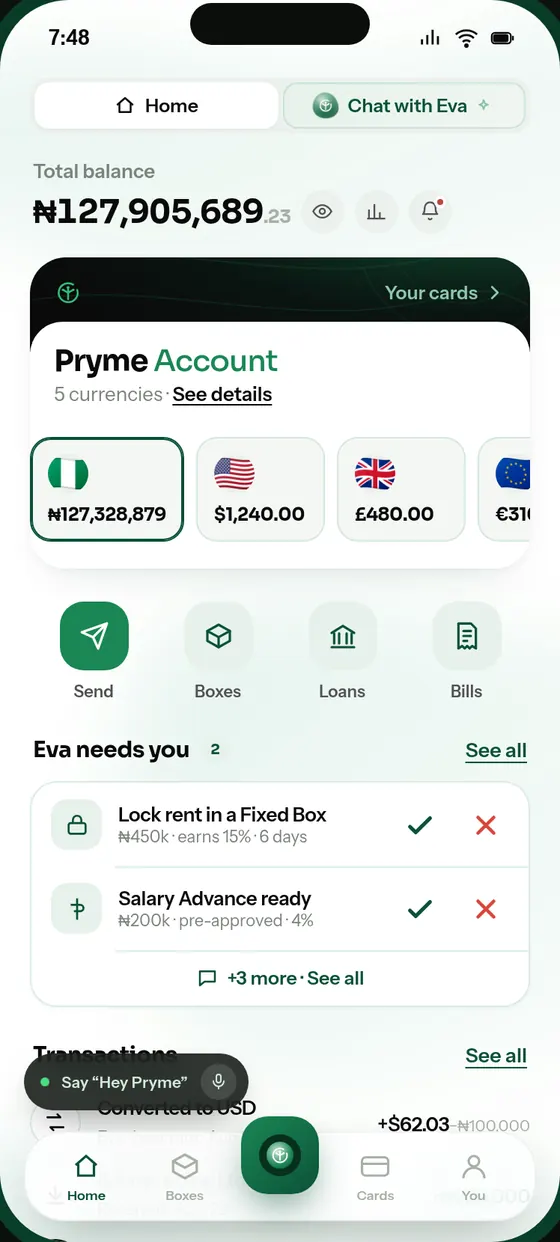
Meet Eva, the assistant inside the Pryme app. She opens accounts, moves money, saves toward your goals and follows up. Nothing leaves your account without your approval.
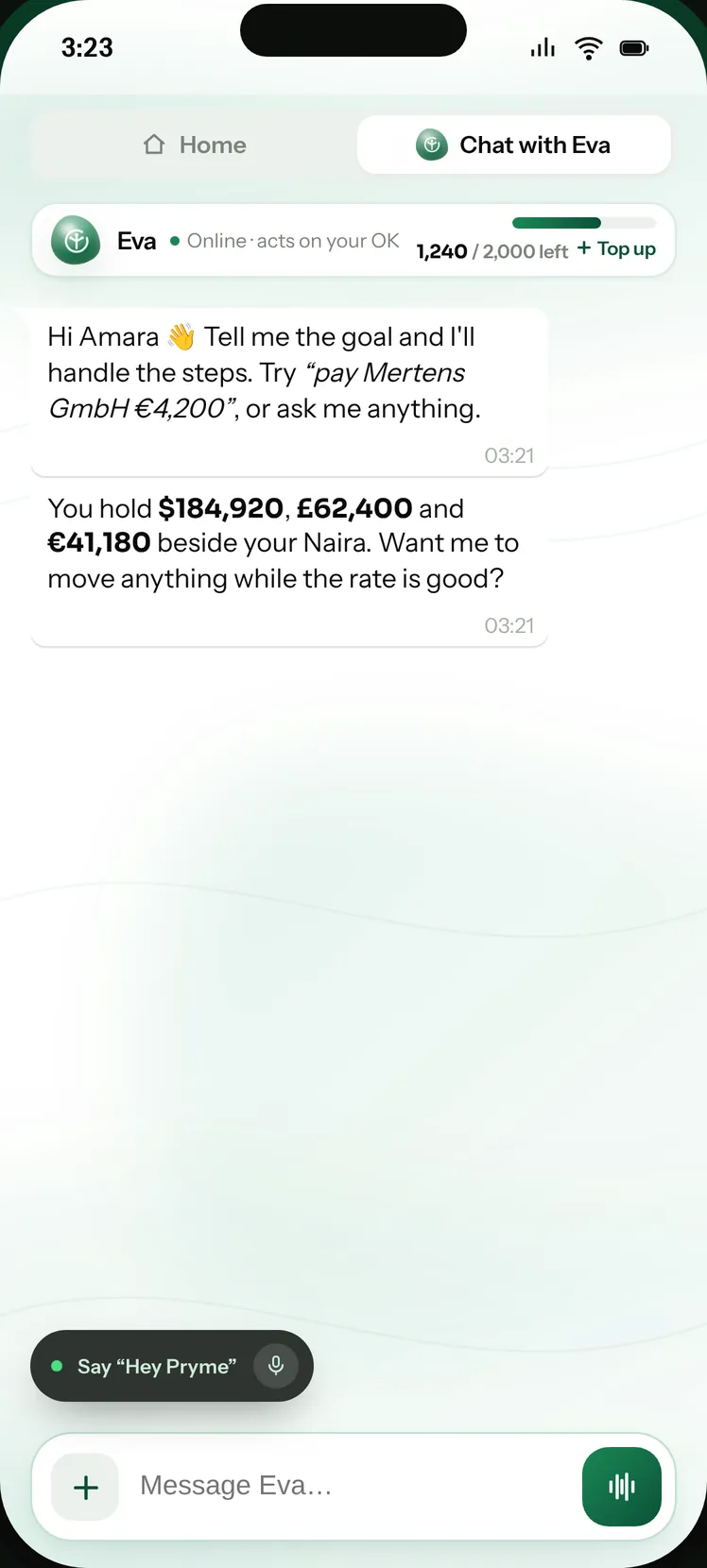
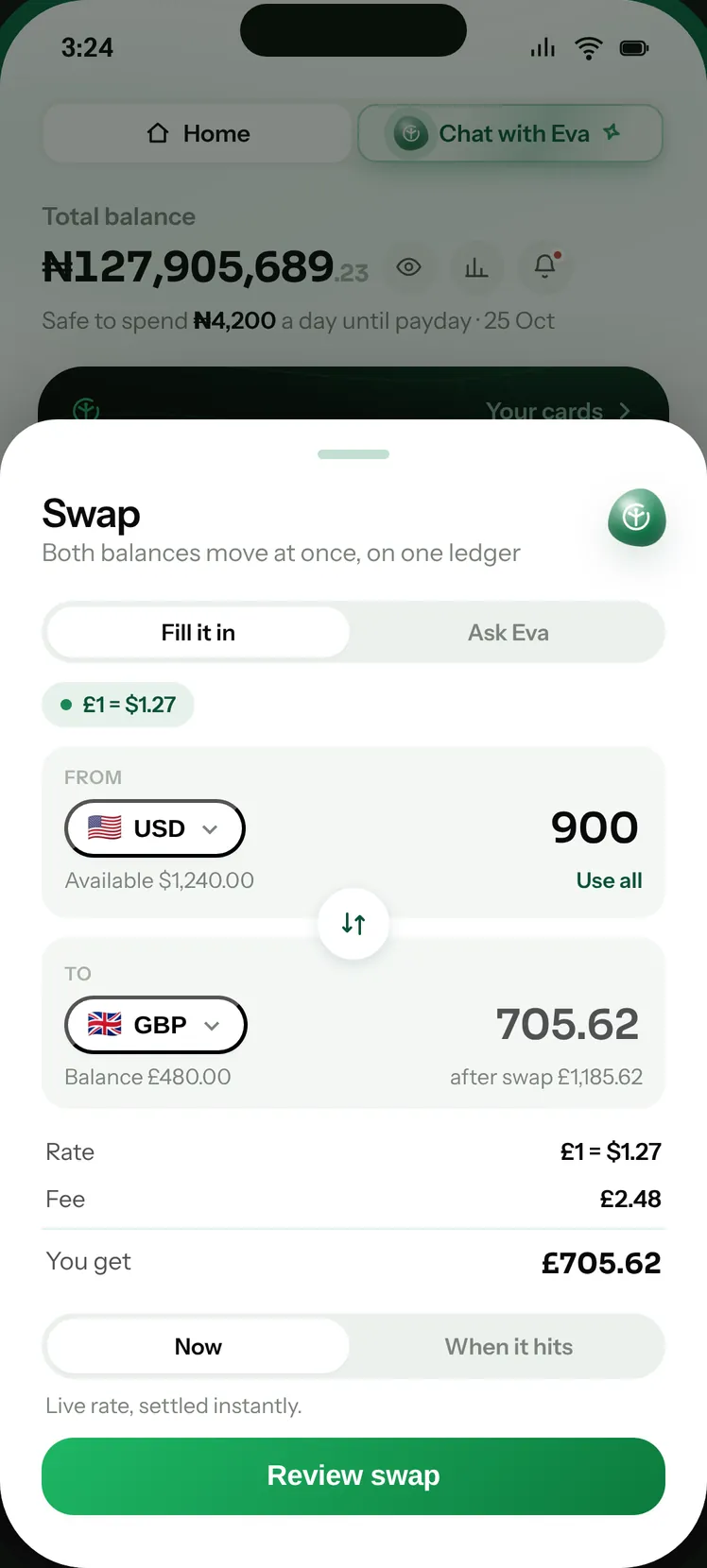
Meet Eva, the assistant inside the Pryme app. She holds dollars, pounds, euros and Naira side by side, swaps at a locked rate, pays bills in any of them and sends anywhere, asking before anything moves.
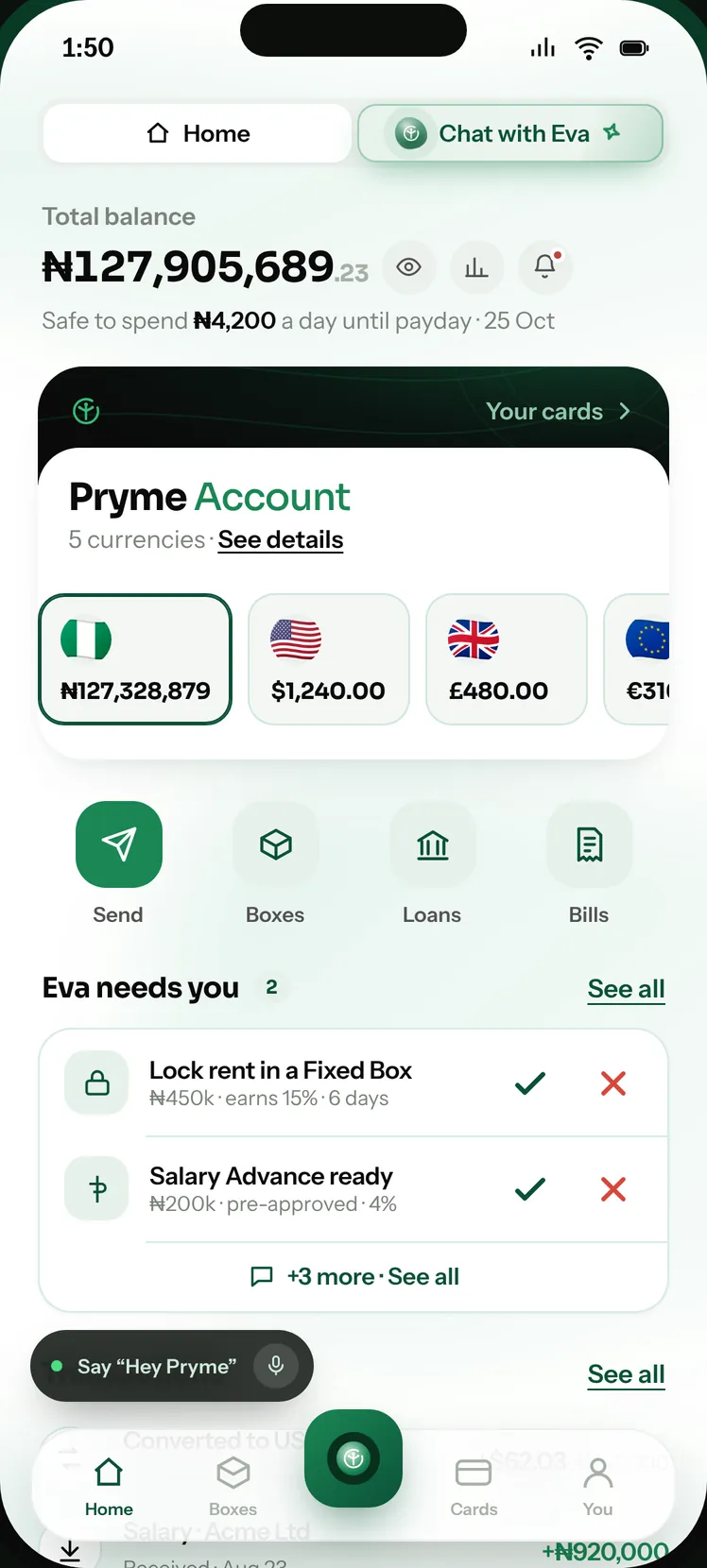
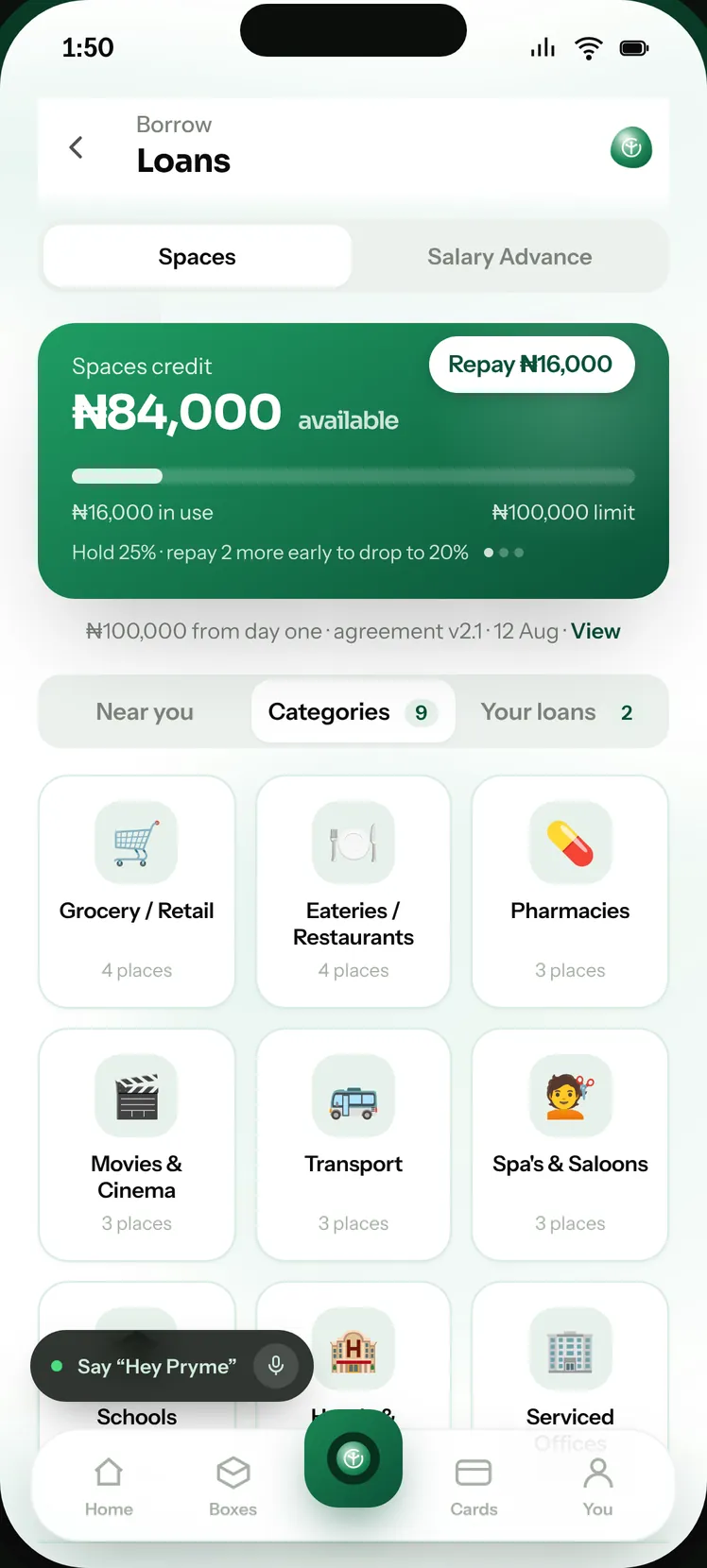
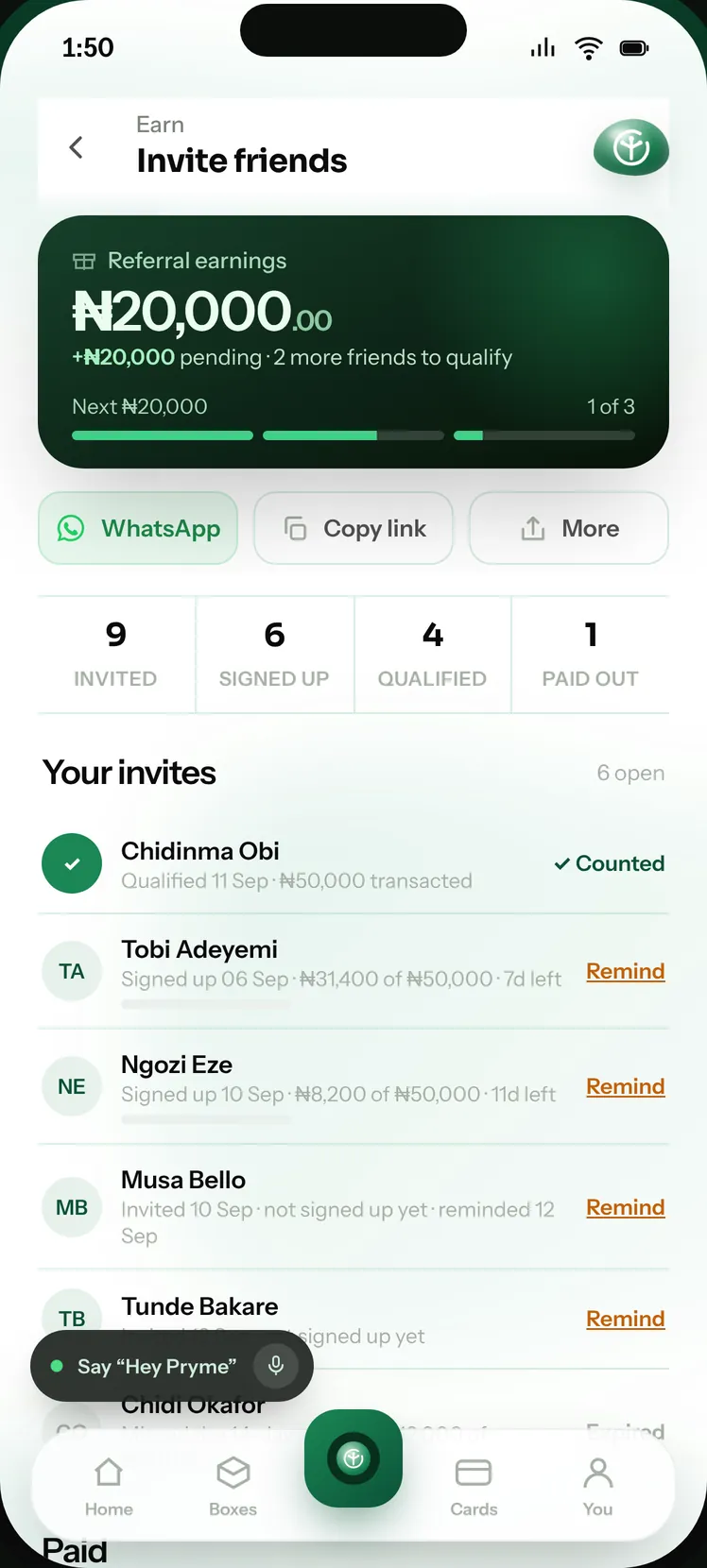
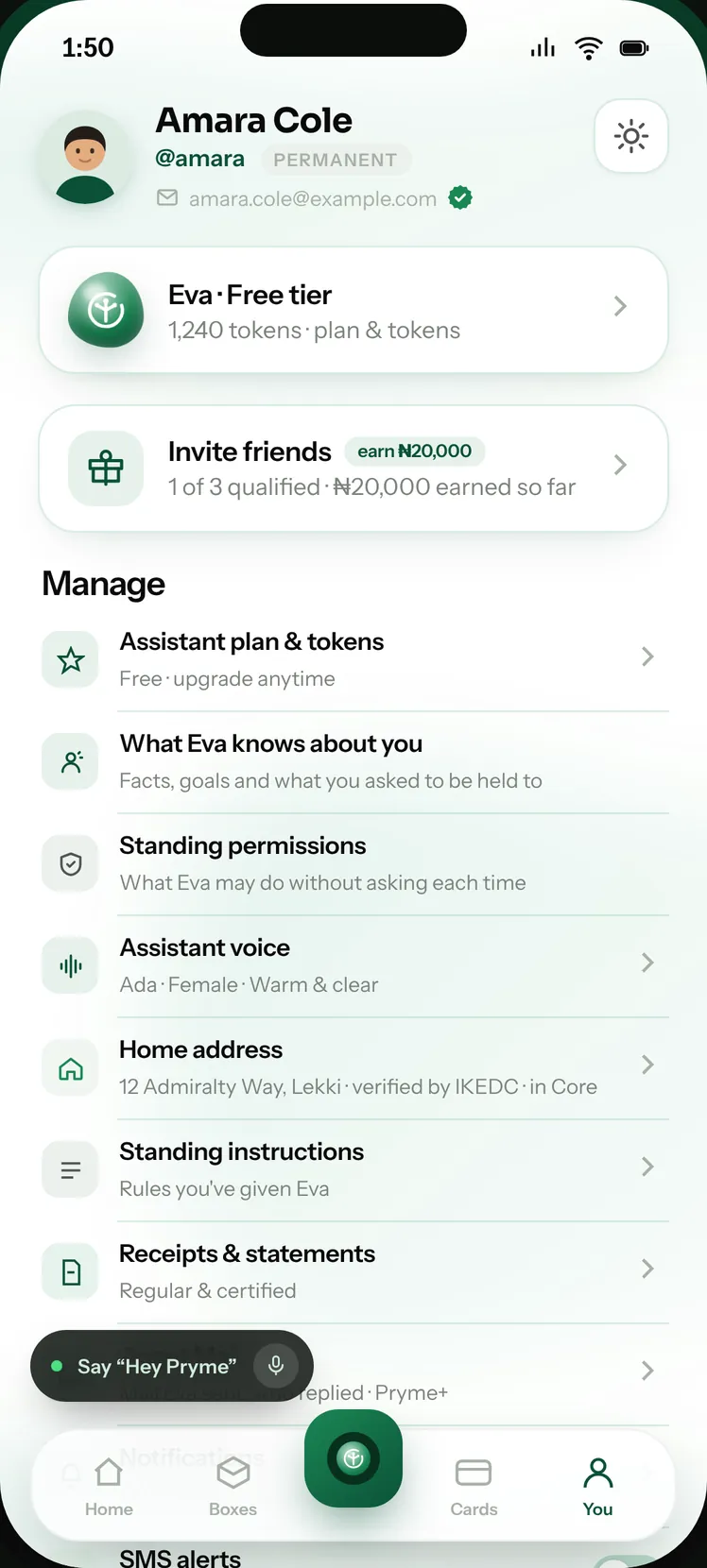
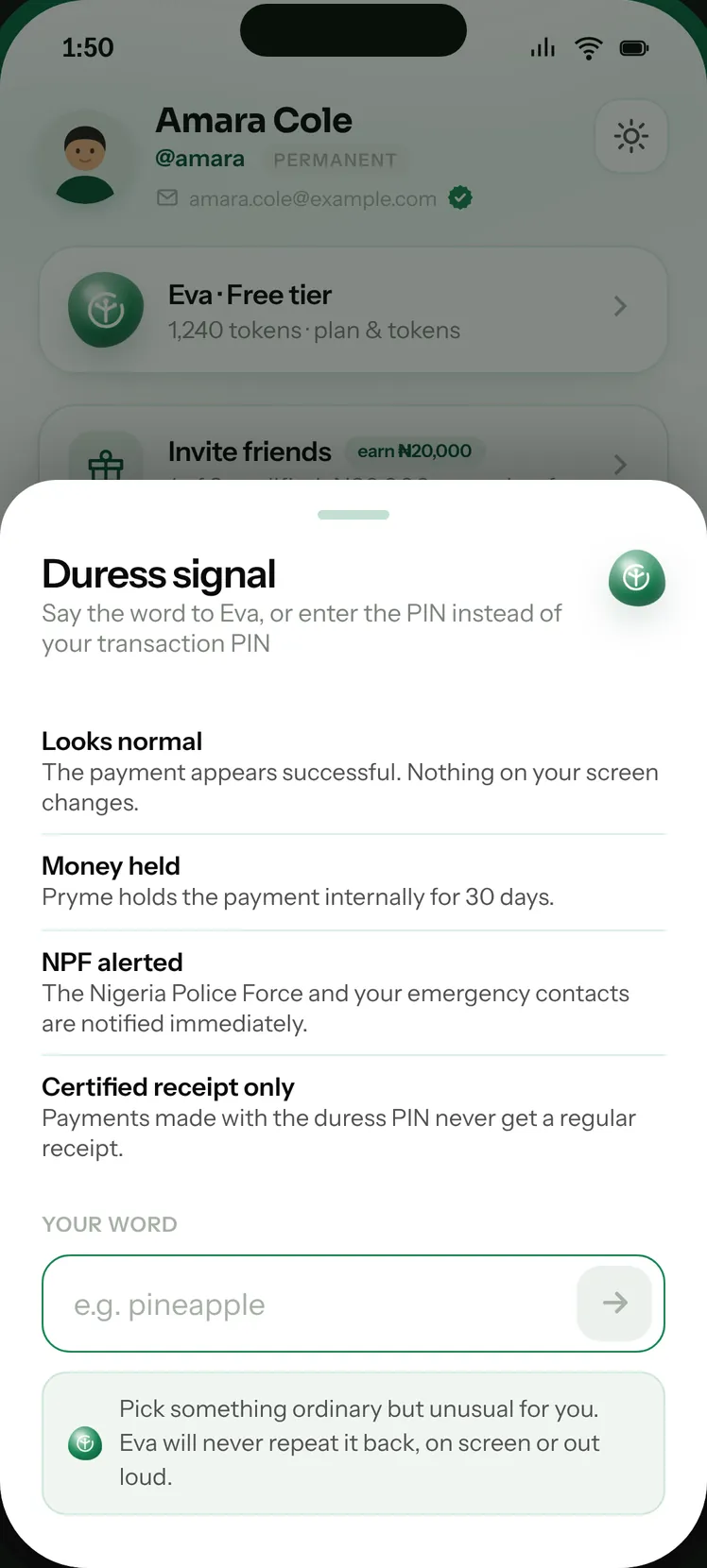
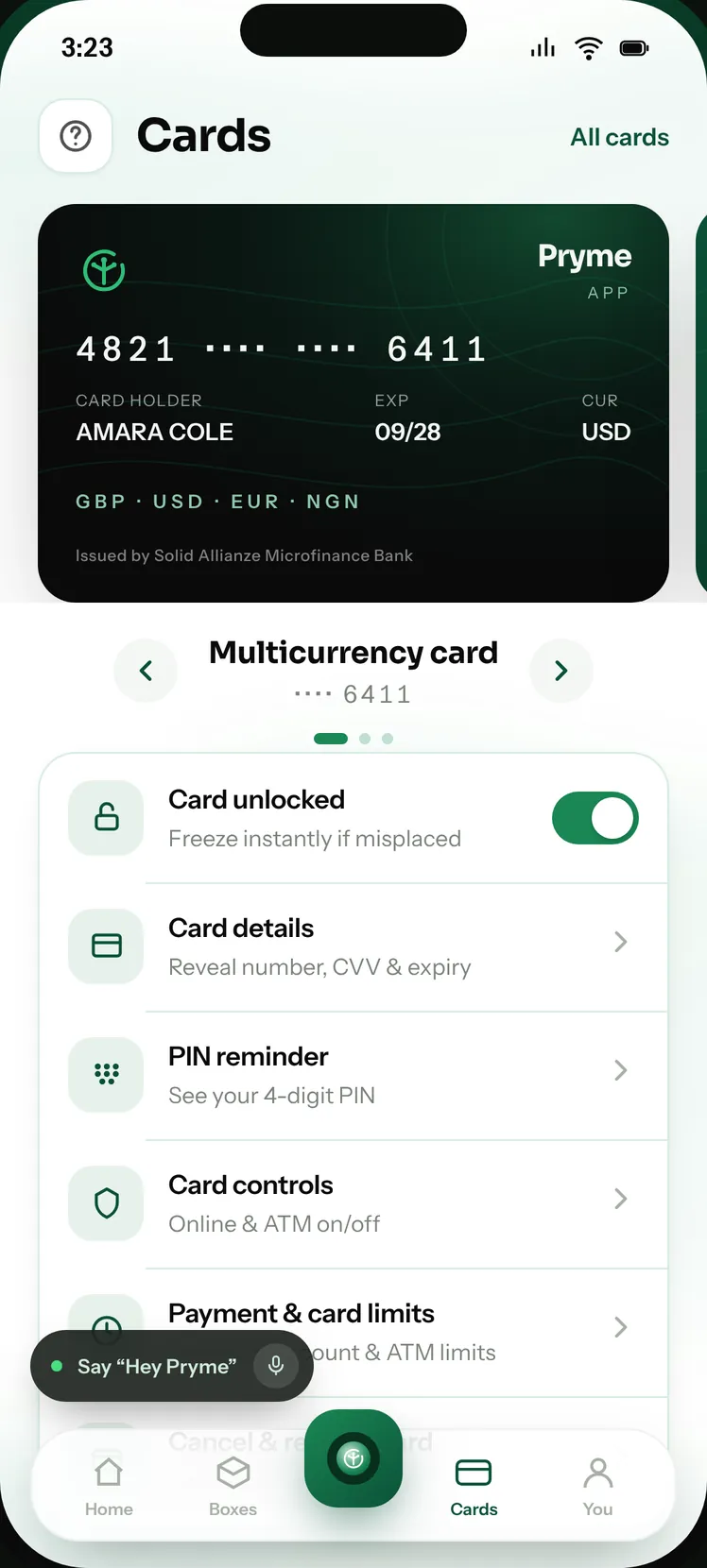
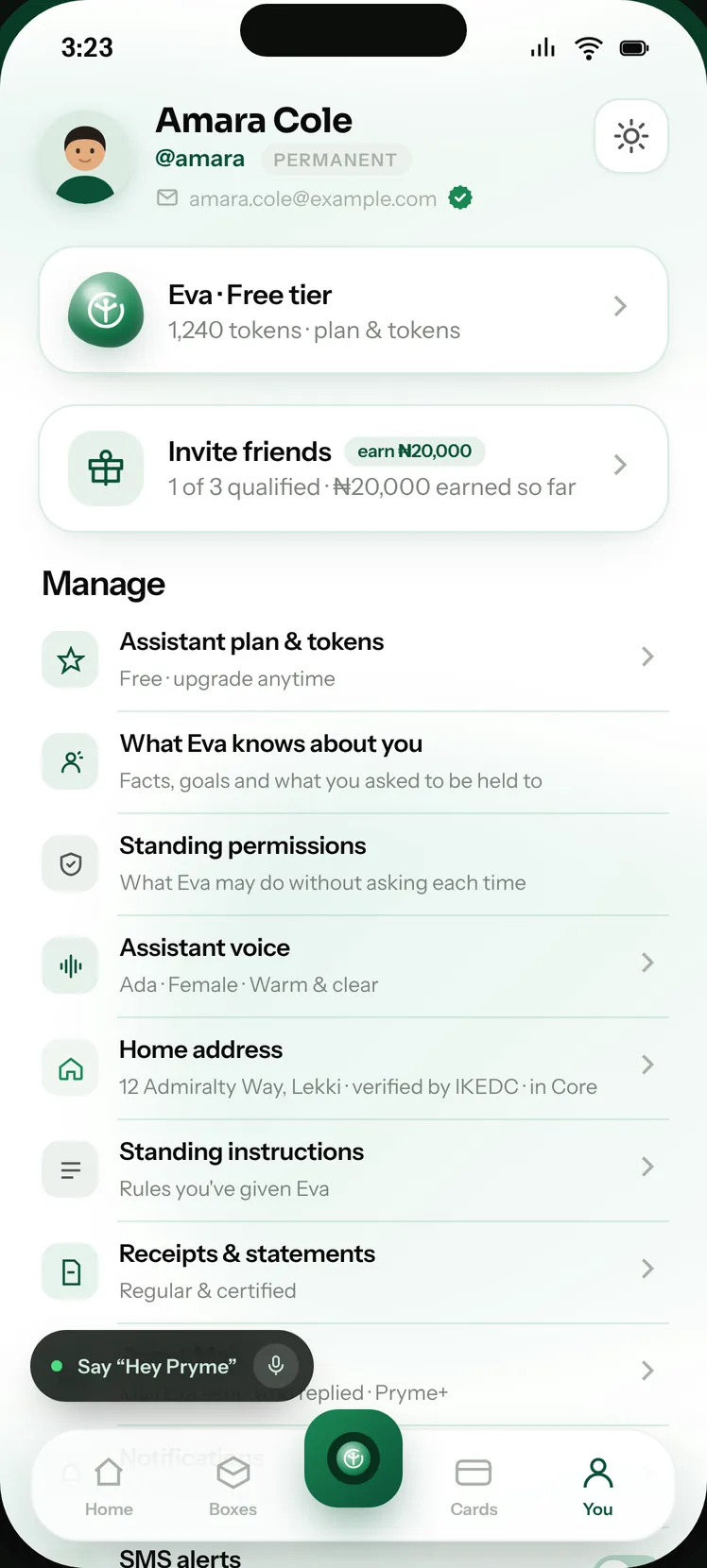
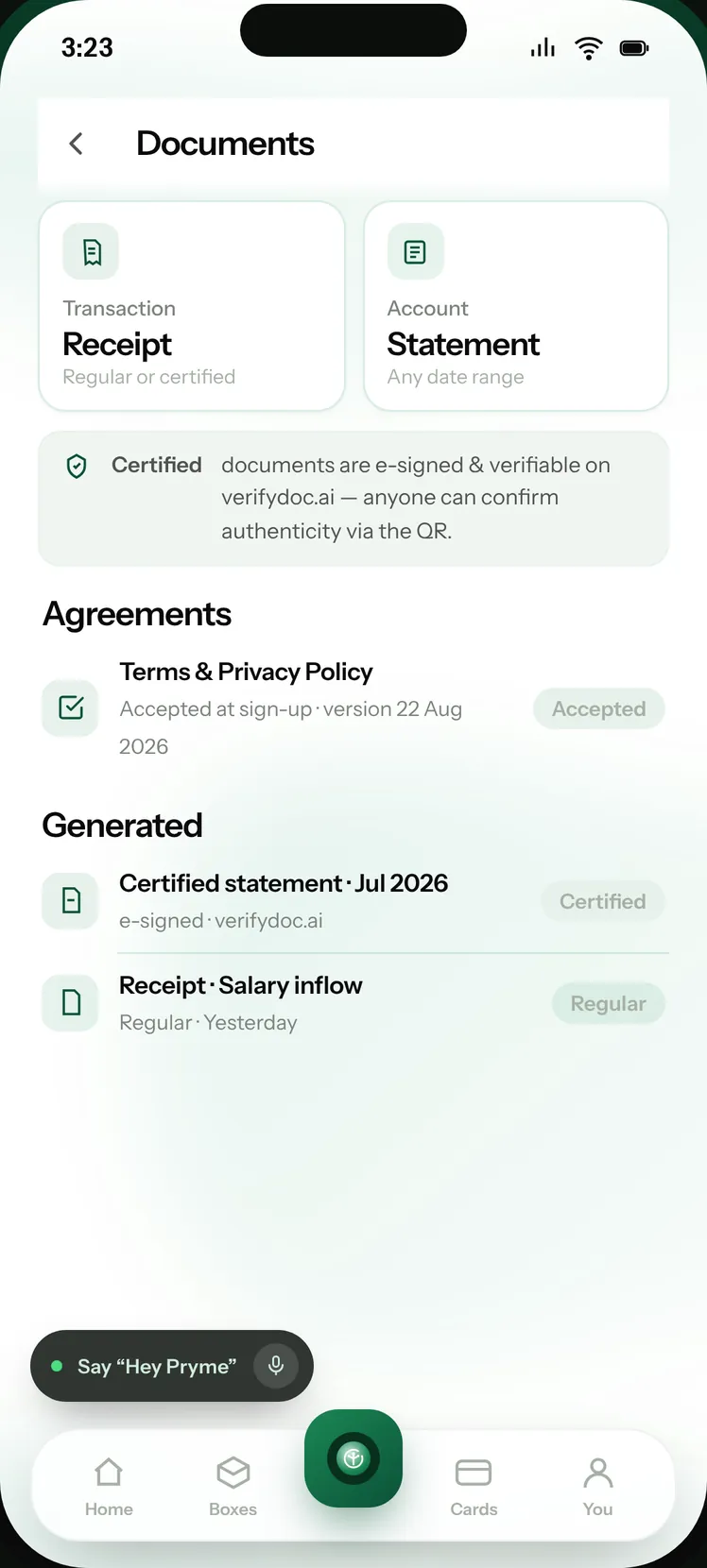
We give you a limit to spend at the shops and services you already use — and an account that works on your month while you get on with it. Dollars, pounds and euros sit beside your Naira, and an assistant handles the running of it, asking you first every single time.
One global account for your money and business. Move across currencies, automate everyday operations and put AI agents to work — with you in control of every important decision.


 Evayour assistant
 DanielChief of Staff
 BenFinance
 BruceCare
Your competitor down the road sells the same thing you sell. The difference is who walks in. We put money in people’s hands that can only be spent in businesses like yours — and then we point them at you.
You are not borrowing. You are selling to somebody who already has the money — and that money can only be spent with a business like yours.
₦100,000 from day one · agreement v2.1 · 12 Aug · View
Eva waits for your rate and asks before she moves anything.
No card, no OTP, nothing for the buyer to type in. They transfer from the bank app they already use, and the money lands in the same account your agents are running — already matched to the order, already in your books.
We give the buyer a one-time account number. They transfer to it from any bank app or by USSD — no card, no OTP, nothing to type in.
Get the account numberTo this account, from any bank app. We watch it, and the page updates itself.
₦26,767.50 from GTBank · John D., matched to order ORD‑1042.
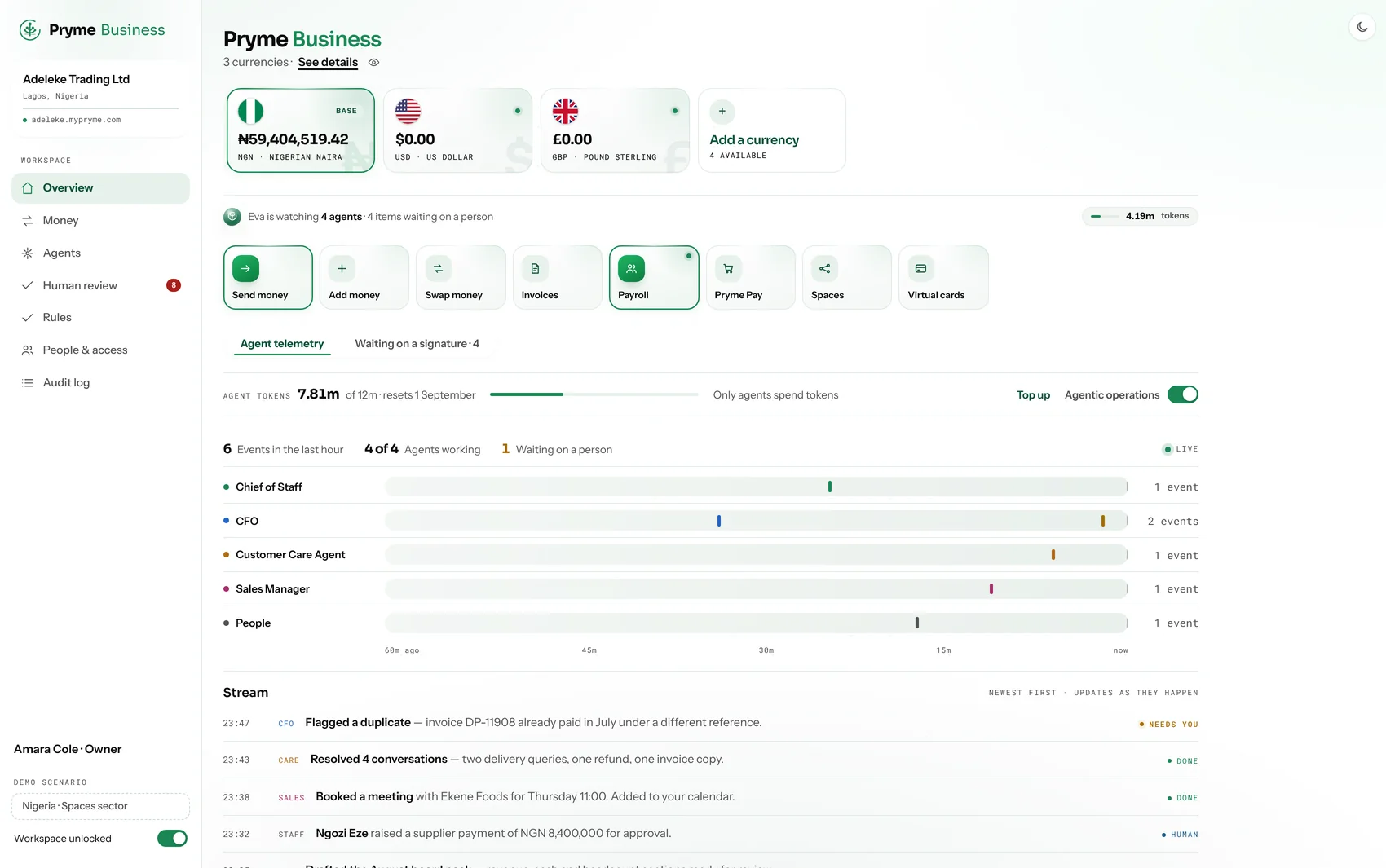
Five agents come with the account. Each one has a job description, a budget and a ceiling you set. They do the work and bring it to you — nothing leaves the account without your signature.
Knows what is stuck, who is waiting and what you promised — and keeps all three moving.
Booked a meeting with John Doe Foods for Thursday 11:00.Keeps the books as you trade and tells you the moment something does not add up.
Flagged a duplicate — invoice DP‑11908 was already paid in July.Holds every filing to its own clock and screens names and payments against your policy — and logs what it refuses.
Screened 412 payments overnight and refused two of them.Goes back to the buyers who went quiet, with the receipt already attached.
Recovered ₦410,000 across three overdue invoices.Replies, follows up on what they asked for and hands you only the ones that need you.
Resolved 4 conversations — two deliveries, one refund.Issue a dedicated Naira account number to each of your own customers, collect into it and reconcile against it. The same rails the Business Account runs on, with the licence behind them.
Dollars, pounds and euros beside a Naira account, on one ledger and one set of books. Five agents come with it and run the account — nothing leaves without your signature.
Five agents come with the account. Each has a job description, a budget and a ceiling you set. They do the work and bring it to you — they propose, you approve.
Knows what is stuck, who is waiting and what you promised, and keeps all three moving.
Booked the quarterly review with your auditor for Thursday.Keeps the books in every currency you hold and flags the moment something does not add up.
Flagged a duplicate — invoice DP‑11908 was already paid in July.Holds every filing to its own clock and screens names and payments against your policy — and logs what it refuses.
Screened 412 payments overnight and refused two of them.Goes back to the buyers who went quiet, with the invoice and the receipt already attached.
Recovered $12,400 across three overdue invoices.Replies, follows up on what they asked for and hands you only the ones that need you.
Resolved 4 conversations — two deliveries, one refund.The business has changed shape four times and never changed what it was rooted in. Each version was built out of what the last one could not do.
An online grocery store, built out of a faulty tab. Selling the food was the easy part — taking the money for it, and moving it, turned out to be the business.
A prepaid card. The first time the company issued rather than resold, and the first time it carried the obligations that come with holding somebody else’s money.
Solid Allianze acquired — an existing bank with an existing licence. The perimeter stopped being someone else’s to draw.
More than one currency on one balance, and the rebrand to Pryme. A Nigerian business could hold dollars without holding a second institution.
Accounts that do the work rather than only hold value. Five agents on the account, inside a policy you write — which is where the new mark starts.
Pryme is a financial technology company. It gives people and businesses in Nigeria one account that holds Naira alongside dollars, pounds and euros, and a set of agents that do the running of it — keeping the books, chasing what is owed, answering customers and paying bills. Nothing leaves an account without the owner’s approval.
Yes. A Pryme account holds Naira, US dollars, pounds sterling and euros side by side on one ledger, each with its own account details — a Nigerian account number, a US account number, a UK sort code and an IBAN for the euro area. You can swap between them at a rate you set, and every currency has its own statement.
Spaces is available in Nigeria. It gives a shopper money to spend that can only be spent with a participating business. The business is paid into its Naira account whether or not the shopper repays, because Pryme carries the credit. For the business it is free to join, there is nothing monthly, and the customer’s identity is never shown — only a reference and what it is worth.
Five agents come with the account. The Chief of Staff runs the week and keeps what is stuck moving. Finance watches the money and keeps the books as you trade. Compliance keeps the filings on time and screens what moves. Sales chases what you are owed. Customer Support answers your customers and follows up. Each has a job description, a budget and a ceiling you set, and each one proposes rather than acts — nothing leaves the account without your signature.
Pryme Pay takes payments on your own site or on a checkout page you control. The buyer is given a one-time account number and transfers to it from any bank app or by USSD — no card, no OTP, nothing to type in. The money lands in the same account your agents are running, already matched to the order and already in your books.
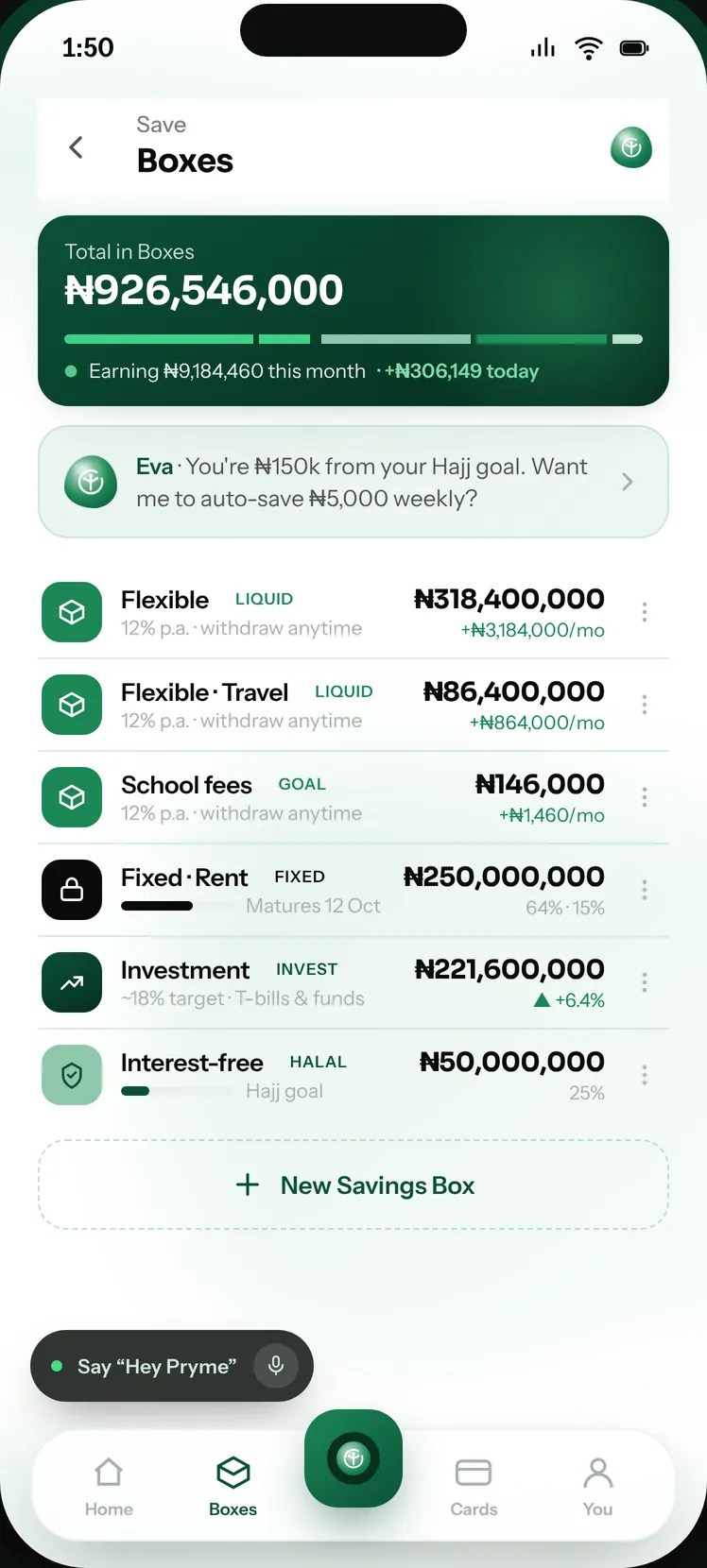
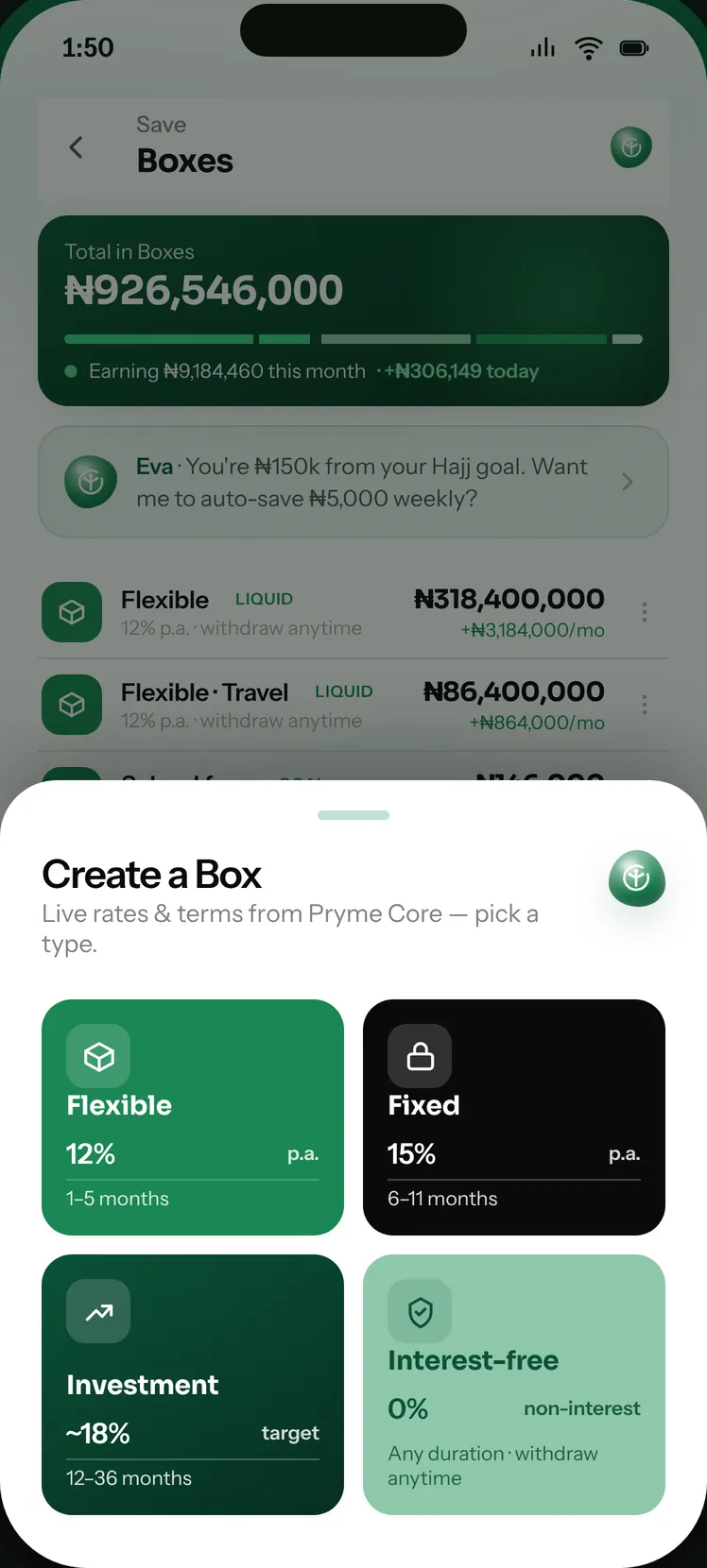
Savings Boxes are separate pots inside a Pryme account, held in Naira. Flexible Boxes can be withdrawn at any time, Fixed Boxes hold to a date, Investment Boxes hold for longer, and Interest-free Boxes earn nothing by design. A business can use them to ring-fence payroll and the tax it withholds, so that money cannot be spent by accident.
Pryme is a financial technology company, not a bank. Accounts and deposits are provided by Solid Allianze Microfinance Bank Limited, which is licensed by the Central Bank of Nigeria and is a member of the Nigeria Deposit Insurance Corporation.
Yes. Pryme Rails lets a platform issue a dedicated Naira account number to each of its own customers, collect into it and reconcile against it, over one API — the same rails the Pryme Business Account runs on.
Pryme is a financial technology company. It gives you one account that holds US dollars, pounds sterling and euros beside Naira, with an assistant that runs the account for you and asks before anything moves. Accounts are provided in Nigeria today, and further markets open as each licence lands.
Accounts are provided in Nigeria today, subject to verification and approval. Foreign-currency balances are held and converted inside that account, so you can hold, receive and swap dollars, pounds and euros wherever you are.
Naira, US dollars, pounds sterling and euros, side by side on one ledger. Each has its own details — a Nigerian account number, a US account number, a UK sort code and an IBAN for the euro area — and each has its own statement.
Swap at a rate you set rather than the rate of the day, then send to any Pryme username or to a Nigerian bank account. There is no fee to send to another Pryme account.
Eva is the assistant inside the Pryme app. She opens accounts, moves money, saves toward your goals, pays what is due and follows up what is owed to you — and asks you before anything moves.
Pryme Rails lets a platform issue a dedicated Naira account number to each of its own customers, collect into it and reconcile against it, over one API — the same rails the Pryme Business Account runs on.
Notes on money that does the work: what we are building, what the regulation actually says, and how we think about letting software act on money. Read the Ledger
What AI agents can do in bookkeeping, close, collections and compliance today, where a person must stay in charge, and how to judge a product.
How multi-currency business accounts work: local details vs SWIFT, payment rails, the real cost of FX, safeguarding vs deposit protection, and hedging.
How UK, US, Canadian and European firms pay Nigerian suppliers and get paid by Nigerian clients: FX, Form A and M, tax, compliance and payout routes.
What it really costs to send money to Nigeria from the UK, US, Canada and Europe: fees, exchange-rate margins, CBN naira rules, BVN, speed and scams.
What AI can and cannot do in day-to-day bookkeeping, how much time it saves on real numbers, and which jobs must stay with you or your accountant.
What we are building, what the regulation actually says, and how we think about letting software act on money.
How much the NDIC insures per depositor at banks, microfinance banks, PSBs and MMOs, what counts as a deposit, and how payouts work in 2026.
How microfinance banks and commercial banks in Nigeria differ on capital, NDIC cover and failure rates, and how to choose where to keep your money.
A ten-minute check for any Nigerian bank, fintech or loan app: find the legal name, search the CBN, NDIC, FCCPC and SEC lists, and spot fakes.
When giving your BVN is normal, when it is a scam, what someone can and cannot do with it, and the 2026 CBN rules that protect BVN holders.
The difference between Nigeria's BVN and NIN: who issues each, what they are used for, which accounts need both, and who is allowed to ask for them.
What Tier 1, Tier 2 and Tier 3 accounts need in Nigeria, the CBN's daily and balance limits for each, and how to upgrade when you hit a cap.
If a Nigerian fintech app closes, your money's fate depends on who held it: a partner bank, an MFB, an investment custodian or nobody. What to do next.
Step-by-step: complain to the provider first, then escalate to the CBN, FCCPC, NDPC or SEC. What to include, timelines, and a template you can copy.
The signs of a Ponzi or fake investment scheme in Nigeria, lessons from CBEX, how to check SEC registration, and what to do if you have already paid in.
What the Nigeria Data Protection Act 2023 lets you demand from banks and fintechs: access, correction, deletion, objection and NDPC complaints.
What AI can and cannot do in day-to-day bookkeeping, how much time it saves on real numbers, and which jobs must stay with you or your accountant.
How AI agents chase unpaid invoices, what late-payment law lets you charge in the UK and EU, and where a person must step in before a customer is lost.
How AI matches bank lines to invoices and bills, the cases it still gets wrong, and the controls that stop a bad match becoming a bad set of accounts.
Which month-end close tasks AI can take on, a day-by-day example of a shorter close, typical benchmarks, and the review steps a finance lead must keep.
A decision-by-decision map of what an AI agent may do alone, what needs one or two approvers, and how to make human review real rather than a rubber stamp.
Which finance uses of AI the EU AI Act treats as high-risk, the dates after the 2026 Omnibus, deployer duties and what finance teams should do now.
The fields every AI agent action should log, a sample record for one payment, how long to keep logs in the UK, US and EU, and how to test a vendor.
AI CFO software against a part-time human CFO: tasks, costs at real UK day rates, risks, and when a business needs one, the other or both.
What an AI support agent can safely answer for a financial business, what must go to a person, what UK, US and EU regulators expect, and a cost example.
Where AI helps with customer checks and transaction monitoring, where it falls short, what UK, US and EU regulators say, and what a person decides.
A step-by-step check of the FCCPC's approved lenders list, what each status means, and what to do when a loan app is missing or the names do not match.
What a loan app may and may not do to recover a debt in Nigeria, the evidence to keep, and how to report harassment to the FCCPC, NDPC, police and Google.
How to turn a flat fee, a monthly rate or an upfront deduction into an annual rate, with worked naira examples, so you can compare any two loan offers.
How salary advances and earned wage access work in Nigeria, what the flat fee really costs, how repayment on payday works, and when an advance makes sense.
How BNPL works in Nigeria, the difference between interest-free and financed plans, a worked phone purchase, the rules that apply and the risks to watch.
Who holds your credit record in Nigeria, what goes into it, how to get your free report each year, how to dispute an error and how to build a better score.
How Nigerian lenders set and review credit limits, the habits that raise a limit over time, a worked example of early repayment, and what to avoid.
A naira-for-naira comparison of a bank overdraft and a loan app in Nigeria, with a worked example, the hidden fees on each, and when each one makes sense.
Ways to spread school fees in Nigeria, from a school's own payment plan to fee financing and credit, with a worked example of what each option costs.
The safer ways to cover a medical bill or emergency in Nigeria, in the order to try them, with a worked ₦250,000 example and the borrowing traps to avoid.
Three ways a UK company can take payment in US dollars, what each costs on a $12,000 invoice, and the paperwork American customers may ask for.
What each bank identifier tells the payment system, which ones to give a customer in each country, and the mistakes that send money astray.
How to find the margin inside an exchange rate, a four-step calculation you can run on any quote, and a worked example on a €25,000 invoice.
Bank deposits get FSCS cover up to £120,000; e-money is safeguarded instead. What each protects, the May 2026 rule changes, and what to ask.
How a small business can protect its margins from exchange-rate swings: natural hedges, target rates and forwards, with a worked $200,000 example.
How to book foreign-currency invoices, revalue balances at period end, and split realised from unrealised gains, with a worked €30,000 example.
Why a SWIFT transfer can arrive late and short, how providers use local rails instead, and when SWIFT is still the right choice for a business.
Since October 2025, euro-area banks must send instant euro payments at no extra cost and check payee names. What it means for your business payments.
ACH is cheap and batched; a wire is fast, final and costs more. How each works, the 2026 limits and cut-offs, and which to use for which payment.
How to invoice overseas clients so more of each payment reaches you: which currency to bill in, the details to give, and when to convert.
Primary auction or secondary market, minimums, how the discount works, the 10% withholding tax and what you actually earn, with October 2026 rates.
What a Nigerian money-market fund holds, how its yield is calculated, how fast you can withdraw, what protects you and how to pick one (October 2026).
Which pays more, which you can reach, what breaking a deposit costs and how to split money between the two, with October 2026 rates.
Wadiah, qard, mudarabah and sukuk explained: what each pays, how each is protected and how to keep interest-free savings from losing value to inflation.
The 10% tax taken from savings, fixed-deposit, dollar-deposit and Treasury bill interest since 2026: what is covered, what is exempt, and worked examples.
How many months of costs to hold, how to adjust for inflation and irregular income, and where to keep the money in Nigeria so it is there when you need it.
When holding dollars protects your savings and when it costs you: domiciliary account rules, tax on dollar interest, conversion costs and a worked example.
How rotating groups, daily collectors and savings apps compare on cost, return, discipline and safety, with naira examples and when each makes sense.
How to work out the real return on any Nigerian savings product after tax and inflation, with September 2026 figures and the one formula you need.
A term-by-term plan for Nigerian parents: budget the full cost, allow for fee rises, save monthly and time each term's money to mature before fees are due.
The routes UK firms use to pay contractors in Nigeria: pounds to a domiciliary account or naira to a local account, with costs, timings and checks.
What Form A and Form M are, when a Nigerian client must file them to pay you, and what the CBN's 2026 FX Manual changed for foreign suppliers.
The 2026 rates Nigerian clients deduct when paying foreign companies, when it is a final tax, why a Nigerian tax ID matters and how to claim relief.
What the 1987 UK–Nigeria tax treaty covers: permanent establishment, rate caps on dividends, interest and royalties, staff, and how UK firms get credit.
Nigeria left the FATF grey list in October 2025 and the EU high-risk list in January 2026. What that changes for UK, EU and US firms, and what it does not.
How the naira's official rate is set: one willing-buyer, willing-seller market, the EFEMS matching system, the FMDQ closing rate and its use in contracts.
How the Pan-African Payment and Settlement System lets a business in one African country pay another in local currency, who can use it and its limits.
How the African Continental Free Trade Area works for exporters in 2026: tariff cuts, rules of origin, certificates from Nigeria and how payments flow.
When a foreign software, streaming or online business must register for Nigerian VAT, how 7.5% is charged to consumers and businesses, and what to file.
Seven checks before you pay a Nigerian supplier or partner: CAC registration, owners, sanctions, tax ID, bank account name, licences and red flags.
What Nigerian businesses pay to offer buy now, pay later: how merchant fees are built, market benchmarks, a worked break-even and what to ask a provider.
What the research says about buy now, pay later and basket size, why provider claims run high, and how a Nigerian business can measure the real effect.
How a Nigerian pharmacy can let patients spread the cost of medicine without running a credit book: where it helps, the numbers, and what to watch.
How Nigerian private schools can be paid in full at the start of term while parents spread fees: the options, a worked example and what to agree first.
When pay-later makes sense for a Nigerian restaurant, canteen or caterer, when the fee eats the margin, and how consumption tax and VAT affect the sums.
How Nigerian salons, spas and gyms can use pay-later for packages and memberships: where it pays, a worked example, and the refund risk to plan for.
How Nigerian hotels and serviced apartments can take pay-later on longer stays and events: deposits, cancellations, tax and a worked example.
When a Nigerian business gets paid for pay-later sales: settlement timing, net versus gross, refunds, clawbacks, the cost of waiting and reconciliation.
Should a Nigerian shop keep its own credit book or use a pay-later provider? The true cost of each, a worked comparison, and how to switch over.
Where to show pay-later in a Nigerian shop, what staff should and should not say, sample wording, and the FCCPC rules on credit marketing to follow.
How to send pounds to Nigeria from the UK: what it really costs, how fast it arrives, which firms are regulated, and what protection you have.
Sending dollars to Nigeria from the US: average costs, the 1% federal remittance tax on cash-funded transfers since 2026, and your rights.
Sending Canadian dollars to Nigeria: what transfers cost, how to check a provider with FINTRAC and the Bank of Canada, and how payouts arrive.
Sending euros to Nigeria from Italy, Germany, Ireland, Spain and elsewhere in Europe: average costs, EU rules, checking a provider, and payouts.
Why the pound-to-naira rate in your app is lower than the one in the news: mid-market, official and street rates, margins, and how to measure them.
How to pay a Nigerian school or university from the UK, US, Canada or Europe: pay the school directly in naira, use Remita, avoid scams, plan for the rate.
How to pay electricity, airtime, data, TV, rent and medical bills in Nigeria for family from the UK, US, Canada or Europe, in naira and with a record.
The Non-Resident BVN lets Nigerians abroad get a Bank Verification Number online. Who can apply, documents, the $50 fee, timing and what it is for.
How the Central Bank of Nigeria's rules decide how money sent from abroad is paid out: naira-only payouts, the $200 cash limit, and the May 2026 changes.
The money transfer scams that target Nigerians abroad, how to spot them, what protection you have in the UK, US, Canada and Europe, and what to do fast.
What a virtual account is in Nigeria, dedicated vs dynamic, what they cost, the BVN/NIN rule, and how schools, landlords and sellers use them.
How pay-by-transfer checkout works for Nigerian online sellers: the customer journey, fees vs cards, expiry, wrong amounts and how to set it up.
Published payment gateway fees in Nigeria for cards, transfers, virtual accounts and payouts, with worked examples on caps, VAT and settlement time.
How NIBSS Instant Payment (NIP) moves money between Nigerian banks in seconds: name enquiry, credit, settlement, fees, limits and failed transfers.
A practical routine for matching every Nigerian bank transfer to an order or invoice: matching rules, exceptions, WHT short-payments and month-end.
How card chargebacks, transfer recalls and fake alerts work in Nigeria, the 16-hour response window, the evidence that wins, and how to cut your exposure.
Why Nigerian customers pay less than your invoice, the 2026 WHT rates, how to chase receipts and credit notes, and how to use them against your tax.
The main ways Nigerian freelancers receive US dollars in 2026, what each costs, how to compare exchange rates, and the tax rules on foreign income.
POS terminal or bank transfer for a Nigerian shop: 2026 merchant charges, speed, fake alerts, chargebacks, cash limits and a worked cost example.
Nigeria's NRS e-invoicing system explained: who must comply and when, IRN and QR codes, Access Point Providers, penalties and what to do now.
Nigeria's six PAYE bands from 1 January 2026, how to apply them to a monthly salary, worked payslips at three pay levels, and effective tax rates.
Nigeria's rent relief lets tenants deduct 20% of rent, up to ₦500,000, from taxable income. Who qualifies, what evidence counts and what it saves.
Nigeria's pension rates explained: 8% from staff, 10% from employers, on basic, housing and transport, with deadlines, penalties and a worked example.
Nigeria's three payroll levies beyond tax and pension: NHF at 2.5%, NSITF at 1% and ITF at 1%. Who pays, when, the penalties and a worked example.
Ghana's PAYE bands from 1 September 2026, the new GH¢588 tax-free threshold, bonus and overtime rules, and two worked monthly calculations.
How Ghana's 18.5% pension contribution splits across SSNIT, Tier 2 and NHIS, the 2026 earnings limits, deadlines, penalties and two worked examples.
Kenya's SHIF at 2.75% and Affordable Housing Levy at 1.5% plus 1.5%: who pays, deadlines, penalties, tax relief and a worked payslip.
Kenya's NSSF rates from 1 February 2026: 6% each on pay up to KSh 108,000, Tier I and Tier II explained, worked examples and what changes next.
When to hire staff in Nigeria, Ghana or Kenya as contractors, through an employer of record, or through your own entity, with a worked cost comparison.
Every monthly and annual payroll deadline in Nigeria, Ghana and Kenya, a worked calendar for October 2026 pay, and the penalties for missing them.
You can add the other type later — many of our customers hold both.
The business first, then you. Nothing is submitted until you review it.
Ideal customer profiles
Generated from your website by VerifiedLead.ai
Pick the ones that look right. Your Sales agent works these first, and you can change them at any time after opening.
We ask this because you have not given us a website. It helps us set the right limits from day one.
Which of these represents you?
Officers listed against this company on the UK register.
We have sent a six-digit code to your email address. Enter it below to confirm the address is yours.
Wrong address? Go back and change it — nothing is created until this step passes. We never ask for a code by phone or email; anyone who does is not us.
Last step. Each time you sign in we email you a six-digit code — we never send codes by SMS.