AI agents for business finance: what they can and can't do
What AI agents can do in bookkeeping, close, collections and compliance today, where a person must stay in charge, and how to judge a product.
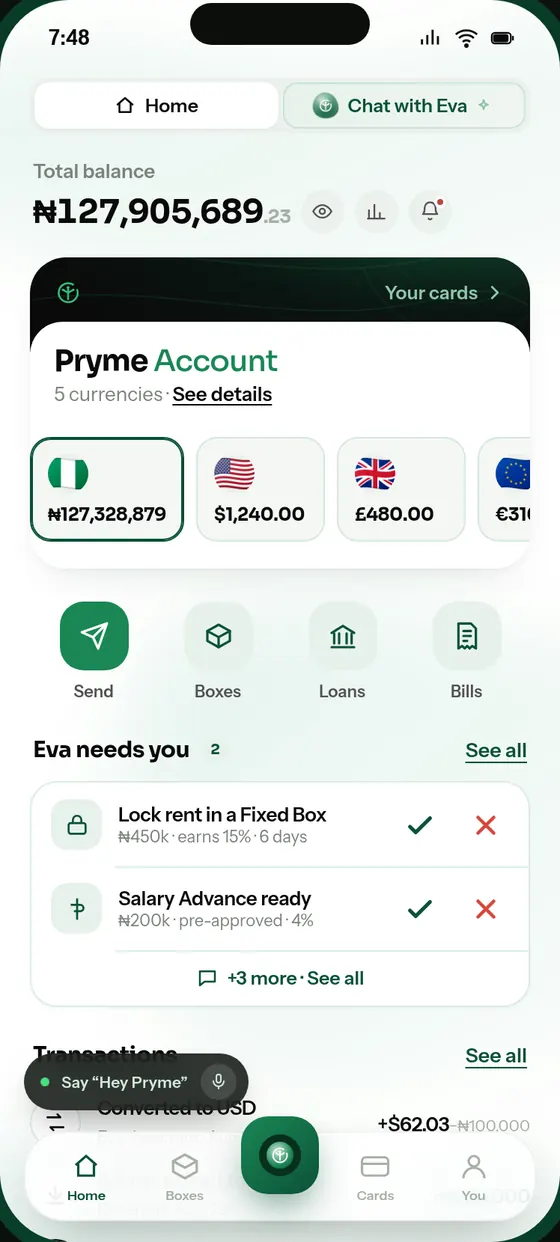
Meet Eva, the assistant inside the Pryme app. She opens accounts, moves money, saves toward your goals and follows up. Nothing leaves your account without your approval.
Meet Eva, the assistant inside the Pryme app. She holds dollars, pounds, euros and Naira side by side, swaps at a locked rate, pays bills in any of them and sends anywhere, asking before anything moves.
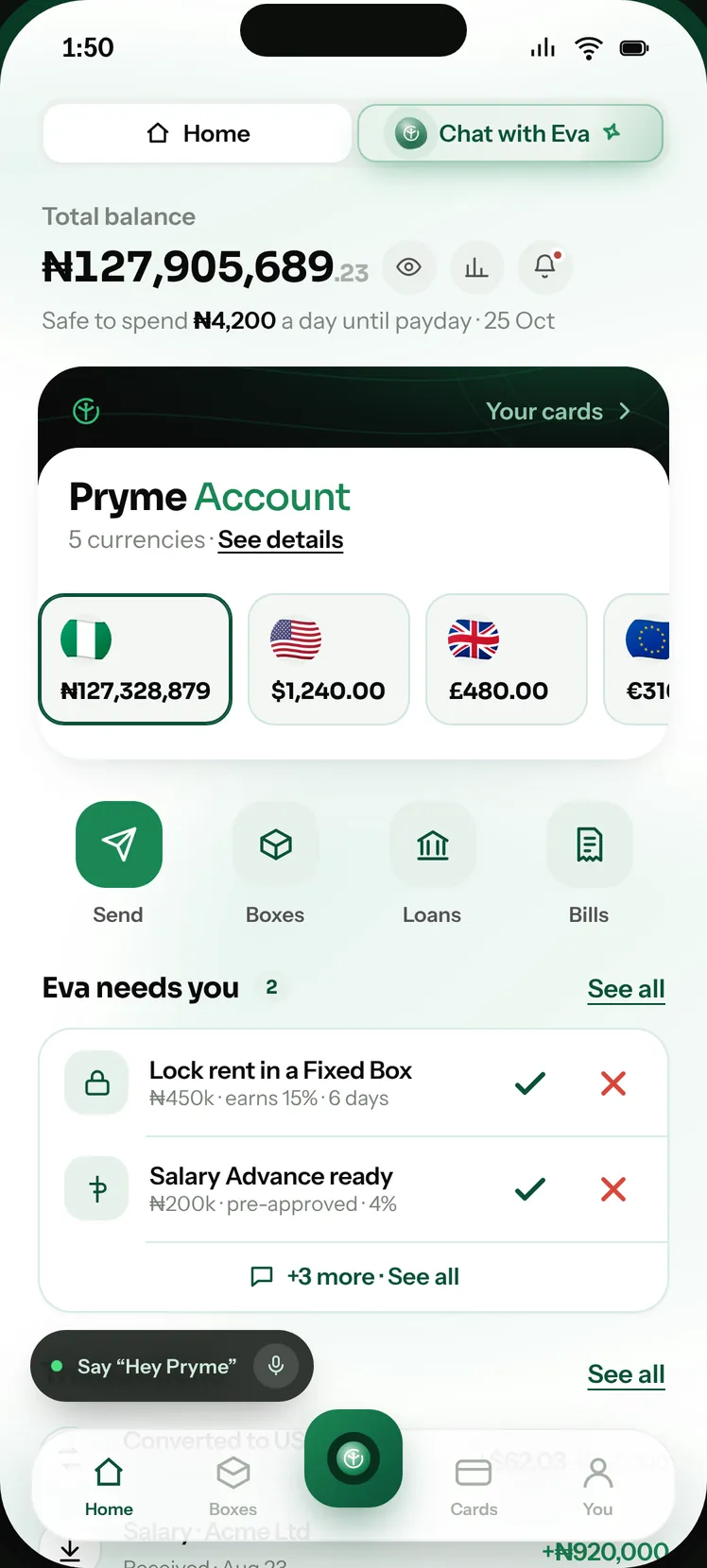
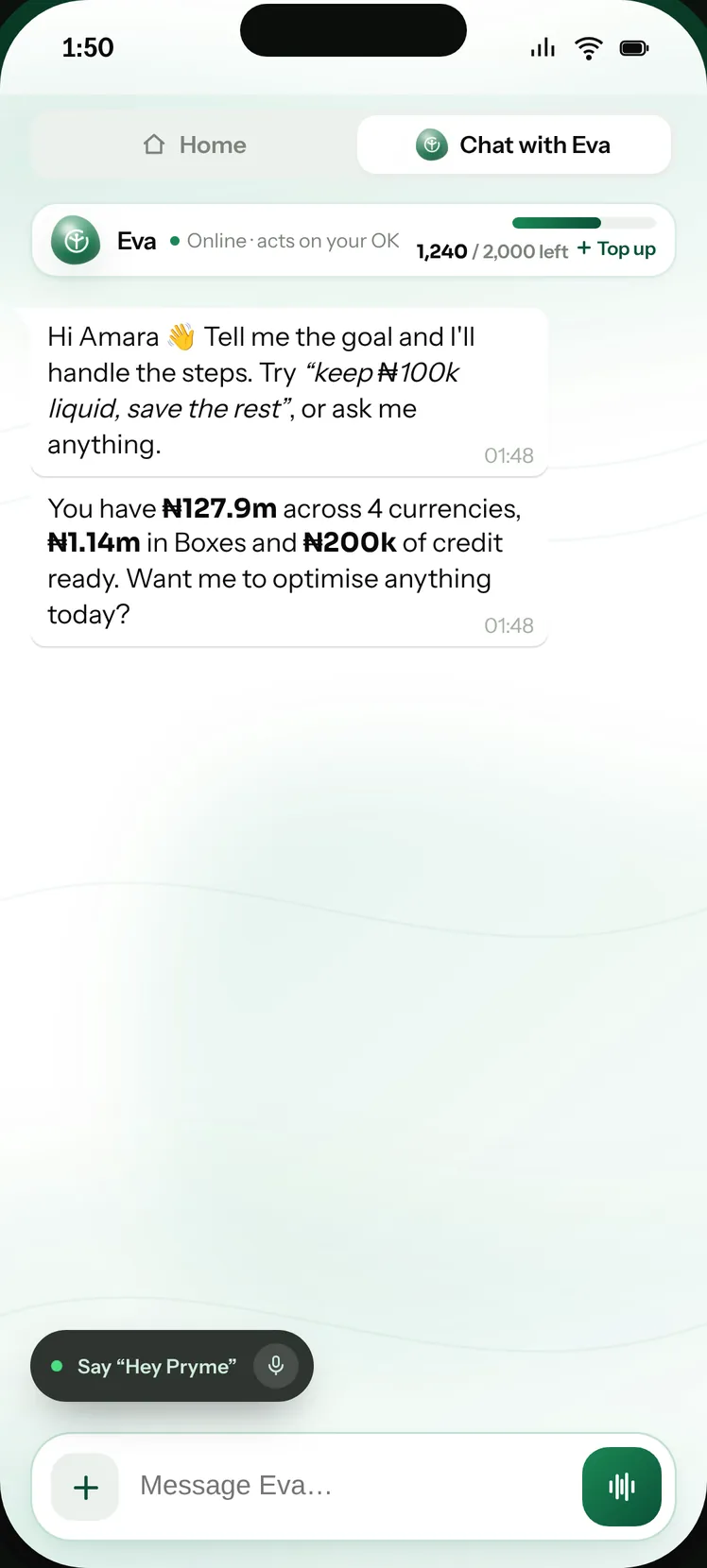
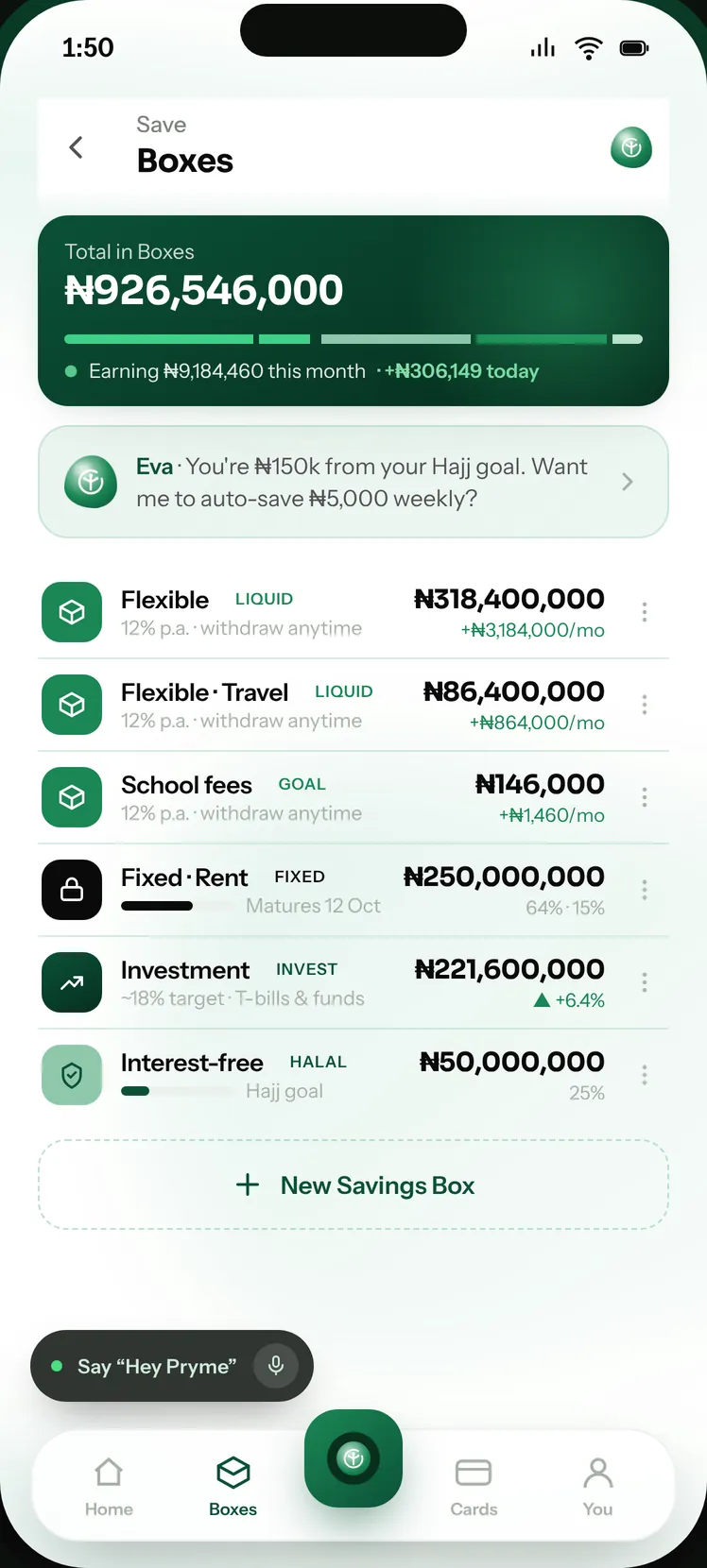
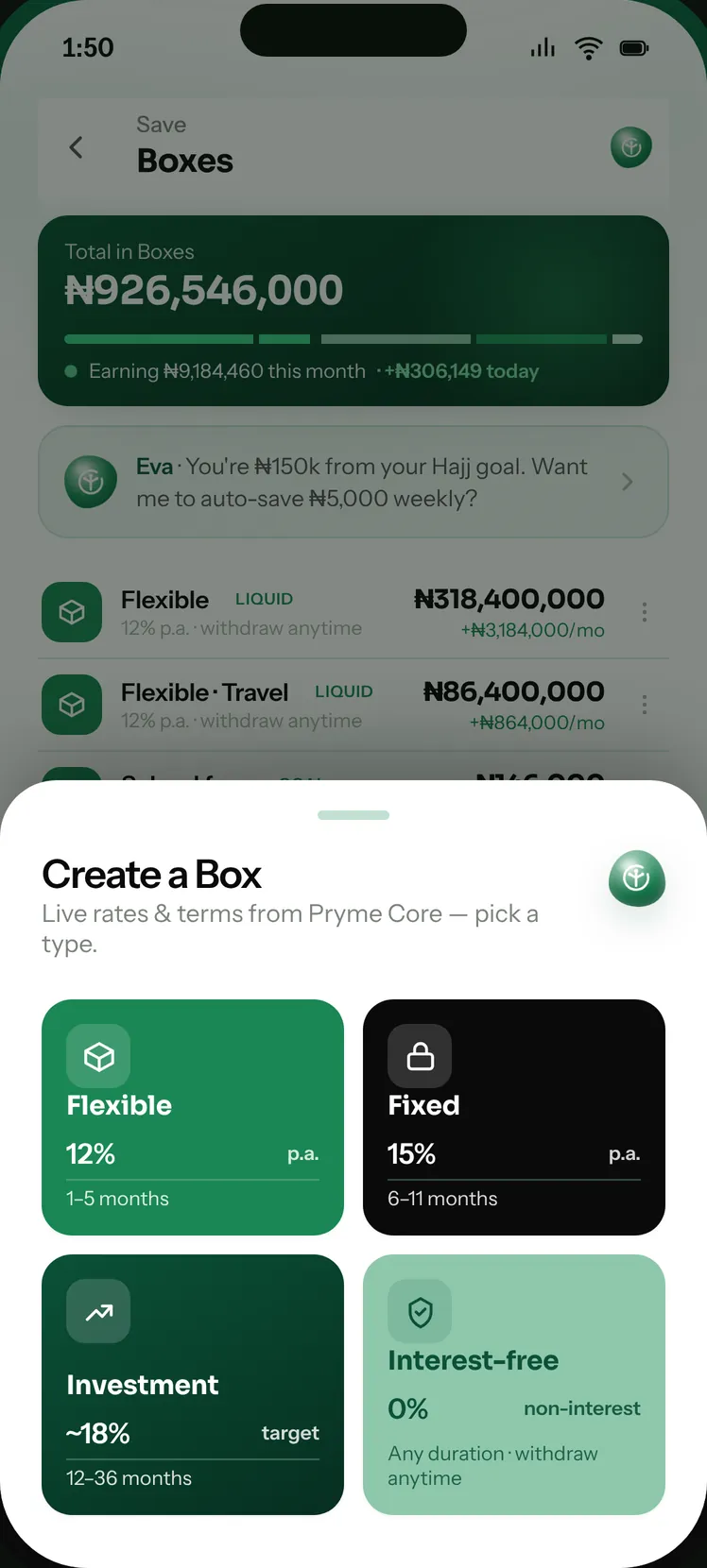
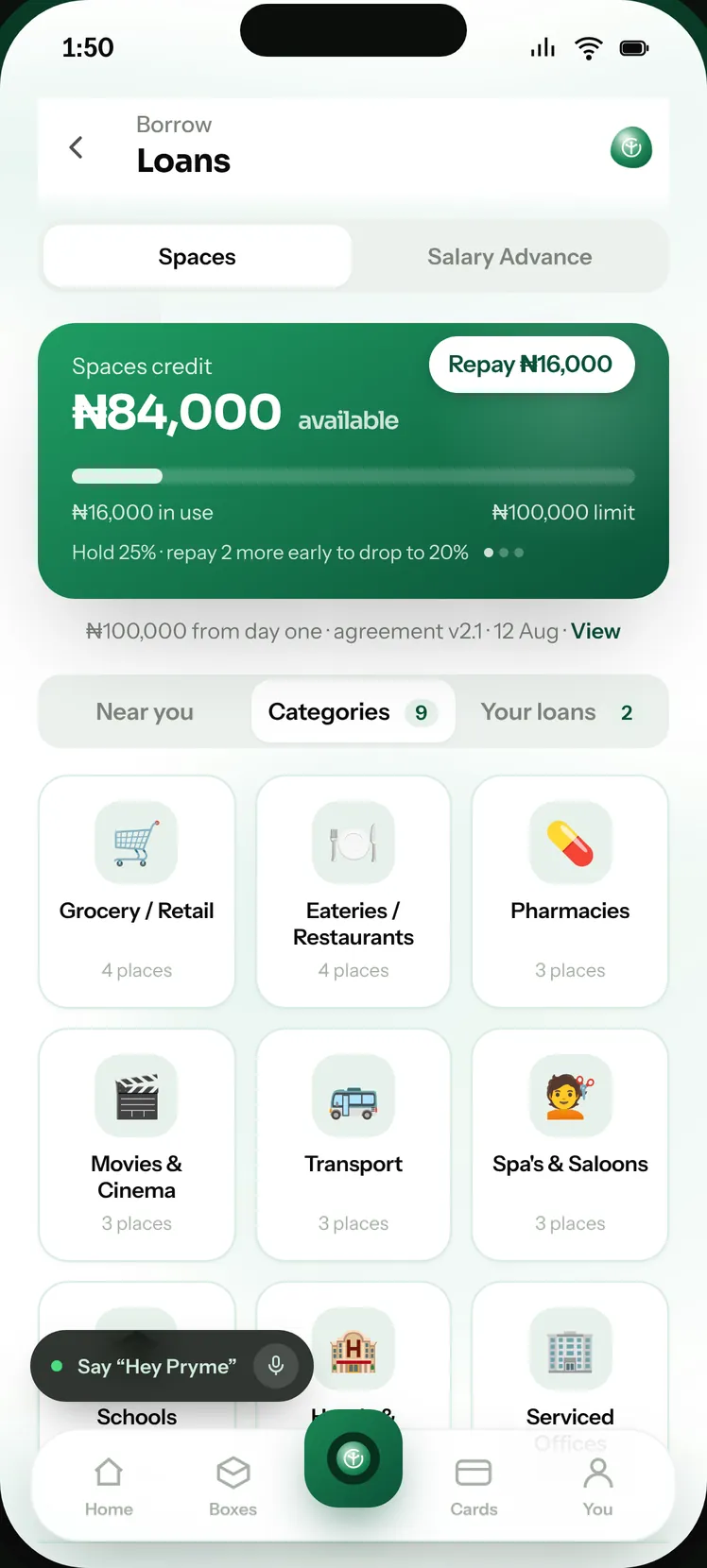
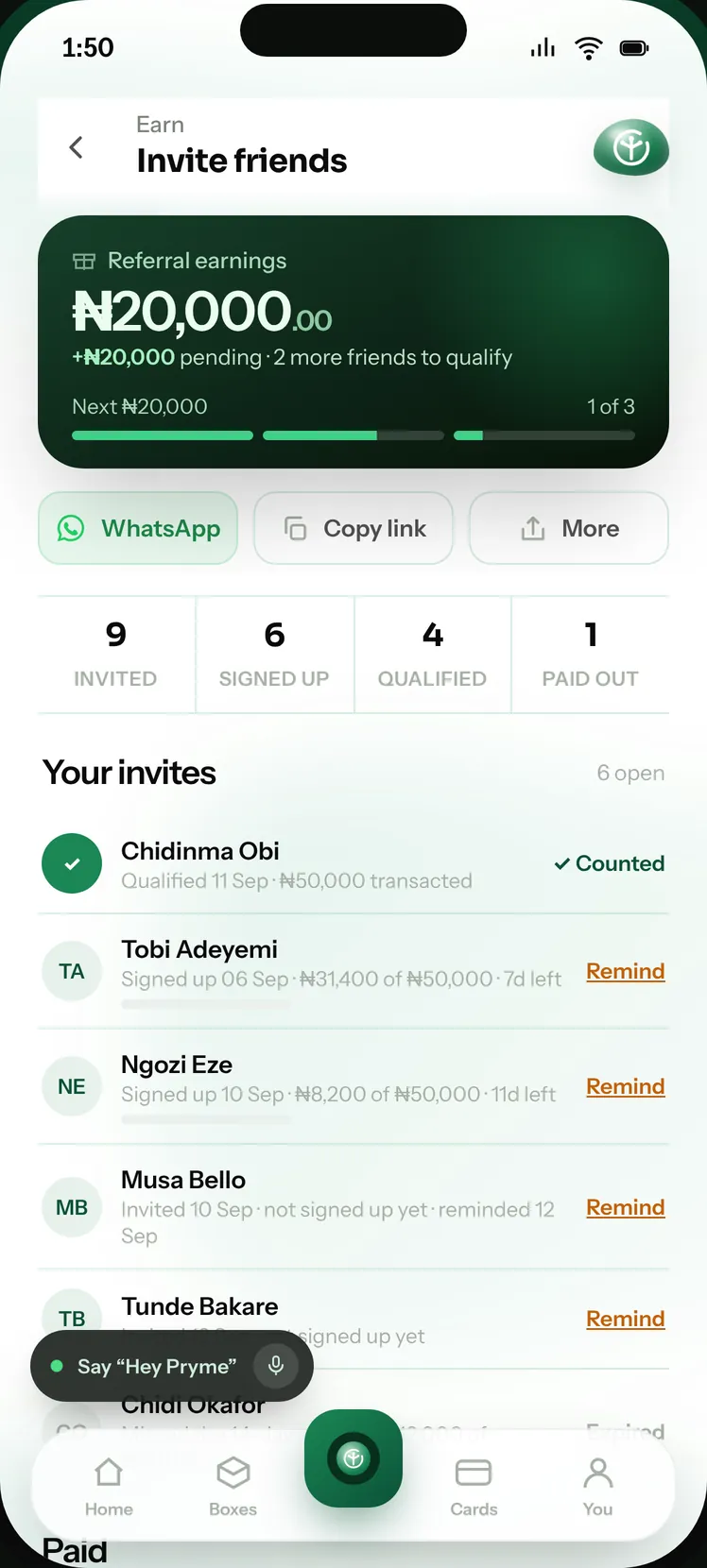
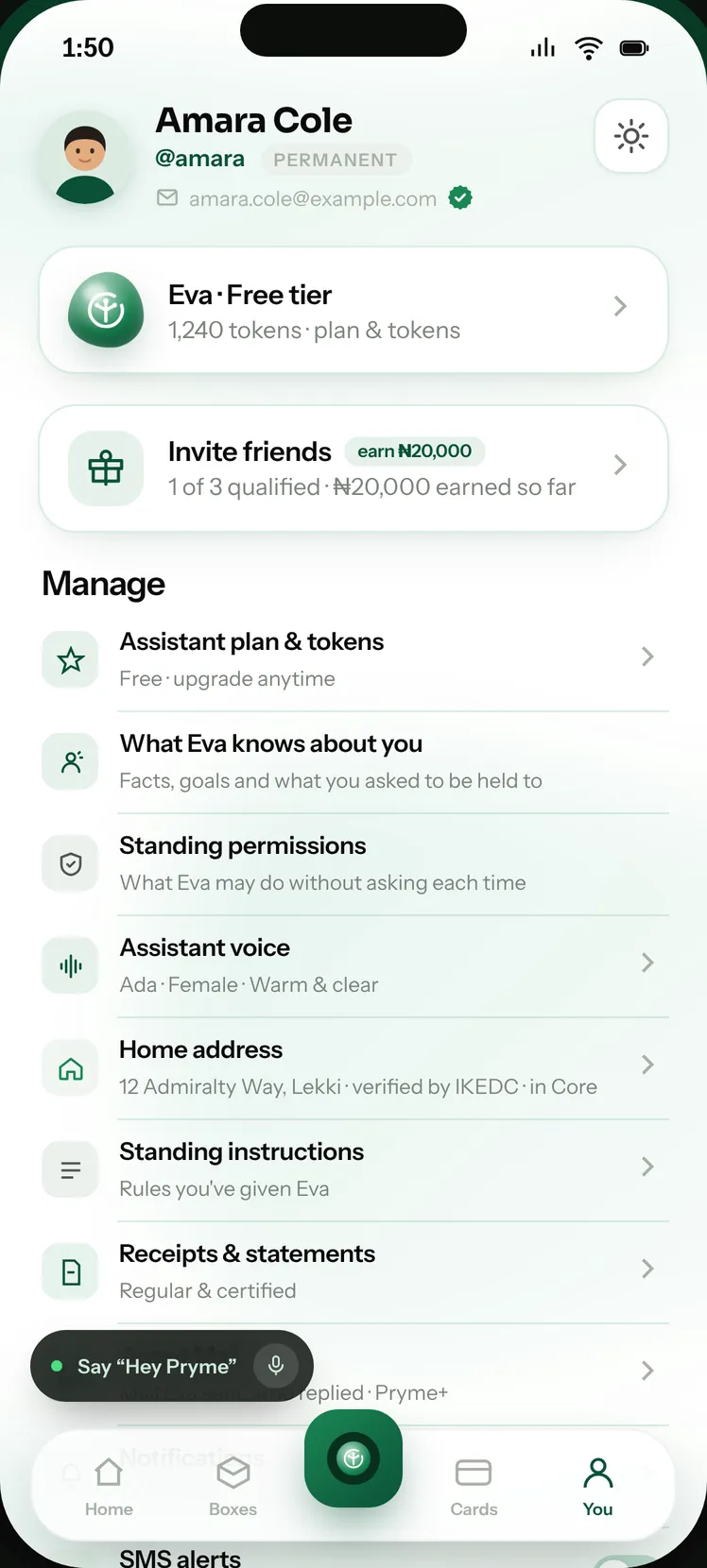
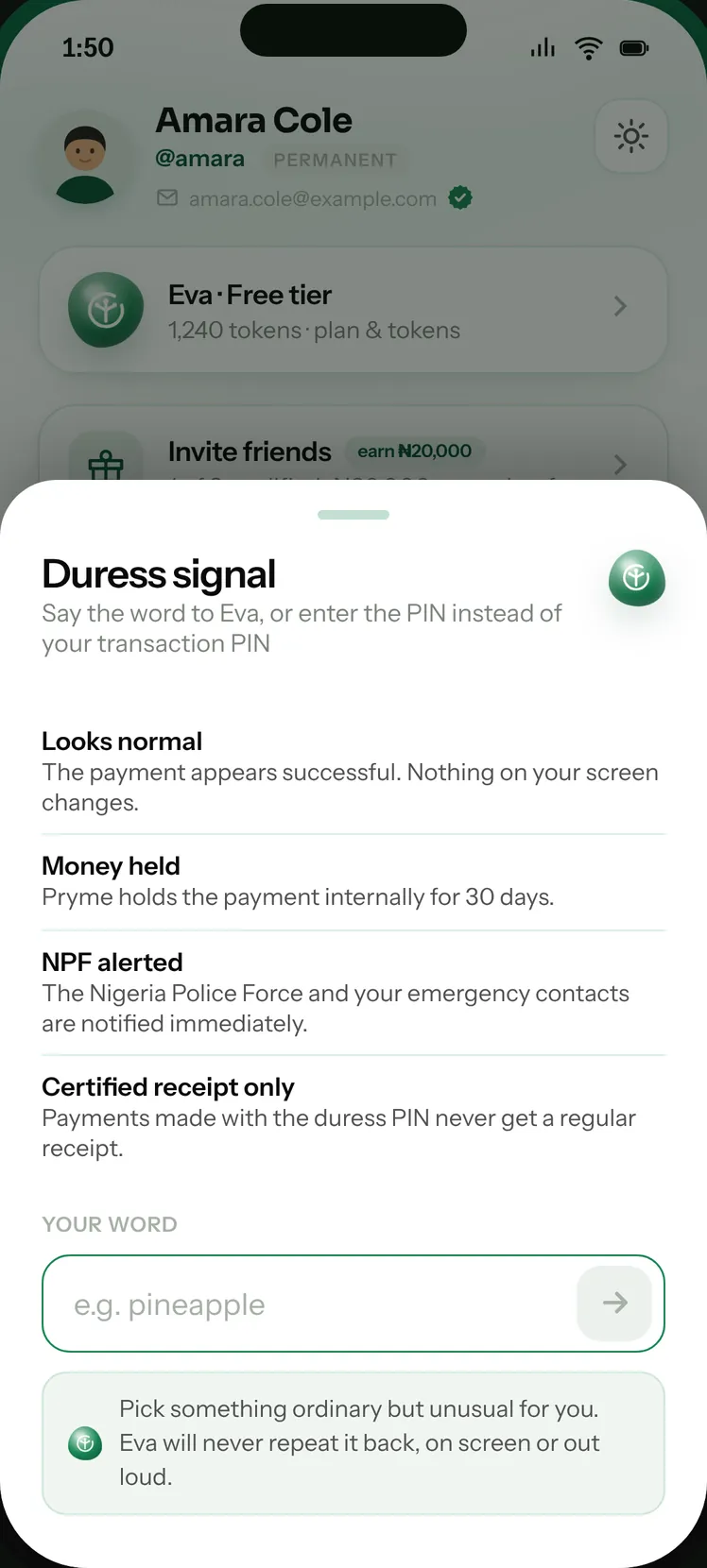
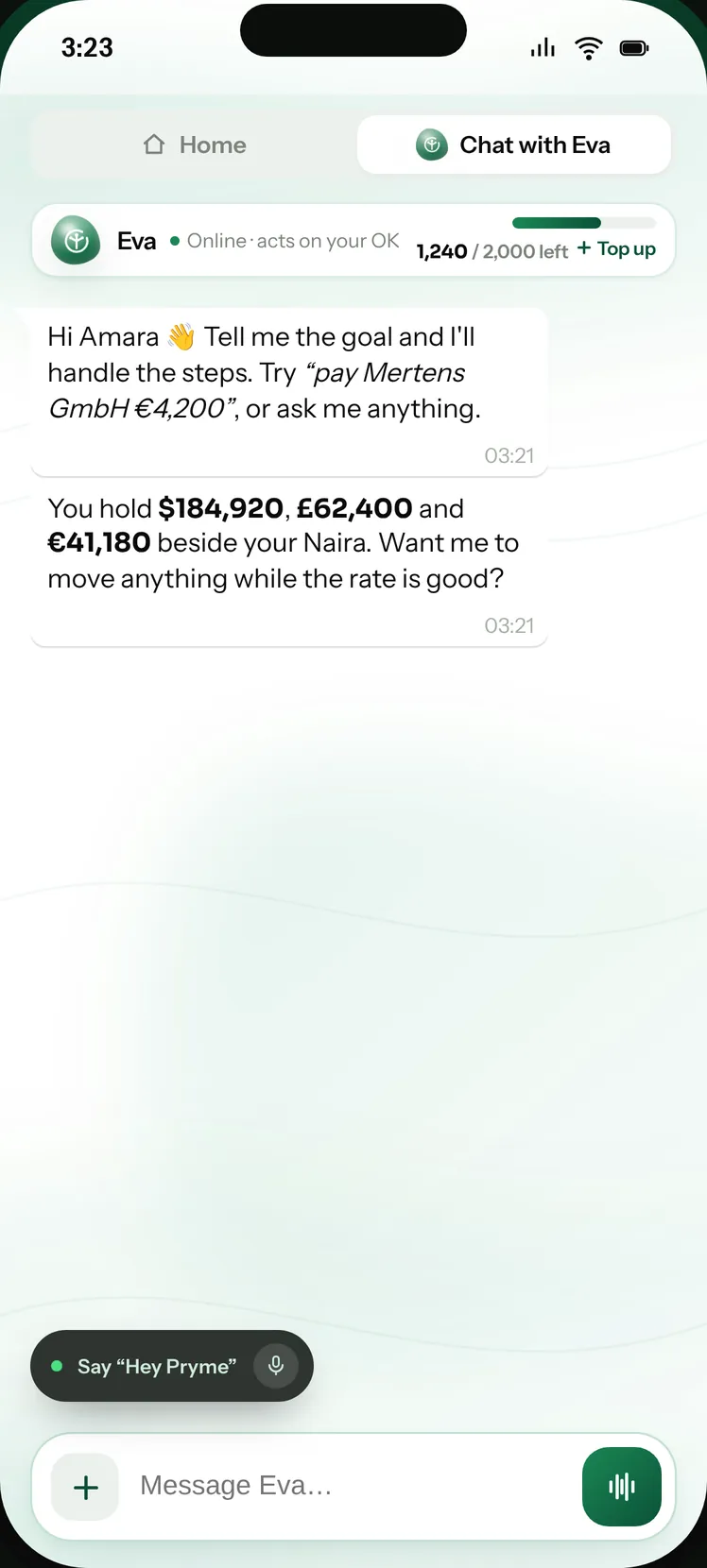
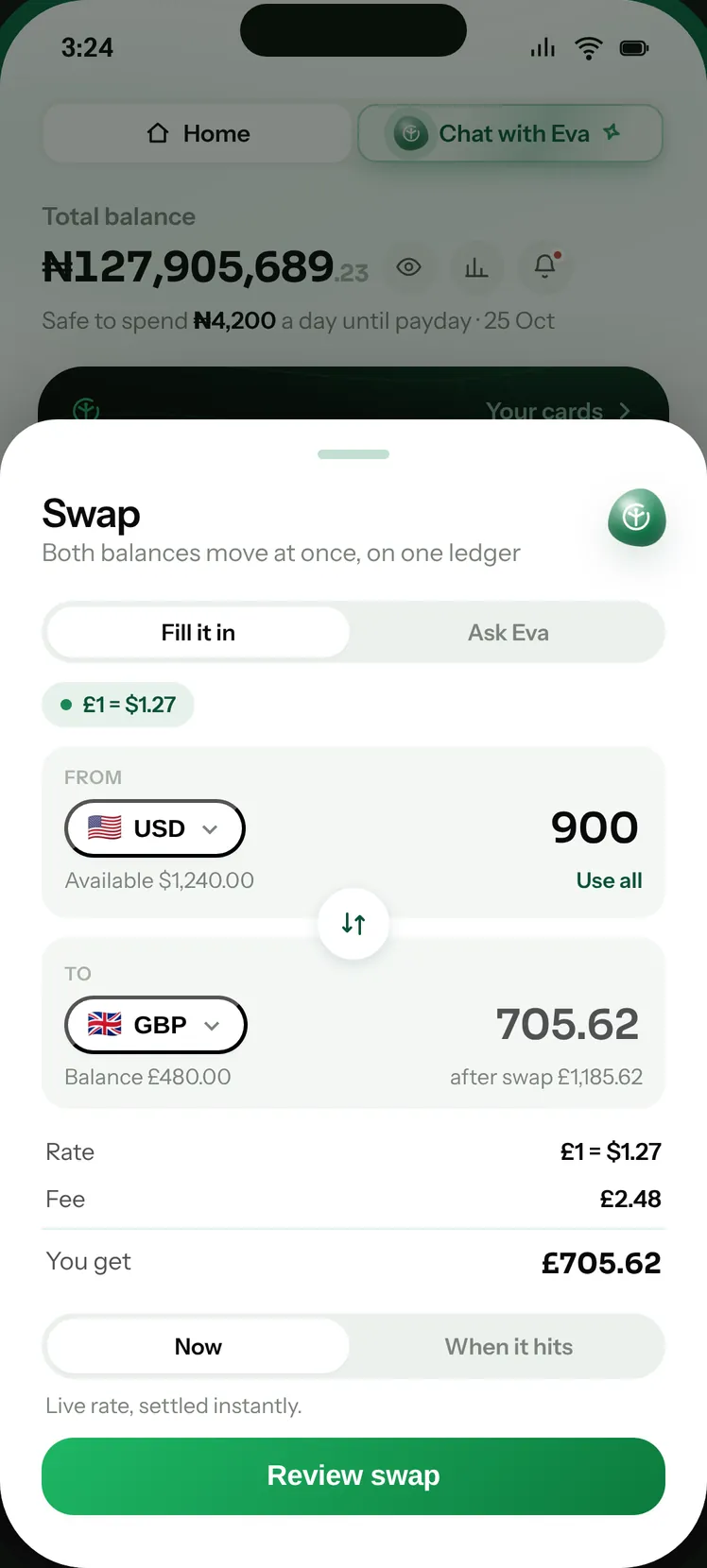
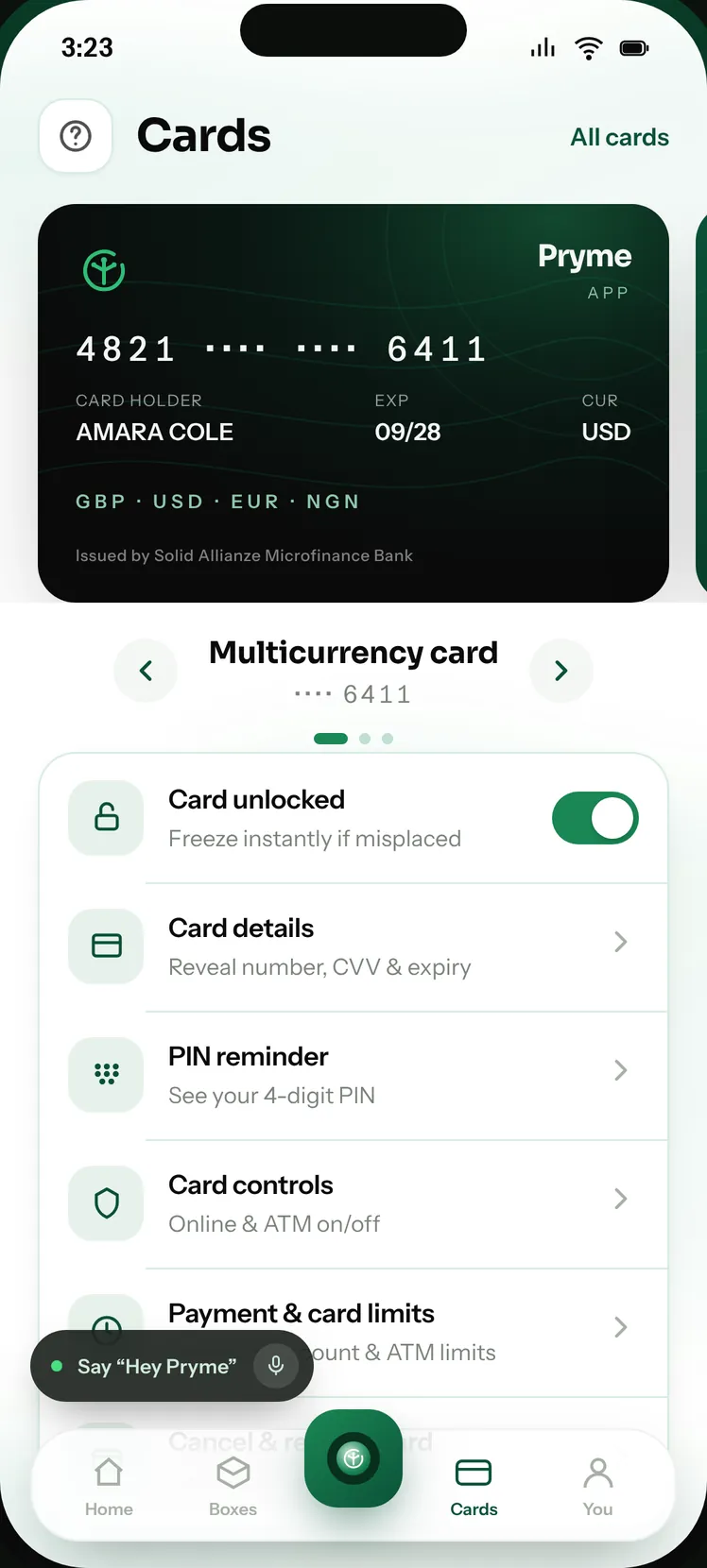
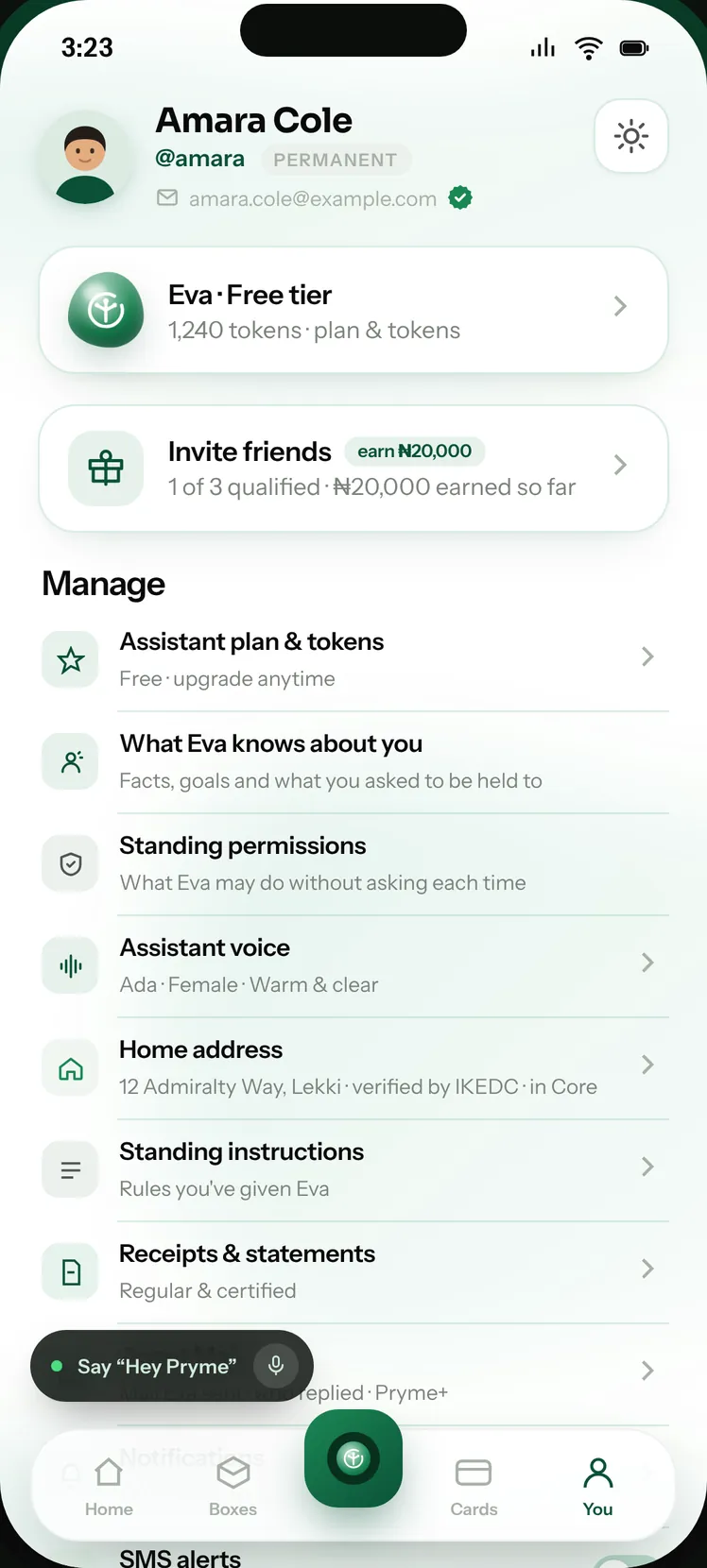
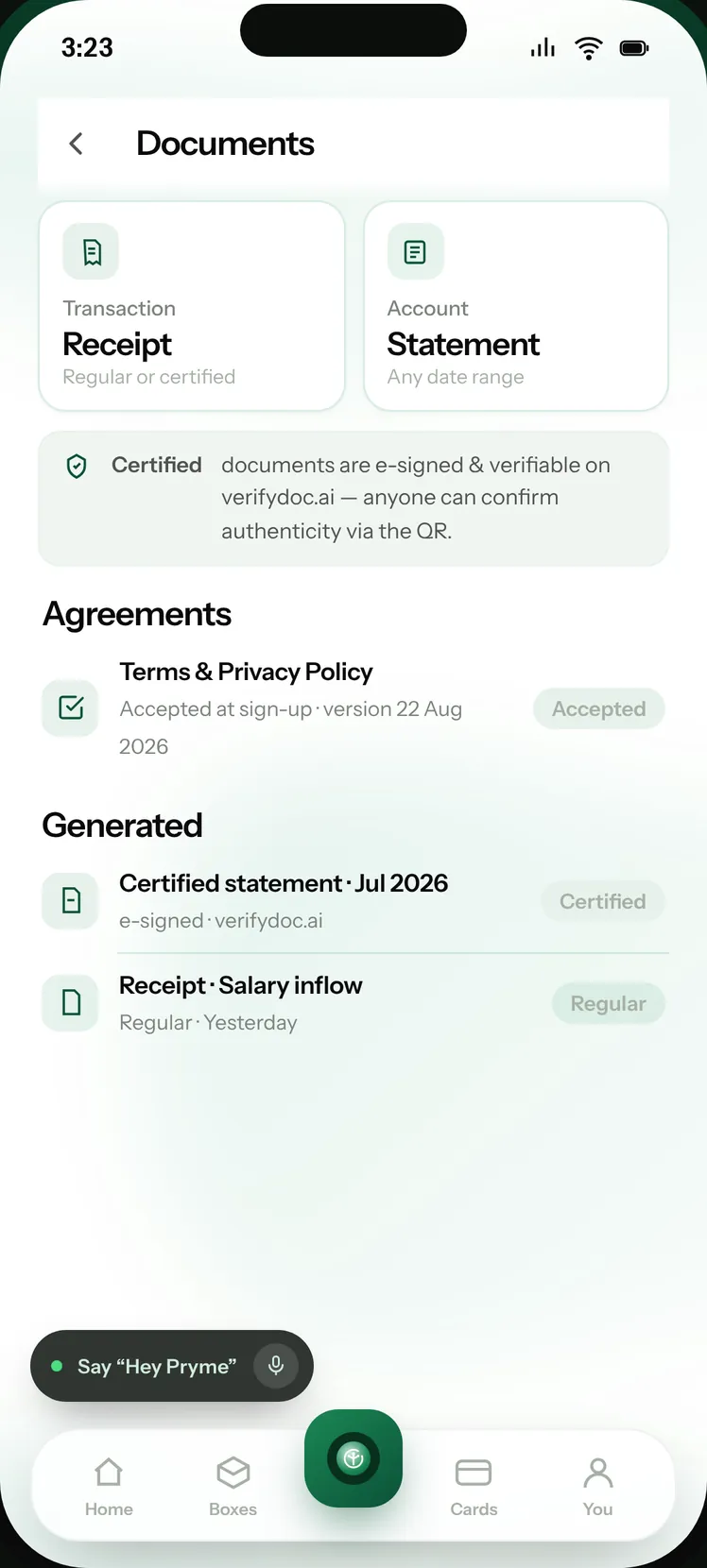
We give you a limit to spend at the shops and services you already use — and an account that works on your month while you get on with it. Dollars, pounds and euros sit beside your Naira, and an assistant handles the running of it, asking you first every single time.
One global account for your money and business. Move across currencies, automate everyday operations and put AI agents to work — with you in control of every important decision.
 Evayour assistant
 DanielChief of Staff
 BenFinance
 BruceCare
Your competitor down the road sells the same thing you sell. The difference is who walks in. We put money in people’s hands that can only be spent in businesses like yours — and then we point them at you.
You are not borrowing. You are selling to somebody who already has the money — and that money can only be spent with a business like yours.
₦100,000 from day one · agreement v2.1 · 12 Aug · View
Eva waits for your rate and asks before she moves anything.
No card, no OTP, nothing for the buyer to type in. They transfer from the bank app they already use, and the money lands in the same account your agents are running — already matched to the order, already in your books.
We give the buyer a one-time account number. They transfer to it from any bank app or by USSD — no card, no OTP, nothing to type in.
Get the account numberTo this account, from any bank app. We watch it, and the page updates itself.
₦26,767.50 from GTBank · John D., matched to order ORD‑1042.
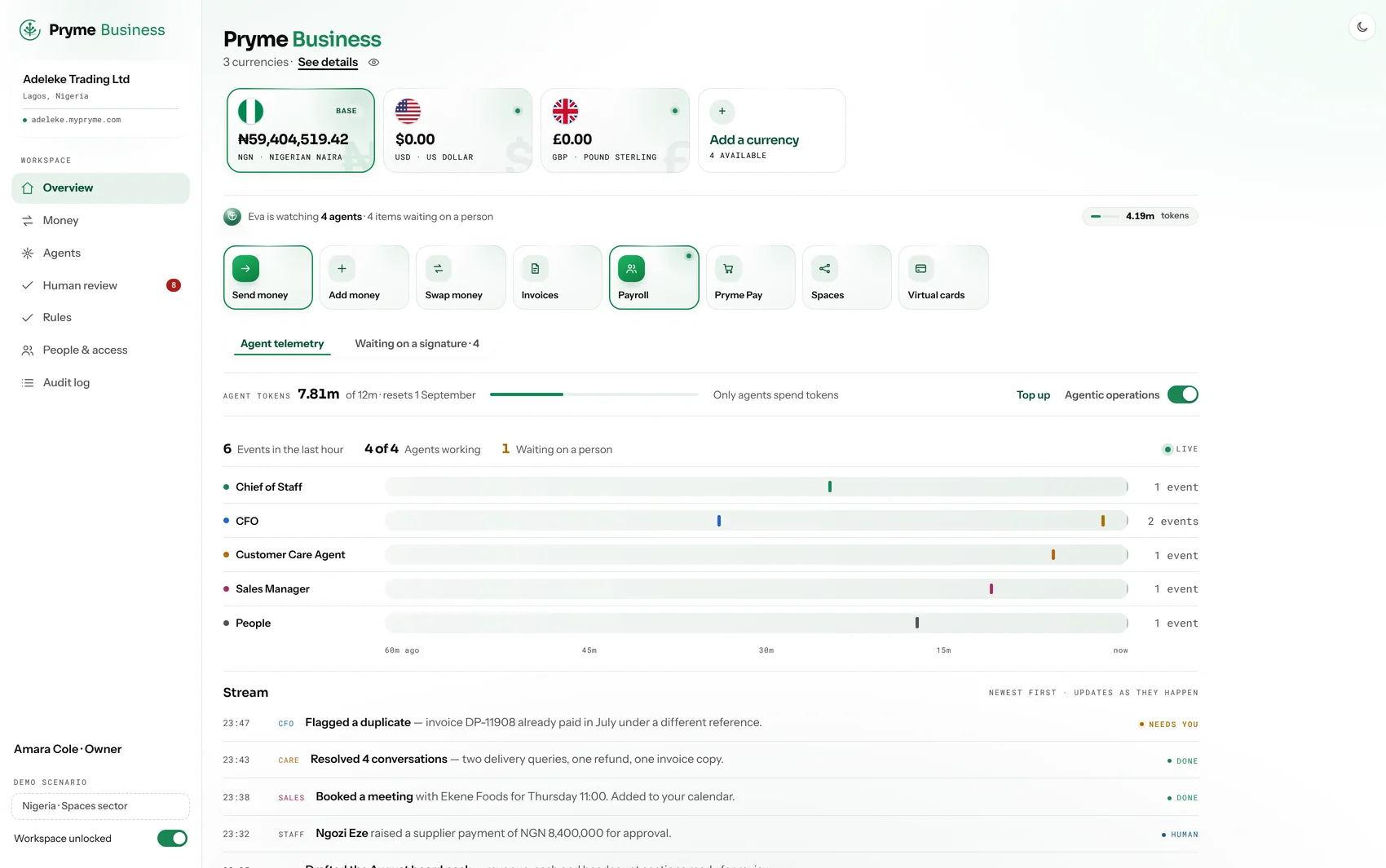
Five agents come with the account. Each one has a job description, a budget and a ceiling you set. They do the work and bring it to you — nothing leaves the account without your signature.
Knows what is stuck, who is waiting and what you promised — and keeps all three moving.
Booked a meeting with John Doe Foods for Thursday 11:00.Keeps the books as you trade and tells you the moment something does not add up.
Flagged a duplicate — invoice DP‑11908 was already paid in July.Holds every filing to its own clock and screens names and payments against your policy — and logs what it refuses.
Screened 412 payments overnight and refused two of them.Goes back to the buyers who went quiet, with the receipt already attached.
Recovered ₦410,000 across three overdue invoices.Replies, follows up on what they asked for and hands you only the ones that need you.
Resolved 4 conversations — two deliveries, one refund.Issue a dedicated Naira account number to each of your own customers, collect into it and reconcile against it. The same rails the Business Account runs on, with the licence behind them.
Dollars, pounds and euros beside a Naira account, on one ledger and one set of books. Five agents come with it and run the account — nothing leaves without your signature.
Five agents come with the account. Each has a job description, a budget and a ceiling you set. They do the work and bring it to you — they propose, you approve.
Knows what is stuck, who is waiting and what you promised, and keeps all three moving.
Booked the quarterly review with your auditor for Thursday.Keeps the books in every currency you hold and flags the moment something does not add up.
Flagged a duplicate — invoice DP‑11908 was already paid in July.Holds every filing to its own clock and screens names and payments against your policy — and logs what it refuses.
Screened 412 payments overnight and refused two of them.Goes back to the buyers who went quiet, with the invoice and the receipt already attached.
Recovered $12,400 across three overdue invoices.Replies, follows up on what they asked for and hands you only the ones that need you.
Resolved 4 conversations — two deliveries, one refund.The business has changed shape four times and never changed what it was rooted in. Each version was built out of what the last one could not do.
An online grocery store, built out of a faulty tab. Selling the food was the easy part — taking the money for it, and moving it, turned out to be the business.
A prepaid card. The first time the company issued rather than resold, and the first time it carried the obligations that come with holding somebody else’s money.
Solid Allianze acquired — an existing bank with an existing licence. The perimeter stopped being someone else’s to draw.
More than one currency on one balance, and the rebrand to Pryme. A Nigerian business could hold dollars without holding a second institution.
Accounts that do the work rather than only hold value. Five agents on the account, inside a policy you write — which is where the new mark starts.
Pryme is a financial technology company. It gives people and businesses in Nigeria one account that holds Naira alongside dollars, pounds and euros, and a set of agents that do the running of it — keeping the books, chasing what is owed, answering customers and paying bills. Nothing leaves an account without the owner’s approval.
Yes. A Pryme account holds Naira, US dollars, pounds sterling and euros side by side on one ledger, each with its own account details — a Nigerian account number, a US account number, a UK sort code and an IBAN for the euro area. You can swap between them at a rate you set, and every currency has its own statement.
Spaces is available in Nigeria. It gives a shopper money to spend that can only be spent with a participating business. The business is paid into its Naira account whether or not the shopper repays, because Pryme carries the credit. For the business it is free to join, there is nothing monthly, and the customer’s identity is never shown — only a reference and what it is worth.
Five agents come with the account. The Chief of Staff runs the week and keeps what is stuck moving. Finance watches the money and keeps the books as you trade. Compliance keeps the filings on time and screens what moves. Sales chases what you are owed. Customer Support answers your customers and follows up. Each has a job description, a budget and a ceiling you set, and each one proposes rather than acts — nothing leaves the account without your signature.
Pryme Pay takes payments on your own site or on a checkout page you control. The buyer is given a one-time account number and transfers to it from any bank app or by USSD — no card, no OTP, nothing to type in. The money lands in the same account your agents are running, already matched to the order and already in your books.
Savings Boxes are separate pots inside a Pryme account, held in Naira. Flexible Boxes can be withdrawn at any time, Fixed Boxes hold to a date, Investment Boxes hold for longer, and Interest-free Boxes earn nothing by design. A business can use them to ring-fence payroll and the tax it withholds, so that money cannot be spent by accident.
Pryme is a financial technology company, not a bank. Accounts and deposits are provided by Solid Allianze Microfinance Bank Limited, which is licensed by the Central Bank of Nigeria and is a member of the Nigeria Deposit Insurance Corporation.
Yes. Pryme Rails lets a platform issue a dedicated Naira account number to each of its own customers, collect into it and reconcile against it, over one API — the same rails the Pryme Business Account runs on.
Pryme is a financial technology company. It gives you one account that holds US dollars, pounds sterling and euros beside Naira, with an assistant that runs the account for you and asks before anything moves. Accounts are provided in Nigeria today, and further markets open as each licence lands.
Accounts are provided in Nigeria today, subject to verification and approval. Foreign-currency balances are held and converted inside that account, so you can hold, receive and swap dollars, pounds and euros wherever you are.
Naira, US dollars, pounds sterling and euros, side by side on one ledger. Each has its own details — a Nigerian account number, a US account number, a UK sort code and an IBAN for the euro area — and each has its own statement.
Swap at a rate you set rather than the rate of the day, then send to any Pryme username or to a Nigerian bank account. There is no fee to send to another Pryme account.
Eva is the assistant inside the Pryme app. She opens accounts, moves money, saves toward your goals, pays what is due and follows up what is owed to you — and asks you before anything moves.
Pryme Rails lets a platform issue a dedicated Naira account number to each of its own customers, collect into it and reconcile against it, over one API — the same rails the Pryme Business Account runs on.
Notes on money that does the work: what we are building, what the regulation actually says, and how we think about letting software act on money. Read the Ledger
What AI agents can do in bookkeeping, close, collections and compliance today, where a person must stay in charge, and how to judge a product.
How multi-currency business accounts work: local details vs SWIFT, payment rails, the real cost of FX, safeguarding vs deposit protection, and hedging.
How UK, US, Canadian and European firms pay Nigerian suppliers and get paid by Nigerian clients: FX, Form A and M, tax, compliance and payout routes.
What it really costs to send money to Nigeria from the UK, US, Canada and Europe: fees, exchange-rate margins, CBN naira rules, BVN, speed and scams.
What AI can and cannot do in day-to-day bookkeeping, how much time it saves on real numbers, and which jobs must stay with you or your accountant.
Nigeria left the FATF grey list in October 2025 and the EU high-risk list in January 2026. What that changes for UK, EU and US firms, and what it does not.
Part of the guideDoing business with Africa: paying and getting paid in Nigeria
The FATF removed Nigeria from its grey list of jurisdictions under increased monitoring at its 22–24 October 2025 plenary, and the EU's removal of Nigeria from its high-risk third country list took effect on 29 January 2026. For UK and EU firms, Nigeria-linked business no longer triggers mandatory enhanced due diligence just because of the country, but sanctions screening, ownership checks and risk-based due diligence still apply.
Between February 2023 and October 2025, every UK or EU firm dealing with a Nigerian counterparty had to treat that relationship as higher risk by default. That rule has gone. This article sets out what changed, on what dates, and which checks remain. For how compliance fits with FX, tax and payments, see the parent guide on paying and getting paid in Nigeria.
| Date | Event |
|---|---|
| February 2023 | FATF places Nigeria on its list of jurisdictions under increased monitoring (the grey list). |
| 2023–2025 | Nigeria works through a 19-point action plan with FATF and GIABA, the West African FATF-style body. |
| 22–24 October 2025 | FATF plenary in Paris removes Nigeria, with South Africa, Mozambique and Burkina Faso, commending it for completing the action plan on time. |
| 3–4 December 2025 | European Commission adopts Delegated Regulations (EU) 2026/46 and 2026/83, amending its high-risk third country list. |
| 29 January 2026 | The EU amendments enter into force. Nigeria, Burkina Faso, Mali, Mozambique, South Africa and Tanzania leave the EU list. |
The FATF cited reforms across law, institutions and supervision. The main ones:
Since January 2024, the UK Money Laundering Regulations no longer carry their own list of high-risk third countries. Regulation 33 instead points to the FATF's two public lists: the call-for-action list and the increased-monitoring list. Enhanced due diligence (EDD) is mandatory for business relationships with persons established in a country on either list. Because the definition follows the FATF, Nigeria stopped being a UK high-risk third country when the FATF removed it in October 2025. Some secondary guidance pages may still show older lists, so check the FATF's current publication rather than a cached summary.
EU obliged entities apply EDD to the countries on the Commission's own list. From 29 January 2026 Nigeria is off that list, which now contains 26 countries. EU banks and payment firms can therefore stop applying country-based EDD to Nigeria, though their own risk assessments may still rate Nigeria above average.
US firms were never bound by a formal grey-list EDD rule in the same way, but the delisting feeds into banks' country-risk scoring. The US sanctions regime is unaffected: OFAC's list continues to include Nigerian names, and in 2026 it published designations of 27 Nigerian individuals, businesses and groups, including bureaux de change, under terrorism and cyber programmes.
A Dutch food manufacturer wants to appoint a Lagos distributor and expects €400,000 a year in sales. In 2024, Nigeria's EU listing meant the manufacturer's bank applied EDD to every payment from the distributor: source-of-funds questions, senior approval and extra monitoring. In October 2026, those steps are no longer required because of the country alone.
Analysts expect the delisting to ease correspondent banking and reduce compliance costs on cross-border payments over time, but those benefits build gradually as banks update their internal risk ratings. The Nigeria business guide covers the payment routes those banks use.
If your firm is regulated in the UK or EU, your business-wide risk assessment and customer risk scoring probably still carry a flag that made Nigeria high risk by default. Updating them is the practical step most firms have not yet taken.
The FATF updates its lists after each plenary, in February, June and October. A country can be relisted, so build a check of the latest FATF statement into your compliance calendar.
Compliance on a cross-border relationship is mostly repeatable checks, and the sanctions screening described above remains your firm's responsibility. Pryme's business agents, including the Compliance agent, are built and certified by Pryme Intelligence, a separate company. They prepare work inside a mandate you set, with a ceiling; above it a person decides, nothing moves without approval, and actions are recorded on an audit trail.
A Pryme Business account can be opened from any country. Pryme uses tiered verification, and Nigerian KYC rules generally require a BVN or NIN for Nigerian directors and signatories. Pryme Financial Ltd is a technology company, not a bank. In Nigeria, naira deposits are held by Solid Allianze Microfinance Bank Ltd, licensed by the CBN and insured by the NDIC up to the applicable limit; outside Nigeria, activities are carried out through regulated partners.
No. The FATF removed Nigeria from its list of jurisdictions under increased monitoring at its plenary of 22–24 October 2025. Nigeria had been listed since February 2023.
No. The EU's amending delegated regulations took effect on 29 January 2026 and removed Nigeria, along with Burkina Faso, Mali, Mozambique, South Africa and Tanzania.
Not because of the country alone. The UK rules link high-risk third countries to the FATF lists, and Nigeria is no longer on them. Firms still apply EDD where the specific relationship is high risk.
No. Sanctions are separate. OFAC designated Nigerian individuals, businesses and groups in 2026, so screening remains essential.
Over time it may be, as banks rebuild correspondent relationships and cut compliance overheads. Analysts describe these as expected benefits rather than ones already fully realised.
This article is general information, not financial, legal or tax advice. Products described are provided under the terms on this site and are subject to regulation and eligibility.
How UK, US, Canadian and European firms pay Nigerian suppliers and get paid by Nigerian clients: FX, Form A and M, tax, compliance and payout routes.
How the naira's official rate is set: one willing-buyer, willing-seller market, the EFEMS matching system, the FMDQ closing rate and its use in contracts.
How the Pan-African Payment and Settlement System lets a business in one African country pay another in local currency, who can use it and its limits.
You can add the other type later — many of our customers hold both.
The business first, then you. Nothing is submitted until you review it.
Ideal customer profiles
Generated from your website by VerifiedLead.ai
Pick the ones that look right. Your Sales agent works these first, and you can change them at any time after opening.
We ask this because you have not given us a website. It helps us set the right limits from day one.
Which of these represents you?
Officers listed against this company on the UK register.
We have sent a six-digit code to your email address. Enter it below to confirm the address is yours.
Wrong address? Go back and change it — nothing is created until this step passes. We never ask for a code by phone or email; anyone who does is not us.
Last step. Each time you sign in we email you a six-digit code — we never send codes by SMS.