AI agents for business finance: what they can and can't do
What AI agents can do in bookkeeping, close, collections and compliance today, where a person must stay in charge, and how to judge a product.
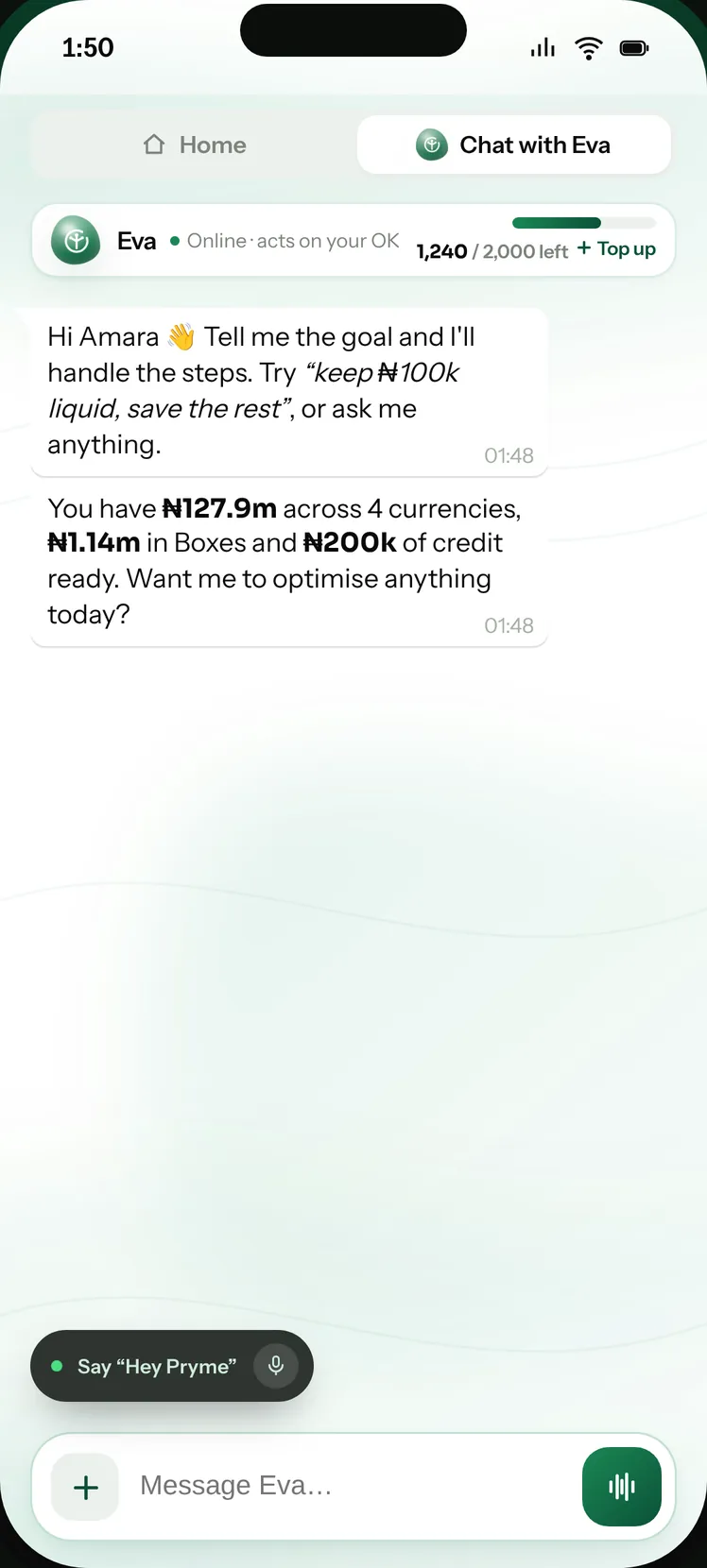
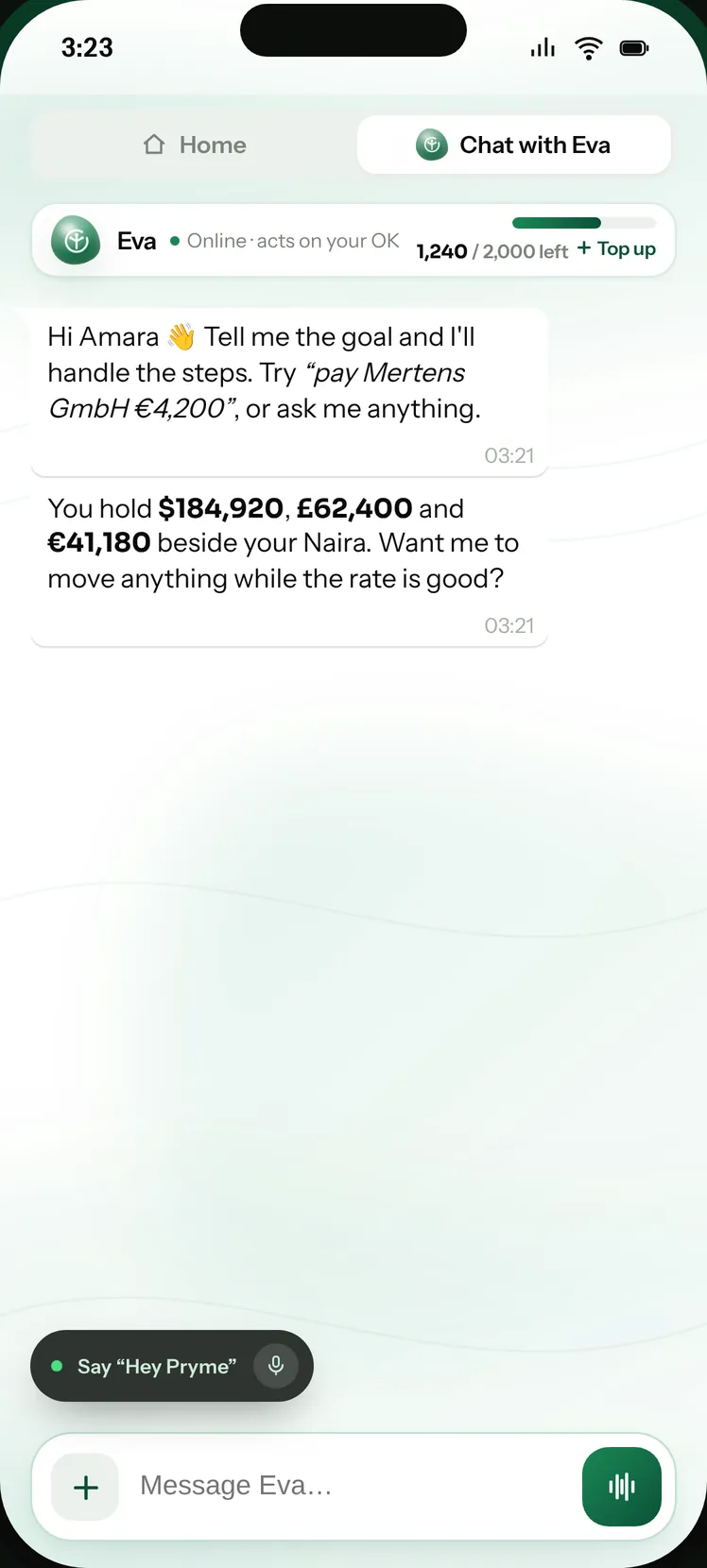
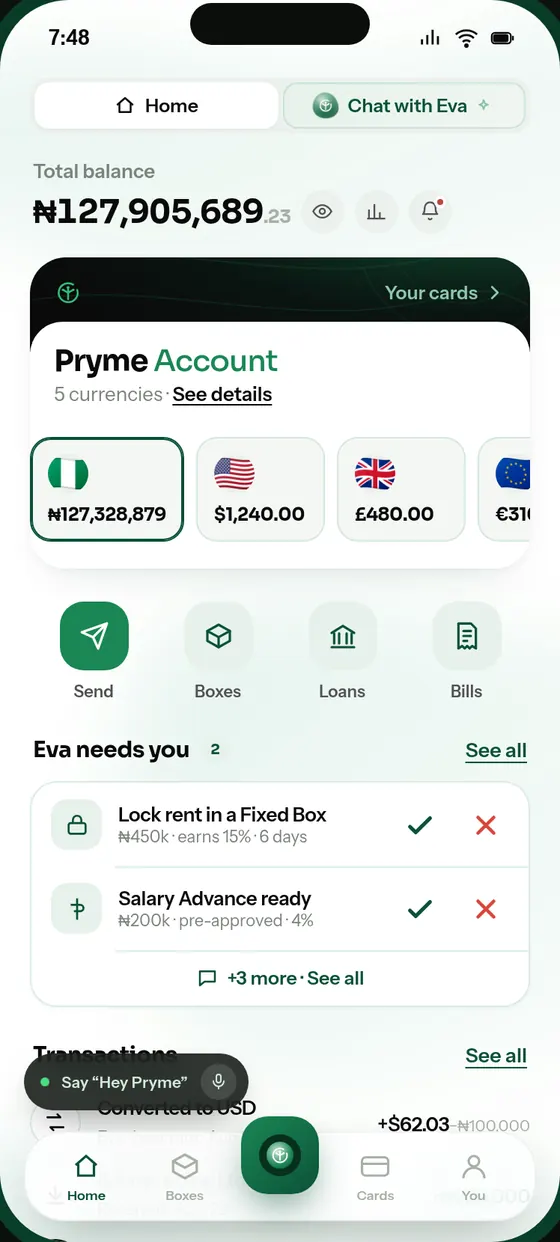
Meet Eva, the assistant inside the Pryme app. She opens accounts, moves money, saves toward your goals and follows up. Nothing leaves your account without your approval.
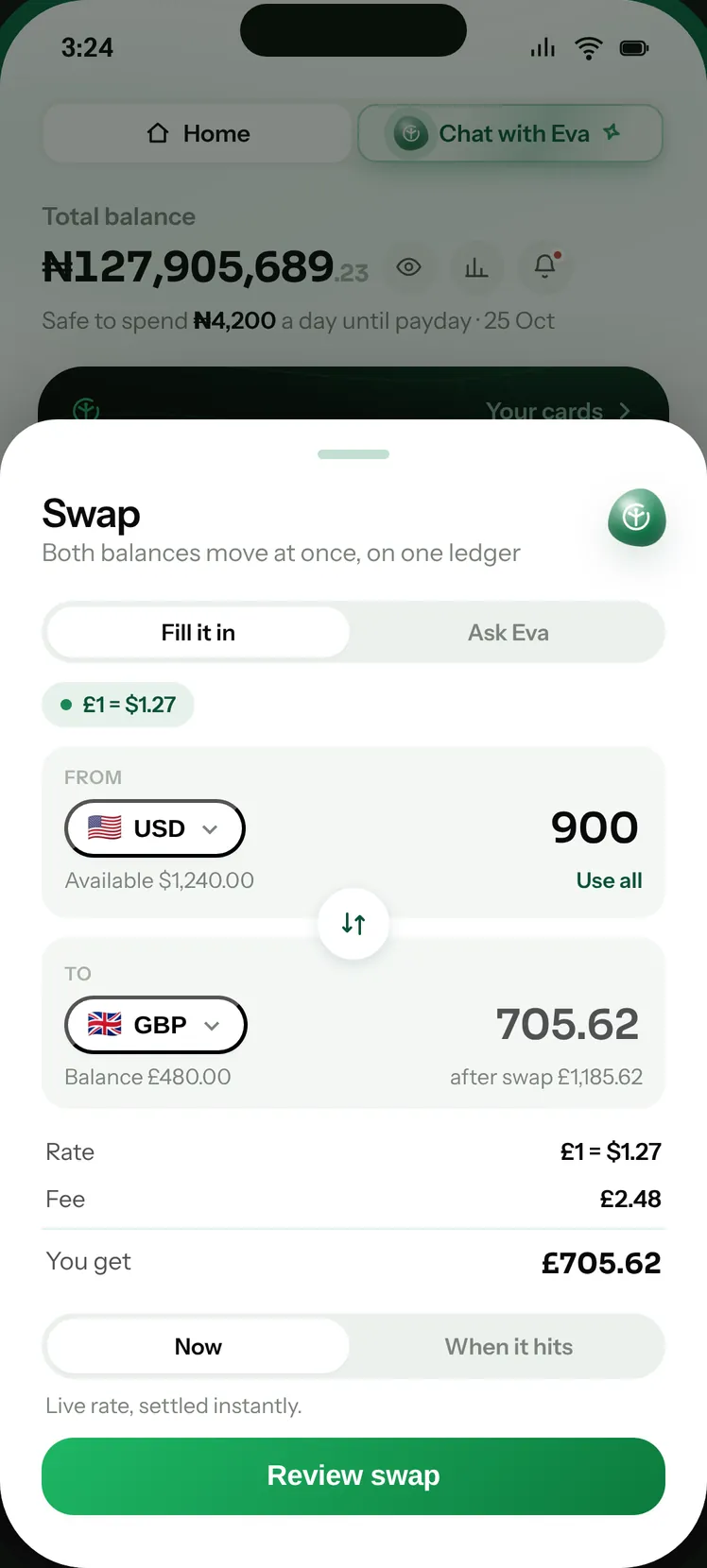
Meet Eva, the assistant inside the Pryme app. She holds dollars, pounds, euros and Naira side by side, swaps at a locked rate, pays bills in any of them and sends anywhere, asking before anything moves.
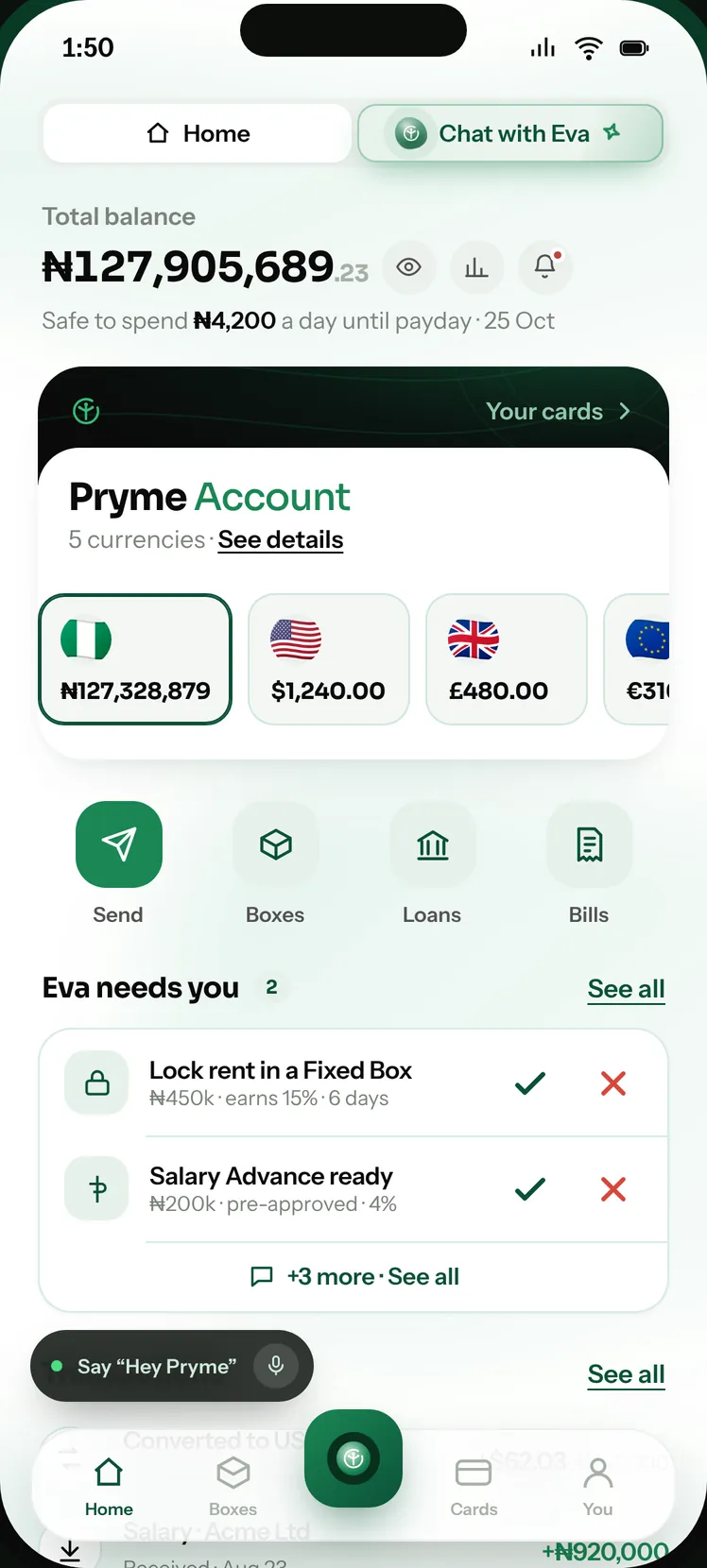
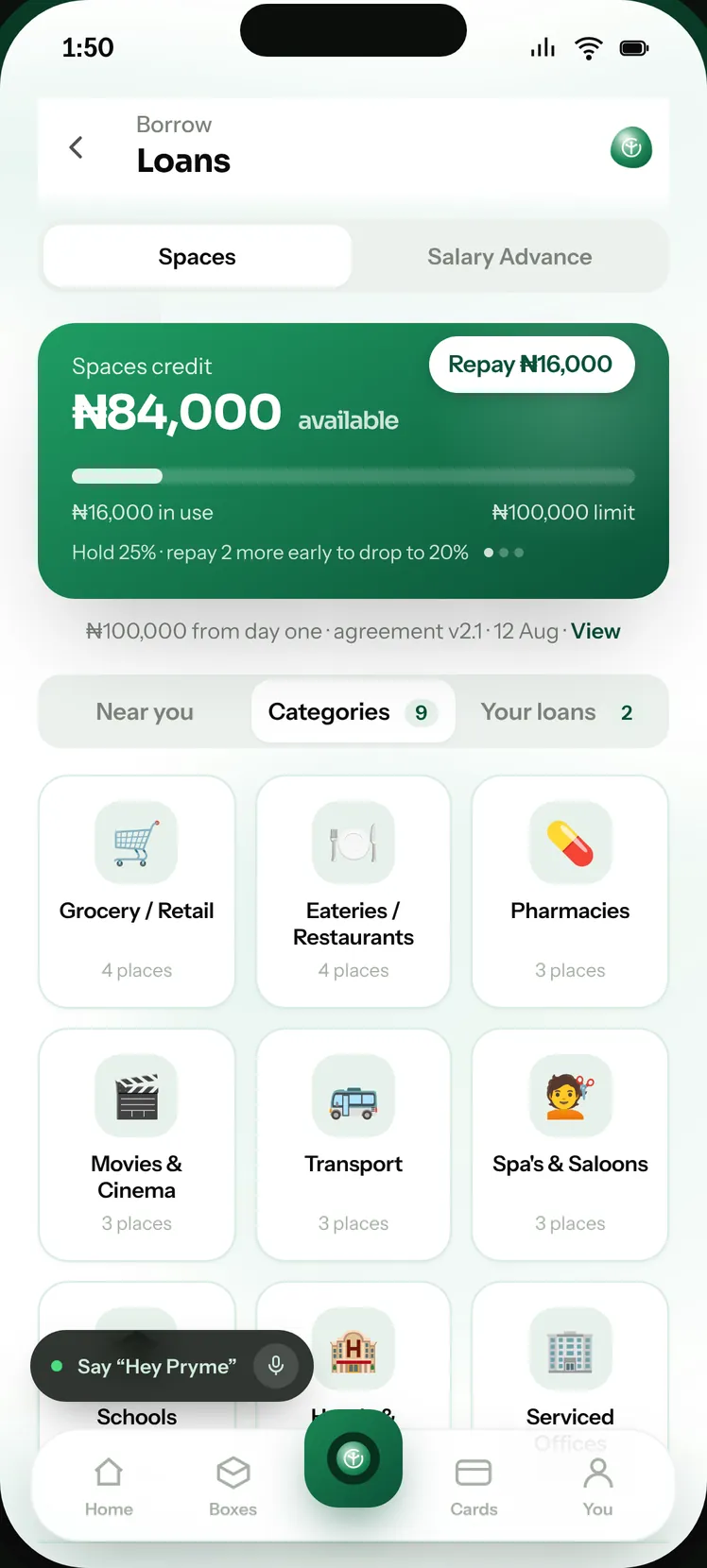
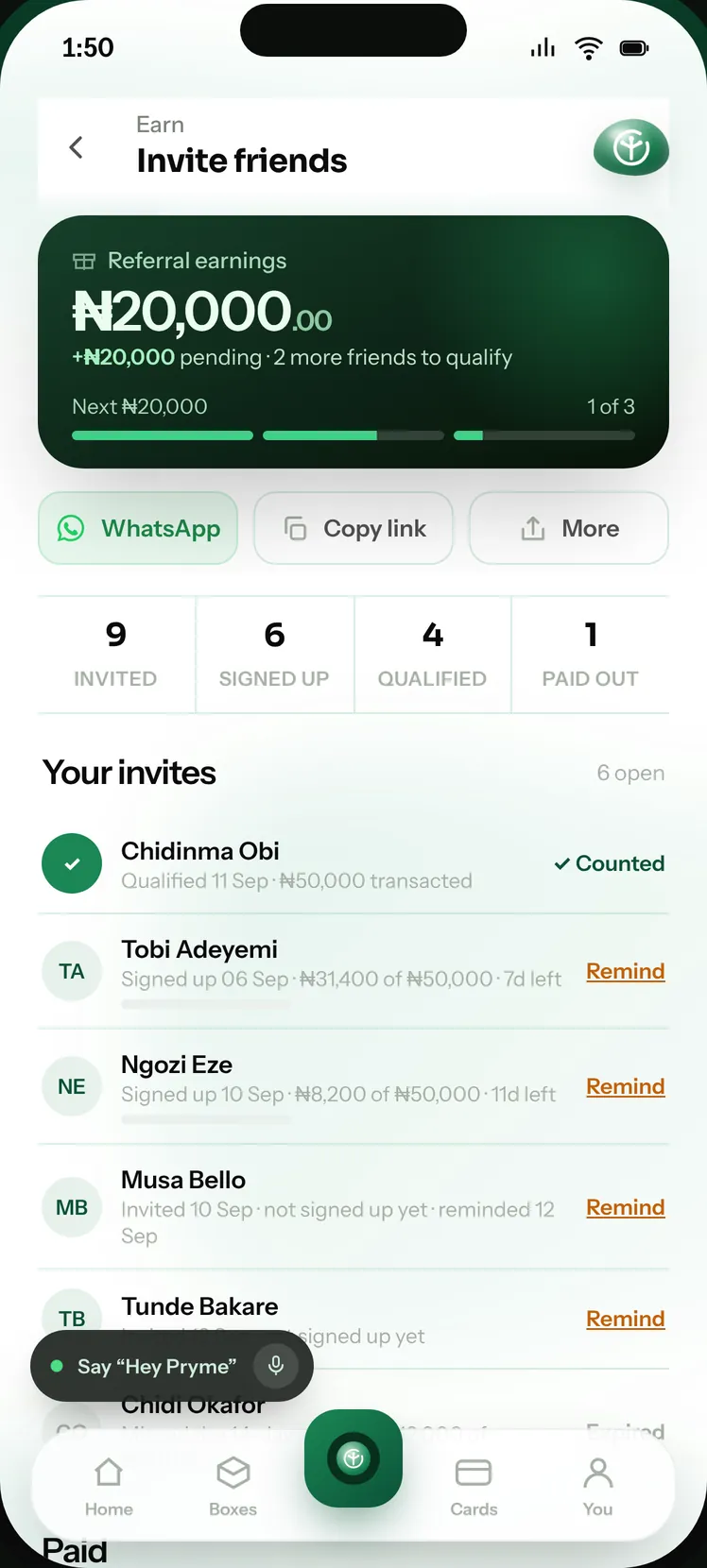
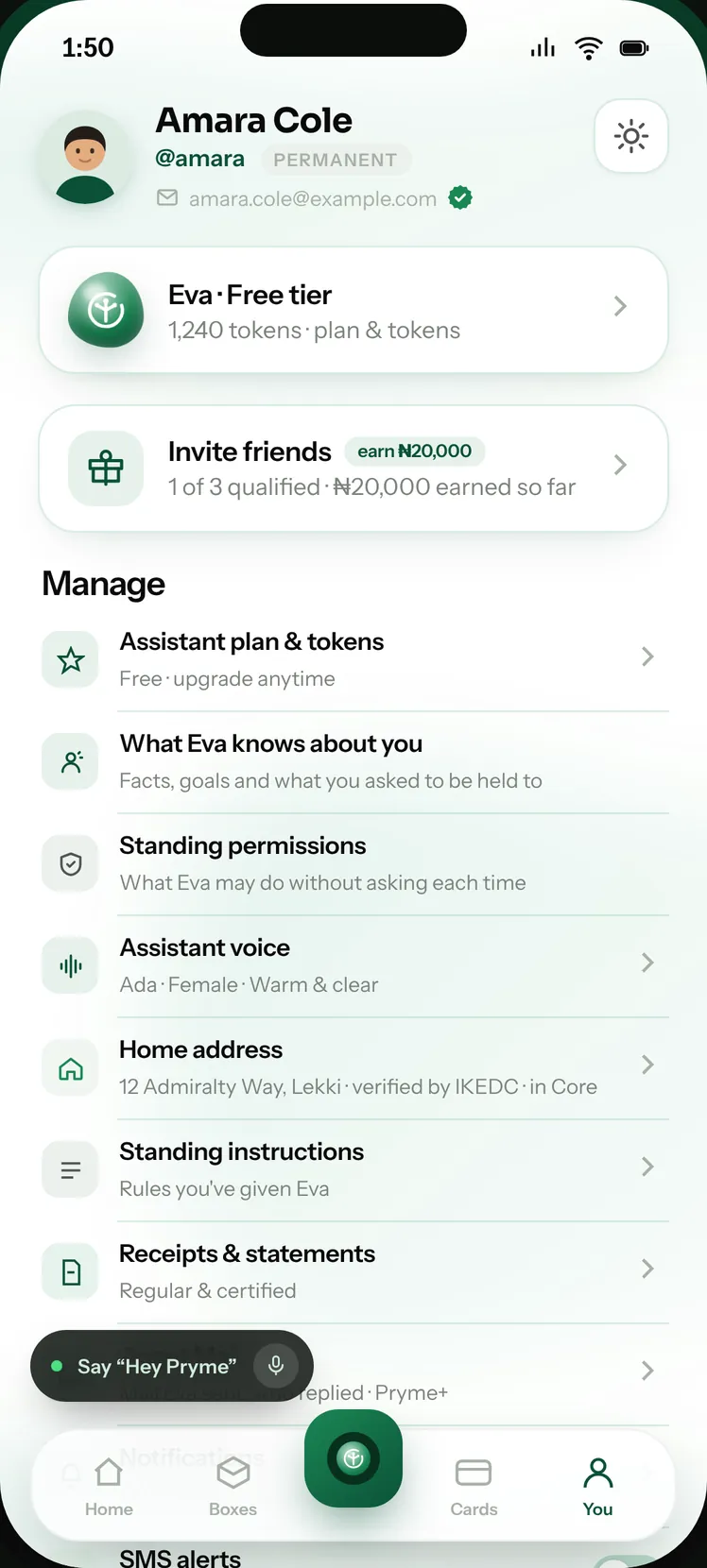
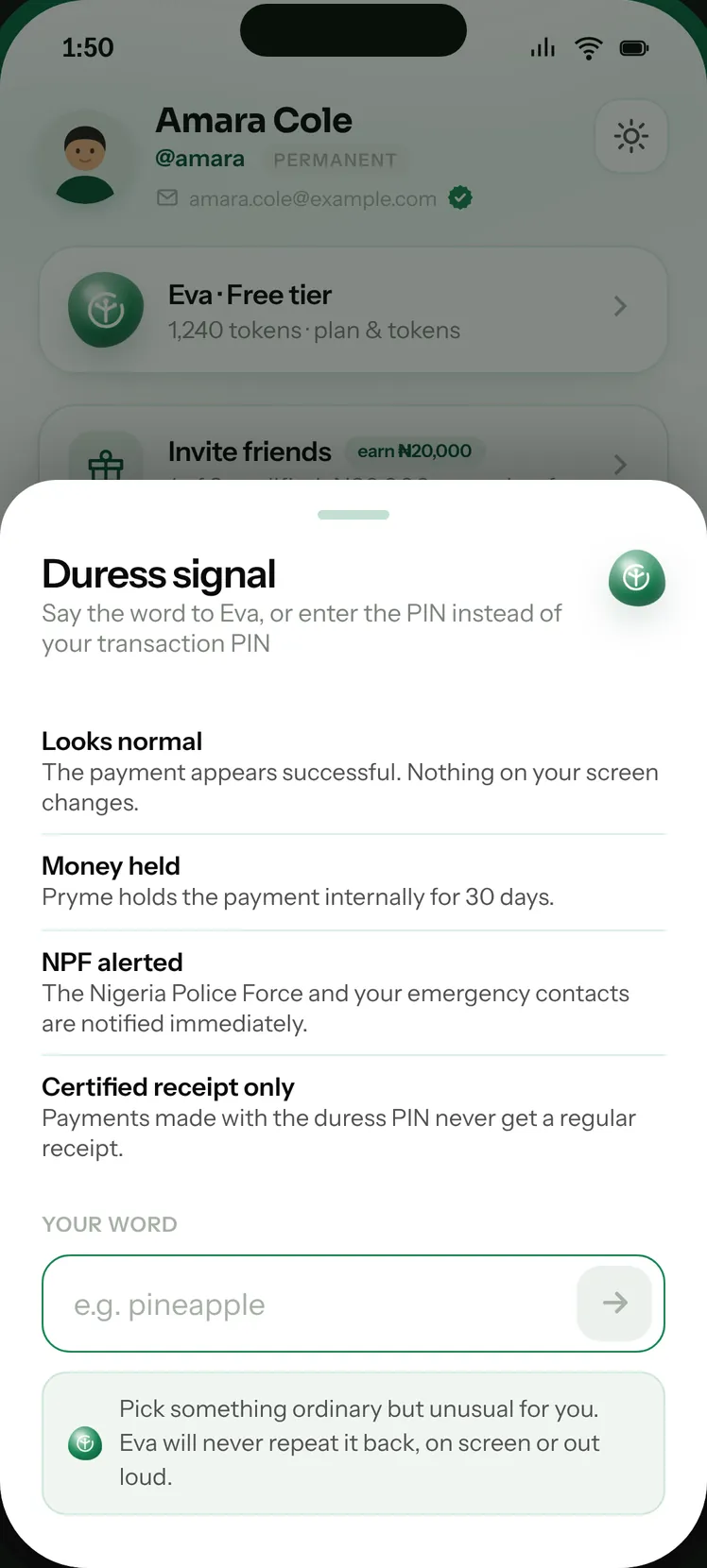
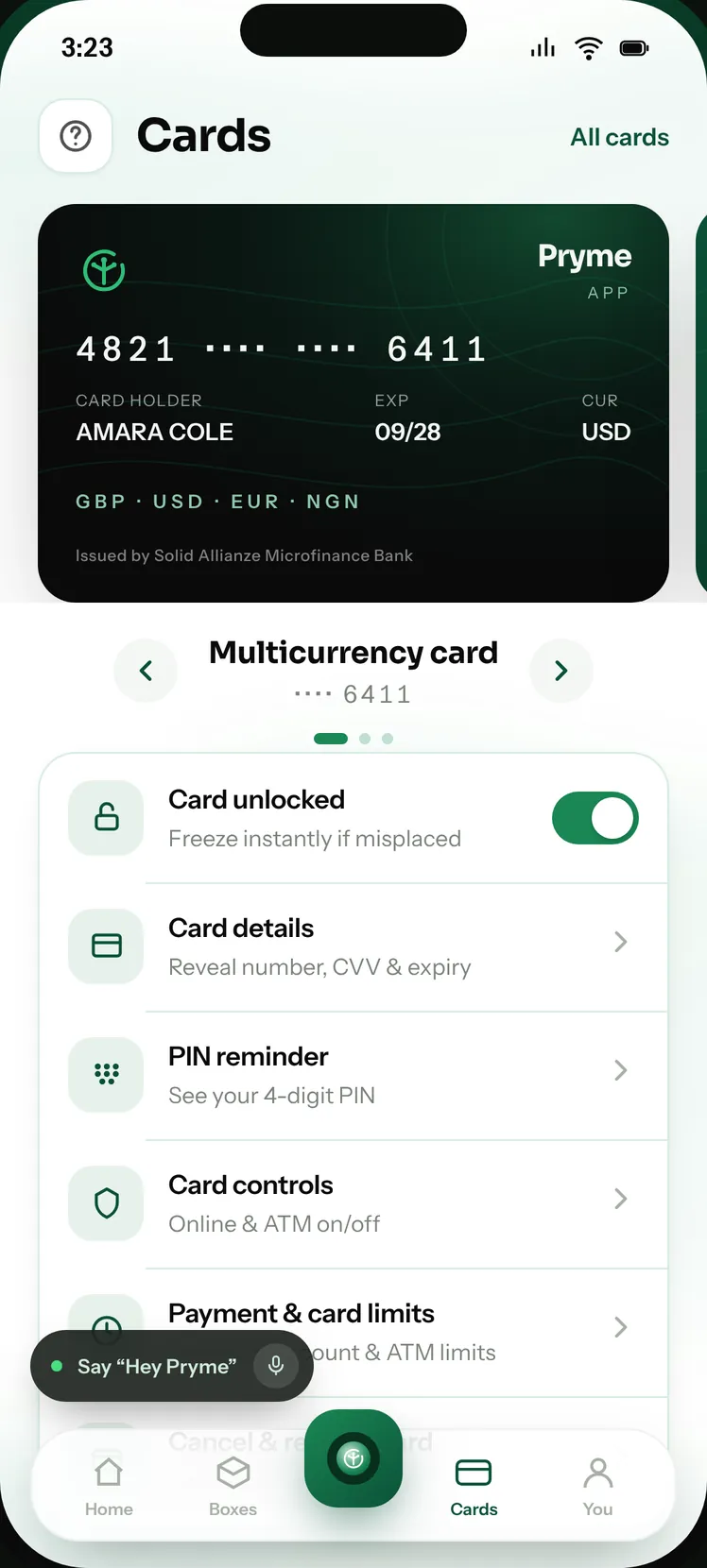
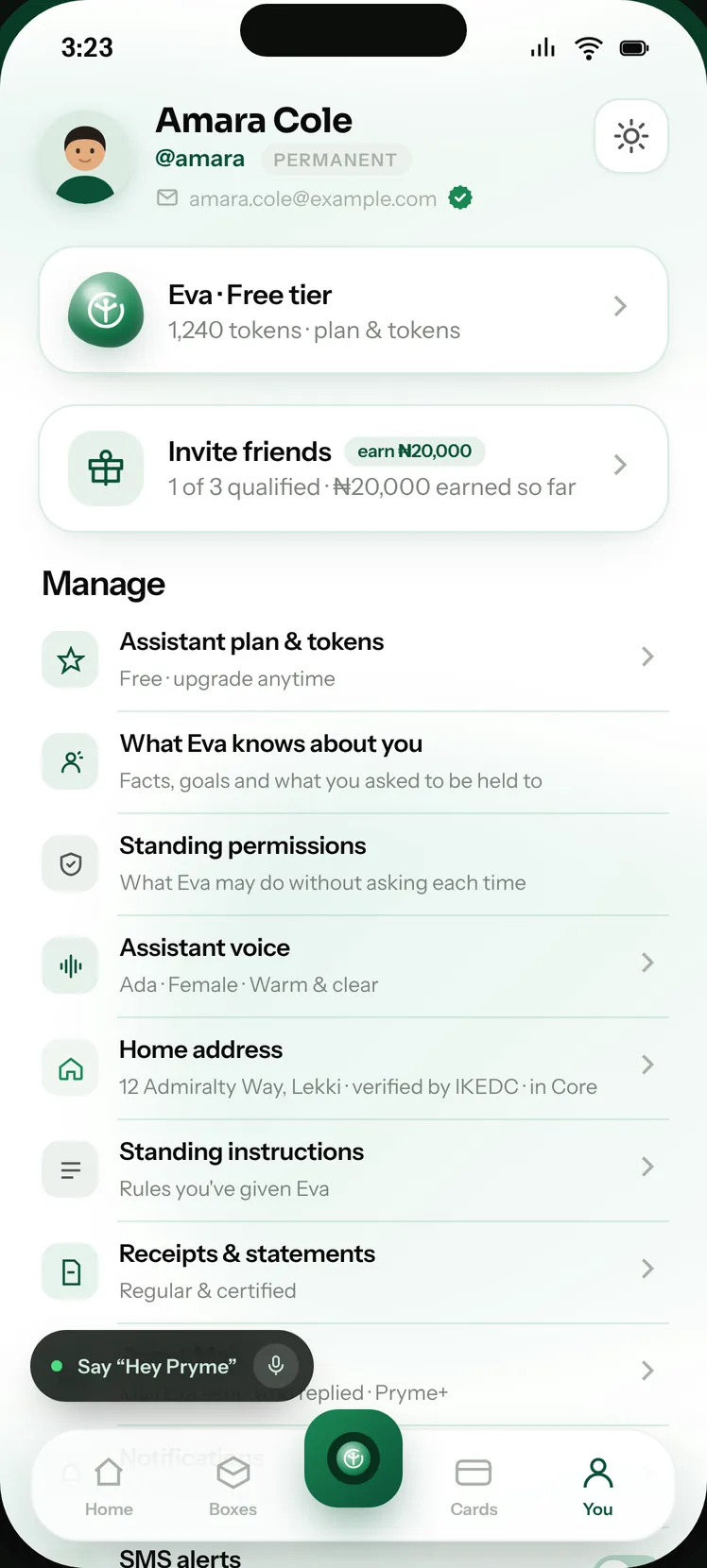
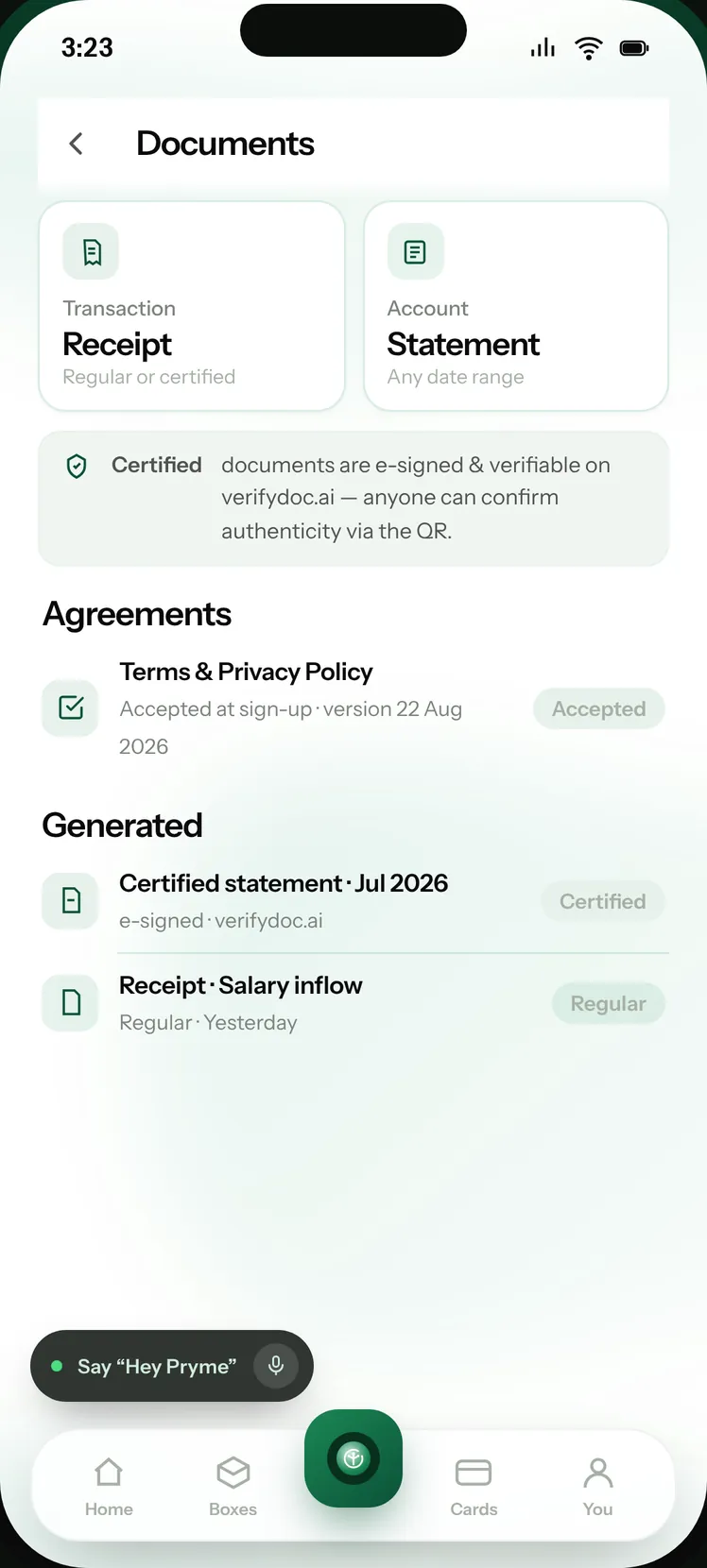
We give you a limit to spend at the shops and services you already use — and an account that works on your month while you get on with it. Dollars, pounds and euros sit beside your Naira, and an assistant handles the running of it, asking you first every single time.
One global account for your money and business. Move across currencies, automate everyday operations and put AI agents to work — with you in control of every important decision.


 Evayour assistant
 DanielChief of Staff
 BenFinance
 BruceCare
Your competitor down the road sells the same thing you sell. The difference is who walks in. We put money in people’s hands that can only be spent in businesses like yours — and then we point them at you.
You are not borrowing. You are selling to somebody who already has the money — and that money can only be spent with a business like yours.
₦100,000 from day one · agreement v2.1 · 12 Aug · View
Eva waits for your rate and asks before she moves anything.
No card, no OTP, nothing for the buyer to type in. They transfer from the bank app they already use, and the money lands in the same account your agents are running — already matched to the order, already in your books.
We give the buyer a one-time account number. They transfer to it from any bank app or by USSD — no card, no OTP, nothing to type in.
Get the account numberTo this account, from any bank app. We watch it, and the page updates itself.
₦26,767.50 from GTBank · John D., matched to order ORD‑1042.
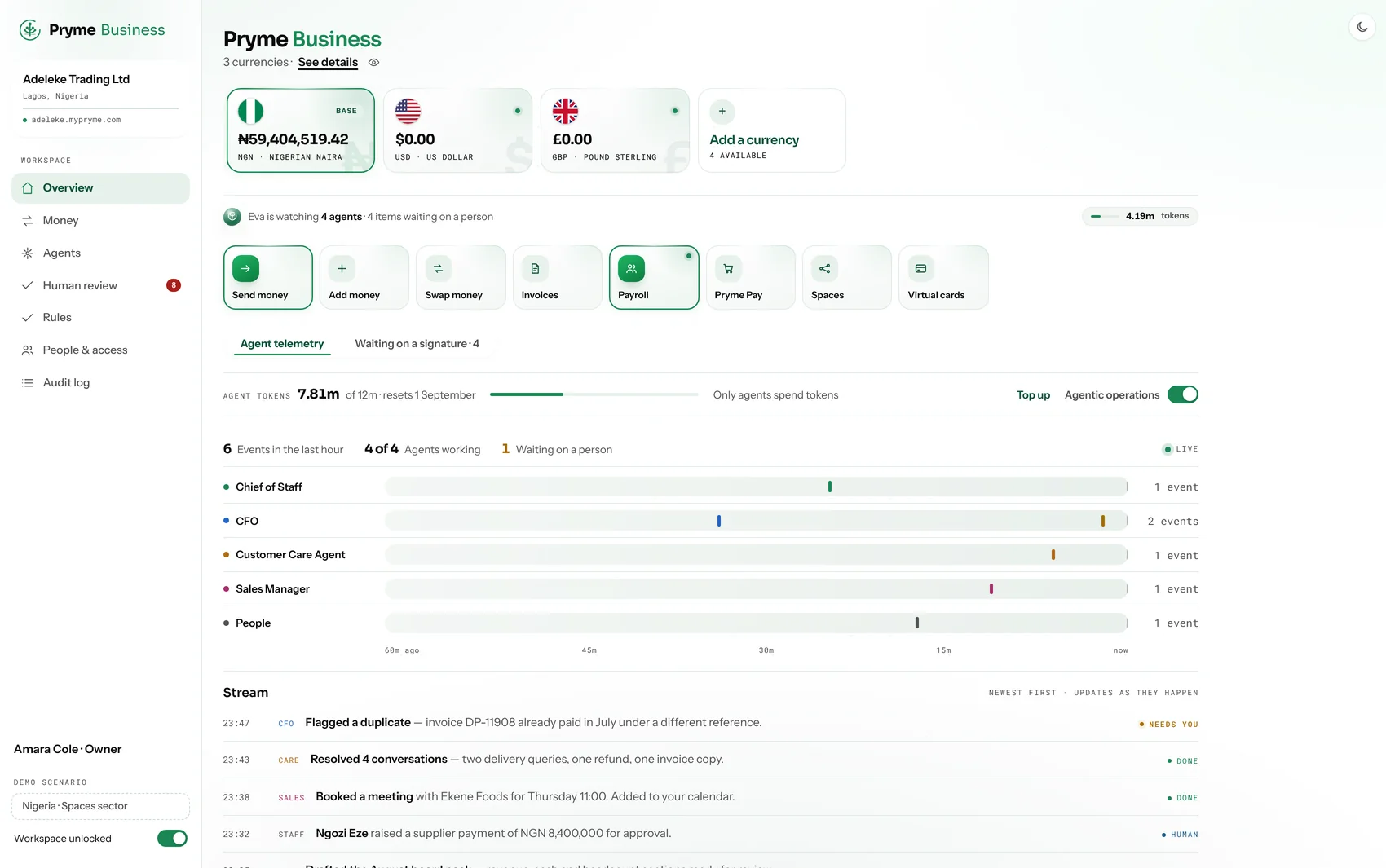
Five agents come with the account. Each one has a job description, a budget and a ceiling you set. They do the work and bring it to you — nothing leaves the account without your signature.
Knows what is stuck, who is waiting and what you promised — and keeps all three moving.
Booked a meeting with John Doe Foods for Thursday 11:00.Keeps the books as you trade and tells you the moment something does not add up.
Flagged a duplicate — invoice DP‑11908 was already paid in July.Holds every filing to its own clock and screens names and payments against your policy — and logs what it refuses.
Screened 412 payments overnight and refused two of them.Goes back to the buyers who went quiet, with the receipt already attached.
Recovered ₦410,000 across three overdue invoices.Replies, follows up on what they asked for and hands you only the ones that need you.
Resolved 4 conversations — two deliveries, one refund.Issue a dedicated Naira account number to each of your own customers, collect into it and reconcile against it. The same rails the Business Account runs on, with the licence behind them.
Dollars, pounds and euros beside a Naira account, on one ledger and one set of books. Five agents come with it and run the account — nothing leaves without your signature.
Five agents come with the account. Each has a job description, a budget and a ceiling you set. They do the work and bring it to you — they propose, you approve.
Knows what is stuck, who is waiting and what you promised, and keeps all three moving.
Booked the quarterly review with your auditor for Thursday.Keeps the books in every currency you hold and flags the moment something does not add up.
Flagged a duplicate — invoice DP‑11908 was already paid in July.Holds every filing to its own clock and screens names and payments against your policy — and logs what it refuses.
Screened 412 payments overnight and refused two of them.Goes back to the buyers who went quiet, with the invoice and the receipt already attached.
Recovered $12,400 across three overdue invoices.Replies, follows up on what they asked for and hands you only the ones that need you.
Resolved 4 conversations — two deliveries, one refund.The business has changed shape four times and never changed what it was rooted in. Each version was built out of what the last one could not do.
An online grocery store, built out of a faulty tab. Selling the food was the easy part — taking the money for it, and moving it, turned out to be the business.
A prepaid card. The first time the company issued rather than resold, and the first time it carried the obligations that come with holding somebody else’s money.
Solid Allianze acquired — an existing bank with an existing licence. The perimeter stopped being someone else’s to draw.
More than one currency on one balance, and the rebrand to Pryme. A Nigerian business could hold dollars without holding a second institution.
Accounts that do the work rather than only hold value. Five agents on the account, inside a policy you write — which is where the new mark starts.
Pryme is a financial technology company. It gives people and businesses in Nigeria one account that holds Naira alongside dollars, pounds and euros, and a set of agents that do the running of it — keeping the books, chasing what is owed, answering customers and paying bills. Nothing leaves an account without the owner’s approval.
Yes. A Pryme account holds Naira, US dollars, pounds sterling and euros side by side on one ledger, each with its own account details — a Nigerian account number, a US account number, a UK sort code and an IBAN for the euro area. You can swap between them at a rate you set, and every currency has its own statement.
Spaces is available in Nigeria. It gives a shopper money to spend that can only be spent with a participating business. The business is paid into its Naira account whether or not the shopper repays, because Pryme carries the credit. For the business it is free to join, there is nothing monthly, and the customer’s identity is never shown — only a reference and what it is worth.
Five agents come with the account. The Chief of Staff runs the week and keeps what is stuck moving. Finance watches the money and keeps the books as you trade. Compliance keeps the filings on time and screens what moves. Sales chases what you are owed. Customer Support answers your customers and follows up. Each has a job description, a budget and a ceiling you set, and each one proposes rather than acts — nothing leaves the account without your signature.
Pryme Pay takes payments on your own site or on a checkout page you control. The buyer is given a one-time account number and transfers to it from any bank app or by USSD — no card, no OTP, nothing to type in. The money lands in the same account your agents are running, already matched to the order and already in your books.
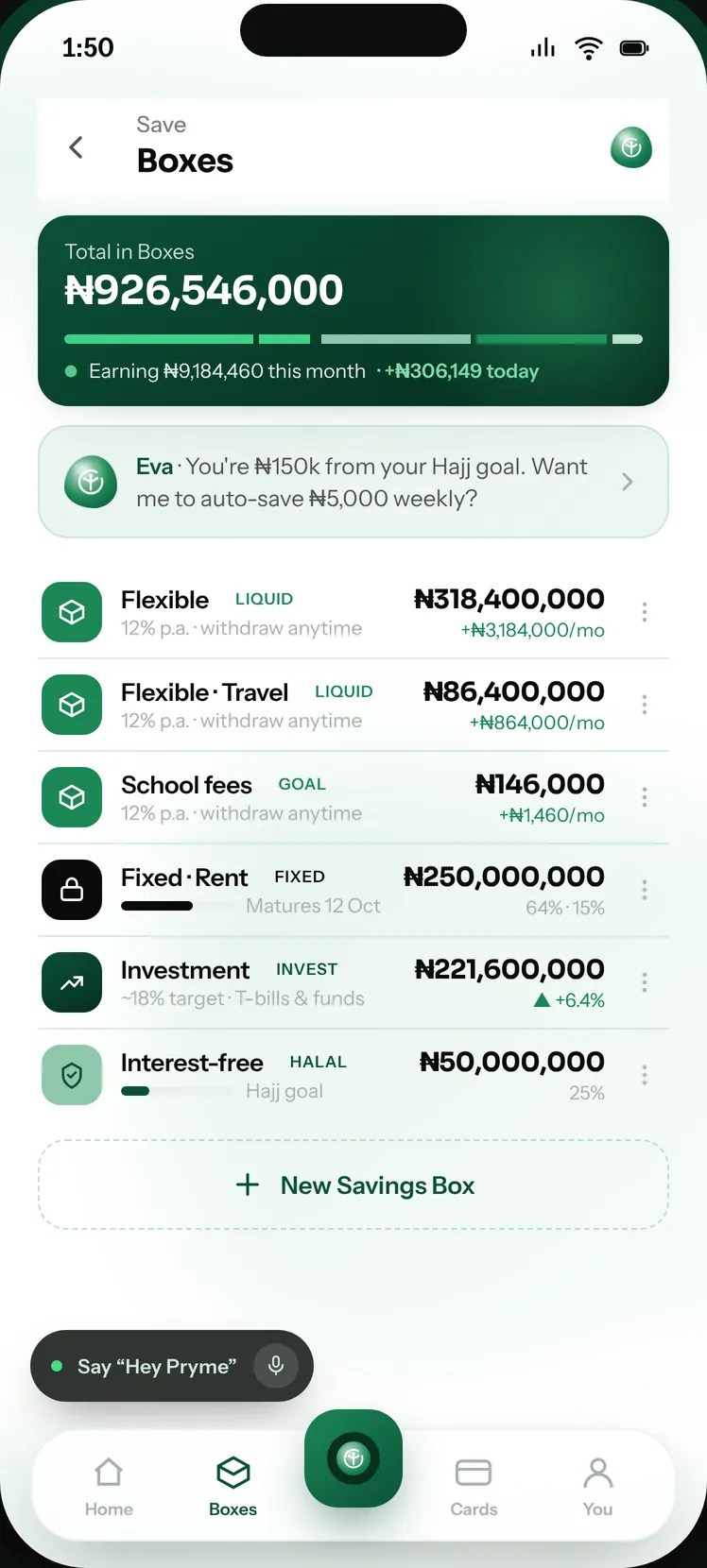
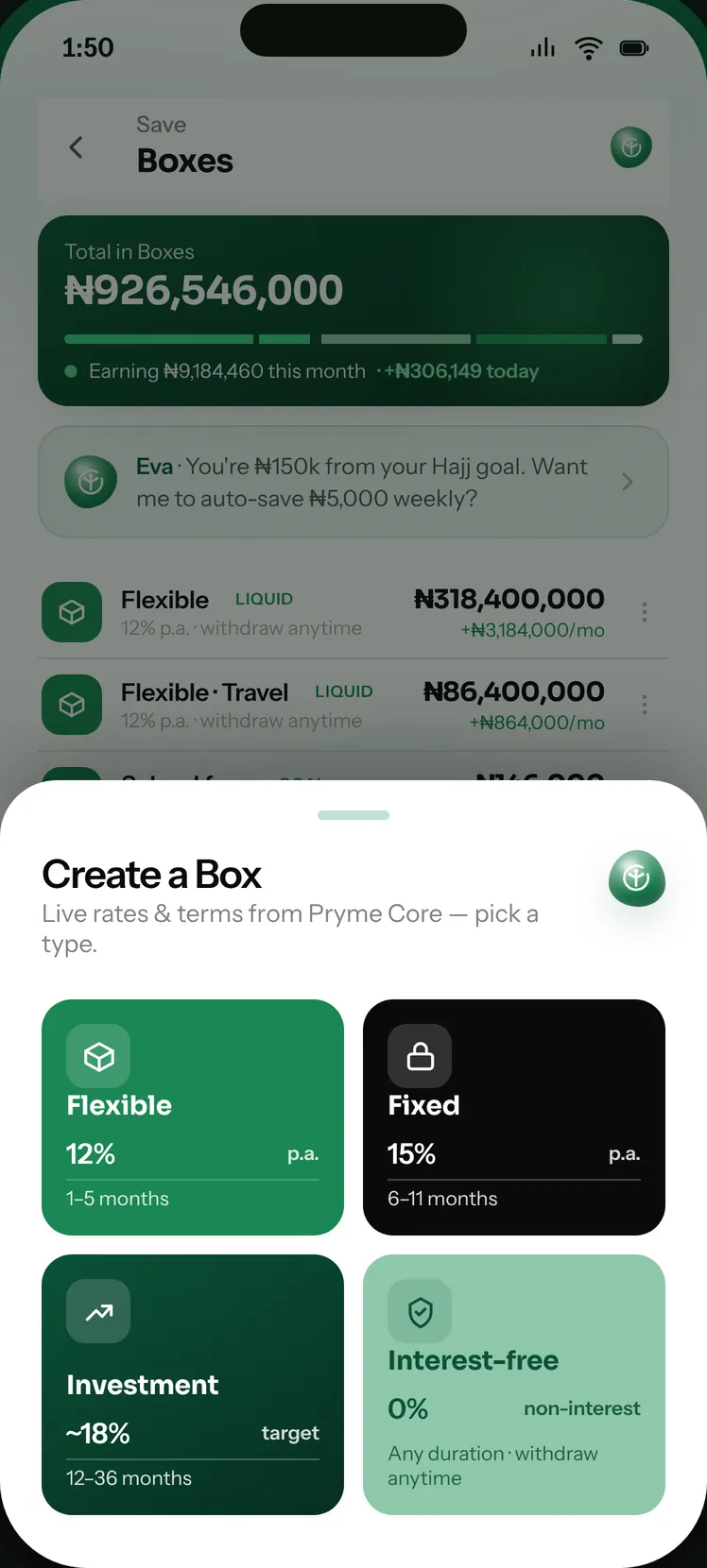
Savings Boxes are separate pots inside a Pryme account, held in Naira. Flexible Boxes can be withdrawn at any time, Fixed Boxes hold to a date, Investment Boxes hold for longer, and Interest-free Boxes earn nothing by design. A business can use them to ring-fence payroll and the tax it withholds, so that money cannot be spent by accident.
Pryme is a financial technology company, not a bank. Accounts and deposits are provided by Solid Allianze Microfinance Bank Limited, which is licensed by the Central Bank of Nigeria and is a member of the Nigeria Deposit Insurance Corporation.
Yes. Pryme Rails lets a platform issue a dedicated Naira account number to each of its own customers, collect into it and reconcile against it, over one API — the same rails the Pryme Business Account runs on.
Pryme is a financial technology company. It gives you one account that holds US dollars, pounds sterling and euros beside Naira, with an assistant that runs the account for you and asks before anything moves. Accounts are provided in Nigeria today, and further markets open as each licence lands.
Accounts are provided in Nigeria today, subject to verification and approval. Foreign-currency balances are held and converted inside that account, so you can hold, receive and swap dollars, pounds and euros wherever you are.
Naira, US dollars, pounds sterling and euros, side by side on one ledger. Each has its own details — a Nigerian account number, a US account number, a UK sort code and an IBAN for the euro area — and each has its own statement.
Swap at a rate you set rather than the rate of the day, then send to any Pryme username or to a Nigerian bank account. There is no fee to send to another Pryme account.
Eva is the assistant inside the Pryme app. She opens accounts, moves money, saves toward your goals, pays what is due and follows up what is owed to you — and asks you before anything moves.
Pryme Rails lets a platform issue a dedicated Naira account number to each of its own customers, collect into it and reconcile against it, over one API — the same rails the Pryme Business Account runs on.
Notes on money that does the work: what we are building, what the regulation actually says, and how we think about letting software act on money. Read the Ledger
What AI agents can do in bookkeeping, close, collections and compliance today, where a person must stay in charge, and how to judge a product.
How multi-currency business accounts work: local details vs SWIFT, payment rails, the real cost of FX, safeguarding vs deposit protection, and hedging.
How UK, US, Canadian and European firms pay Nigerian suppliers and get paid by Nigerian clients: FX, Form A and M, tax, compliance and payout routes.
What it really costs to send money to Nigeria from the UK, US, Canada and Europe: fees, exchange-rate margins, CBN naira rules, BVN, speed and scams.
What AI can and cannot do in day-to-day bookkeeping, how much time it saves on real numbers, and which jobs must stay with you or your accountant.
What we are building, what the regulation actually says, and how we think about letting software act on money.
All of All diasporaTrade with Nigeria · 84 articles
Cash in advance, letters of credit, collections or open account: how each works when you sell to a Nigerian buyer, and the 30% FOB rule.
Why groundnuts and egusi from Nigeria are rejected abroad, the limits in the EU, UK and US, and how to test a lot properly before it ships.
How a foodstuff air shipment from Lagos is priced, packed, documented and cleared, and the checks at your end that decide whether it lands on time.
Buying fabric in Lagos does not make it Nigerian. How origin, tariff classification and textile labels decide the duty you pay on ankara and aso-oke.
Infant formula and baby food must be NAFDAC-registered before they enter Nigeria, and the 2019 regulations set strict label and marketing rules.
What Nigeria Customs charges on a barrel of family goods, the $300 de minimis rule, restricted foods and medicines, and what to pack instead.
The clauses a bulk clothing order with a Lagos tailor needs: specification, deadline, defects, payment stages, ownership of designs and disputes.
Why bushmeat such as grasscutter is banned in the US, UK, EU and Canada, the disease concerns behind it, and the fines for travellers and traders.
The NXP is filed by your Nigerian supplier, but it decides where your payment must land. How the form links to the money, and the deadlines.
Who insures goods from Nigeria under FOB, CIF or EXW, Clauses A versus C, what credit insurance does not cover, and how to make a claim.
How bulk cashew and sesame move from farms and aggregators to a Lagos port, the quality and paperwork checks at each step, and how to pay safely.
The CAC public search is free and shows a company's name, RC number, type, status and registration date. How to run it and read the result from abroad.
How to verify a Lagos clearing agent's Customs licence and CRFFN registration from abroad, and how to stop inflated or invented charges.
Groupage lets a small shop share a container from Nigeria. How it is priced, what the house bill of lading means, and the risks you carry.
Registrations, Form NXP, permits, inspection, B'Odogwu customs clearance and port steps behind a container export from Nigeria, in order.
Dried crayfish, bonga and stockfish count as animal products abroad: the listing, certificate, border post and allergen rules for imports.
Shipping orders to customers in Nigeria: the $300 de minimis rule, how duty and VAT are worked out above it, and DAP versus DDP delivery.
What demurrage, detention and terminal storage are at Apapa and Tin Can, why free days run out, and the steps importers take to keep charges down.
Short shipment, bad quality or no delivery? Negotiation, Lagos mediation, arbitration under the 2023 Act and court options, from abroad.
Territory, exclusivity, payment, regulatory duties and termination: the clauses to settle before a foreign brand appoints a Nigerian distributor.
How charities, churches and NGOs abroad apply to the Federal Ministry of Finance for a duty waiver on donated goods, and what still has to be cleared.
How to plan lead times, run quality checks and structure payments when Nigerian makers fulfil the orders you take from customers abroad.
Who qualifies for NEPC's Export Expansion Grant, what it requires, how its credit certificates work, and why buyers abroad keep hearing about it.
When a painting, carving or bronze needs an NCMM export permit, what the law counts as an antiquity, and what to carry for contemporary work.
A Nigerian buyer must register a Form M before you ship. What it is, what you provide as the seller, and why shipping early causes trouble.
Why egusi faces aflatoxin checks in the UK and US, what border officials look at on garri and yam flour, and the usual reasons a consignment is refused.
Why shipments from Nigeria are detained or seized abroad, and the deadlines to challenge, release, re-export or destroy them in the UK, US and Canada.
The hazard analysis, monitoring logs, lab results and traceability records importers abroad ask a Nigerian food supplier for, and why each one matters.
Which bodies certify Nigerian food as halal, when a buyer or retailer abroad needs it, and how to check that a certificate will be accepted.
Meat and dairy are usually refused, plants need certificates, and some Nigerian foods face extra checks or bans. The common rules for shops and importers.
Why live African land snails are banned in the US and closely controlled elsewhere, what processed snail meat travellers may carry, and the penalties.
FOB, CIF, EXW or FCA when buying from Nigeria: who pays freight and insurance, where risk passes, and why EXW clashes with Nigerian export rules.
The checks on leather bags, shoes and poufs from Kano: Nigeria's export ban on raw and unfinished hides, CITES rules for exotic skins, and duty.
How kola nut (obi) and bitter kola (orogbo) are treated as plant products abroad, why fresh nuts face more checks than dried, and the documents that help.
A NAFDAC label is not enough abroad. The UK, EU, US and Canadian rules on ingredients, allergens, origin, address and language, side by side.
A letter of credit replaces your buyer's promise with a bank's. How confirmation, document checks and discrepancies work from the seller's side.
What a licence for a Nollywood film or Nigerian track should say, how royalties are reported and taxed, and how to collect foreign currency cleanly.
NAFDAC certifies regulated products leaving Nigeria: food, cosmetics, drugs and devices. Which certificate applies, the documents and the timeline.
How a manufacturer outside Nigeria registers products with NAFDAC: local applicant, power of attorney, certificates, dossier and inspection.
Which products need NAFDAC registration before sale in Nigeria, who can hold the registration for a seller abroad, and how that choice affects you.
Plant exports from Nigeria need a NAQS certificate issued after inspection and before shipment, now electronic. When it applies and how to get one.
How import duty, the surcharge, CISS, ETLS and VAT stack up on the CIF value of goods entering Nigeria, with a worked example that adds up.
Before you ship to Nigeria, check the import prohibition list: food, drinks, soaps, medicines and used goods. What is banned, what is restricted.
Dried beans from Nigeria still cannot enter the EU. The history since 2015, the pesticide behind it, what the law says today and what would lift it.
How alcohol duty, licences, warehouse rules and labelling apply when you import Nigerian stout, lager, gin or schnapps for sale in the UK or US.
Why export payments must reach the exporter's own domiciliary account in Nigeria, the FX Manual 2026 repatriation window, and what to quote.
Why wooden crates, pallets and some wooden goods from Nigeria need ISPM 15 treatment, what the mark looks like, and the papers that prove it.
NACCIMA, ETLS, AfCFTA through Customs, and REX for the EU: which body issues a Nigerian certificate of origin and when a buyer abroad needs one.
Bitters, teas and herbal mixtures from Nigeria: when they count as medicines abroad, the claims you cannot make, and what NAFDAC export needs.
Why commercial honey imports depend on residue monitoring and country listing, what that means for Nigerian honey, and the small personal allowances.
Labelling, colours and preservatives, the UK sugar levy and FDA entry rules that apply when you import Nigerian malt and soft drinks for sale.
The fields a Nigerian supplier's commercial invoice needs so customs abroad can value, classify and clear the goods, and origin preferences apply.
WhatsApp chats are where most Nigerian supply orders happen. Here is how to turn them into purchase orders and invoices that hold up in a dispute.
How plant health rules treat dried and fresh Nigerian leaves and seeds abroad: risk categories, phytosanitary certificates, pre-notification and checks.
Selling Nigerian skincare and haircare online in the UK, EU, US or Canada: responsible person, safety files, notifications, banned ingredients.
What it takes to sell Nigerian sesame, shea, ginger or hibiscus as organic abroad: recognised control bodies, group certification and paperwork.
Why palm oil from West Africa is tested for Sudan dyes, how the UK and US treat it, and how a buyer protects a consignment before it is paid for.
Before the first transfer to a Nigerian supplier: identity, the CAC record, an account name that matches, and payments staged against proof of goods.
When Nigerian rules expect naira, when they expect dollars, and why goods exported to you should be paid in foreign currency to the export account.
Whether a business abroad can use Paystack or Flutterwave to take naira card payments, what entity it usually needs, and the fees as at October 2026.
NAFDAC and NAQS inspect regulated exports; an independent inspector checks your order. What each covers, timings, and what to ask for.
What to verify about a Nigerian cosmetics manufacturer before putting your brand on its creams, oils or soaps, and the duties you take on abroad.
If you import Nigerian goods and sell them abroad, the law may treat you as the producer when something goes wrong. Here is why, and how cover works.
Getting samples from a Nigerian supplier by courier: declaring value, duty and VAT at your end, regulated goods, and fake duty texts.
The Nigerian buyer's Form M is built from your proforma. The fields that must be on it, how validity works and what causes a bank to send it back.
How a software company abroad bills Nigerian customers: dollar or naira pricing, how customers get FX, VAT under the 2025 Act and collection routes.
Where the time goes on a sea shipment out of Apapa, Tin Can or Lekki: approvals, port dwell, demurrage and detention, and how to plan around them.
How Nigerian fashion brands collect from buyers abroad: cards, transfers and invoices, how chargebacks work, and the CBN rules on export proceeds.
Nigerian customers expect to pay in naira. How a business abroad collects naira, converts it, keeps records and handles Nigerian tax presence rules.
What Etsy allows when you sell ankara made in Nigeria, what its fees are as at October 2026, and how to pay makers and handle returns.
The two sets of rules for listing Nigerian foods on Amazon: Amazon's own grocery approval and FBA limits, and the food law of the country you sell into.
Selling Nigerian shea butter or black soap abroad makes you the regulated party. Responsible person, safety report, notification and label rules by market.
How to buy shea butter from women's cooperatives in Nigeria: what grades mean, testing before you pay, paying the group fairly and keeping it traceable.
Why packaged Nigerian foods need evidence for their best-before or use-by date, how shelf-life studies work, and how producers get the testing done.
Meat from Nigeria cannot be imported commercially into GB and faces bans in most markets; smoked fish can, but only from approved plants with certificates.
How Nigeria Customs has classified solar panels for duty, why kits are treated differently, and the SONCAP certificates panels and batteries need.
Why a sole or exclusive agent in Nigeria can end up controlling your product registration, brand and customers, and the contract terms that limit the risk.
Bought fabric, food or cosmetics in a Lagos market to sell abroad? The receipts, NAFDAC approvals, NXP and declarations each route needs.
How invoice-redirect fraud hits trade with Nigerian suppliers, and the call-back and test-payment checks to run before you pay any new account.
Why a personal account for a business payment is a fraud, records and export-rules risk, and what to ask a Nigerian supplier for instead.
How a fashion brand abroad sets up production with Nigerian tailors or factories: choosing a model, sampling, quality checks, labels and staged pay.
Supplier credit, invoice finance, stock loans and letters of credit: how each works for a small importer of Nigerian goods, and what it really costs.
The age rule for used cars shipped to Nigeria, where sources disagree, and how duty, the import levy cut from July 2026, surcharges and VAT add up.
Plant health, food safety and labelling checks for dried hibiscus (zobo) and tiger nuts from Nigeria, plus the extra rules for ready-made drinks.
You can add the other type later — many of our customers hold both.
The business first, then you. Nothing is submitted until you review it.
Ideal customer profiles
Generated from your website by VerifiedLead.ai
Pick the ones that look right. Your Sales agent works these first, and you can change them at any time after opening.
We ask this because you have not given us a website. It helps us set the right limits from day one.
Which of these represents you?
Officers listed against this company on the UK register.
We have sent a six-digit code to your email address. Enter it below to confirm the address is yours.
Wrong address? Go back and change it — nothing is created until this step passes. We never ask for a code by phone or email; anyone who does is not us.
Last step. Each time you sign in we email you a six-digit code — we never send codes by SMS.