AI agents for business finance: what they can and can't do
What AI agents can do in bookkeeping, close, collections and compliance today, where a person must stay in charge, and how to judge a product.
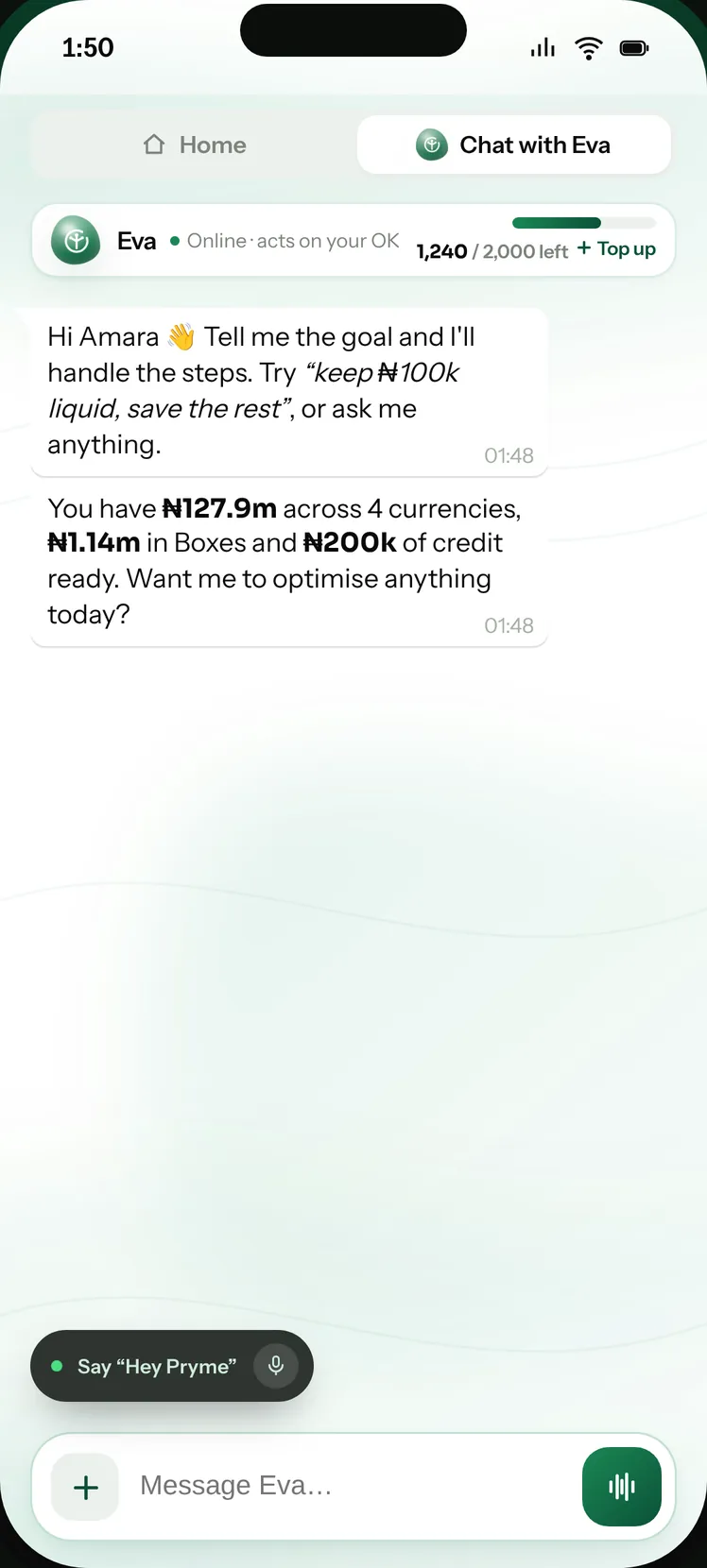
Meet Eva, the assistant inside the Pryme app. She opens accounts, moves money, saves toward your goals and follows up. Nothing leaves your account without your approval.
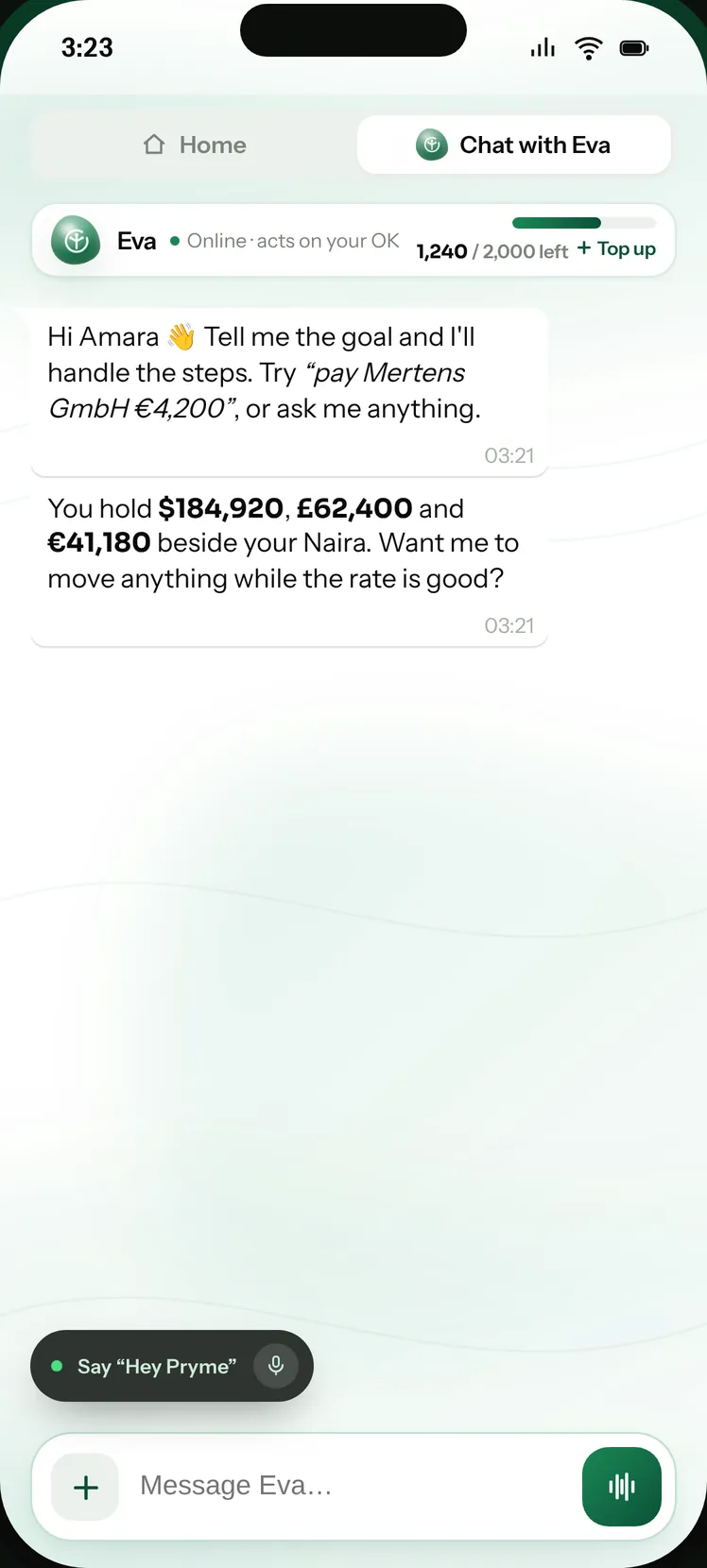
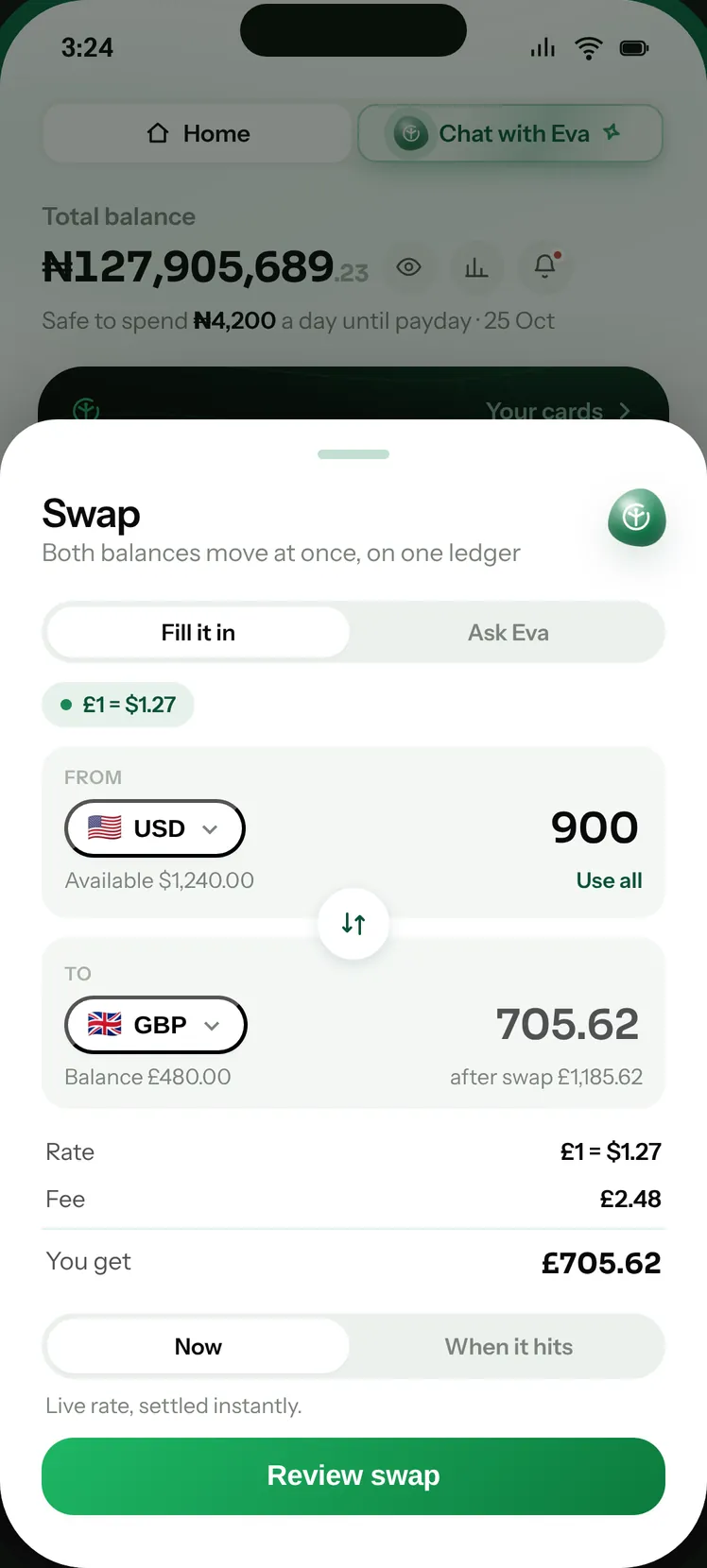
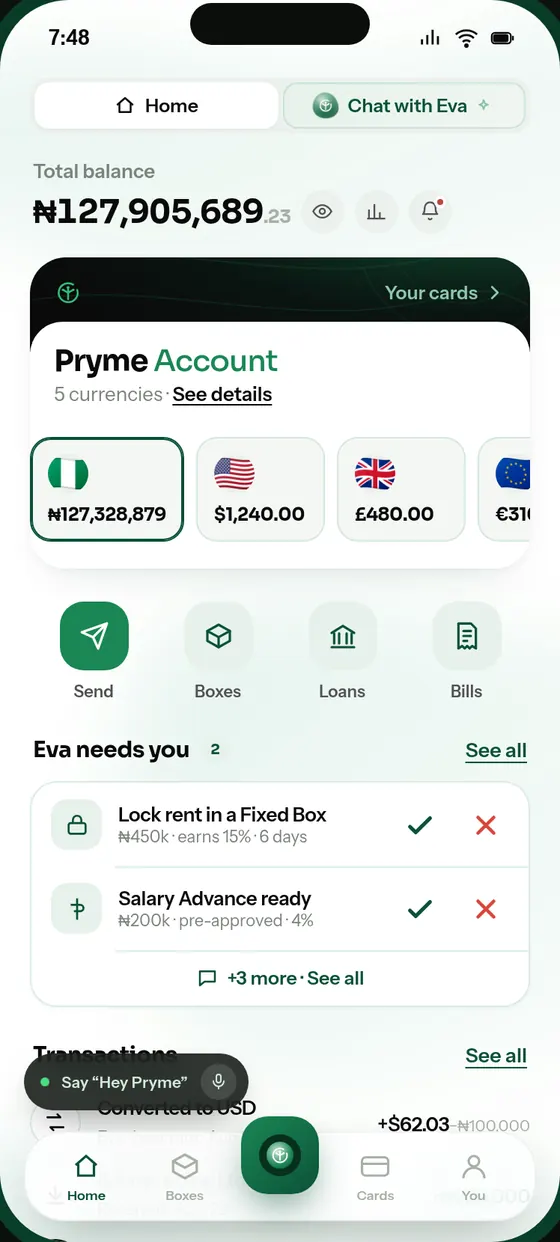
Meet Eva, the assistant inside the Pryme app. She holds dollars, pounds, euros and Naira side by side, swaps at a locked rate, pays bills in any of them and sends anywhere, asking before anything moves.
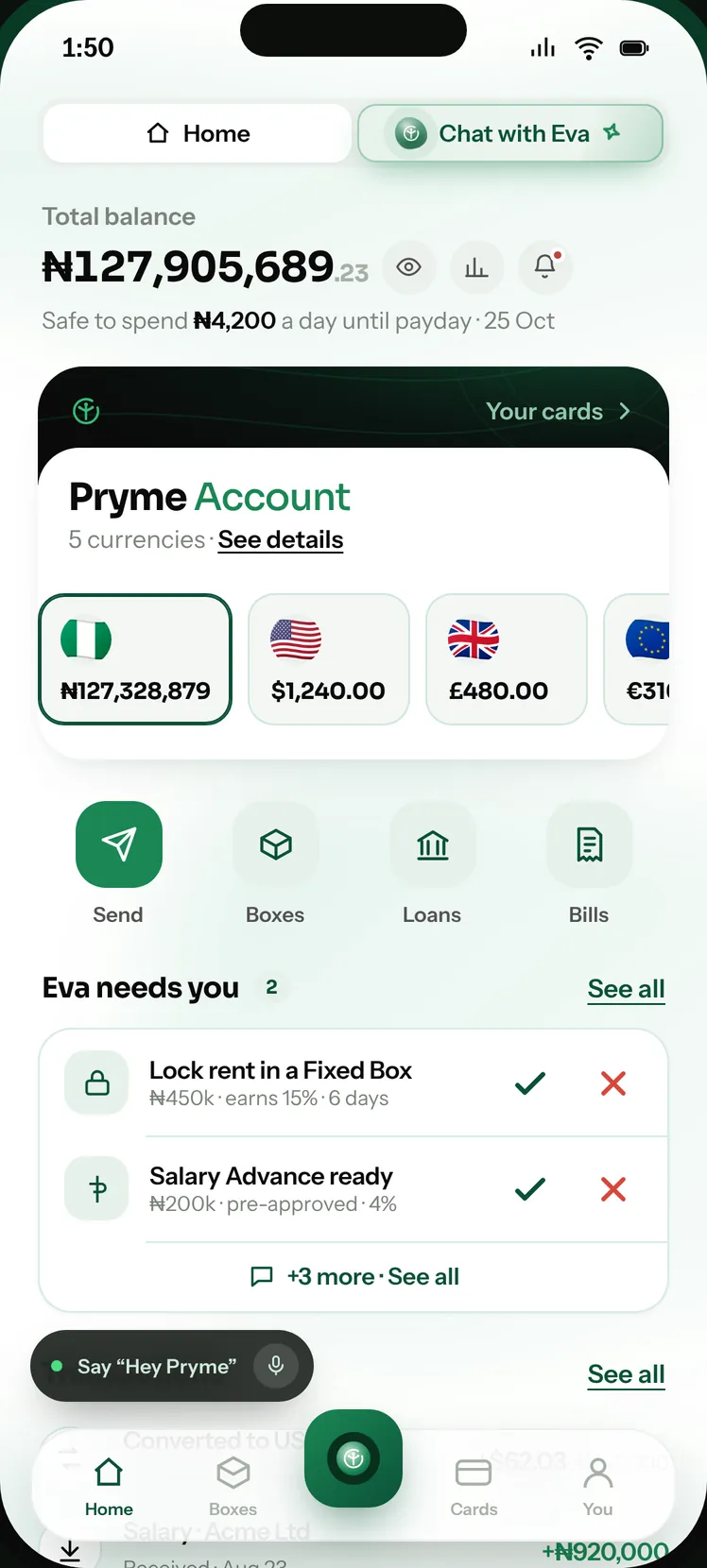
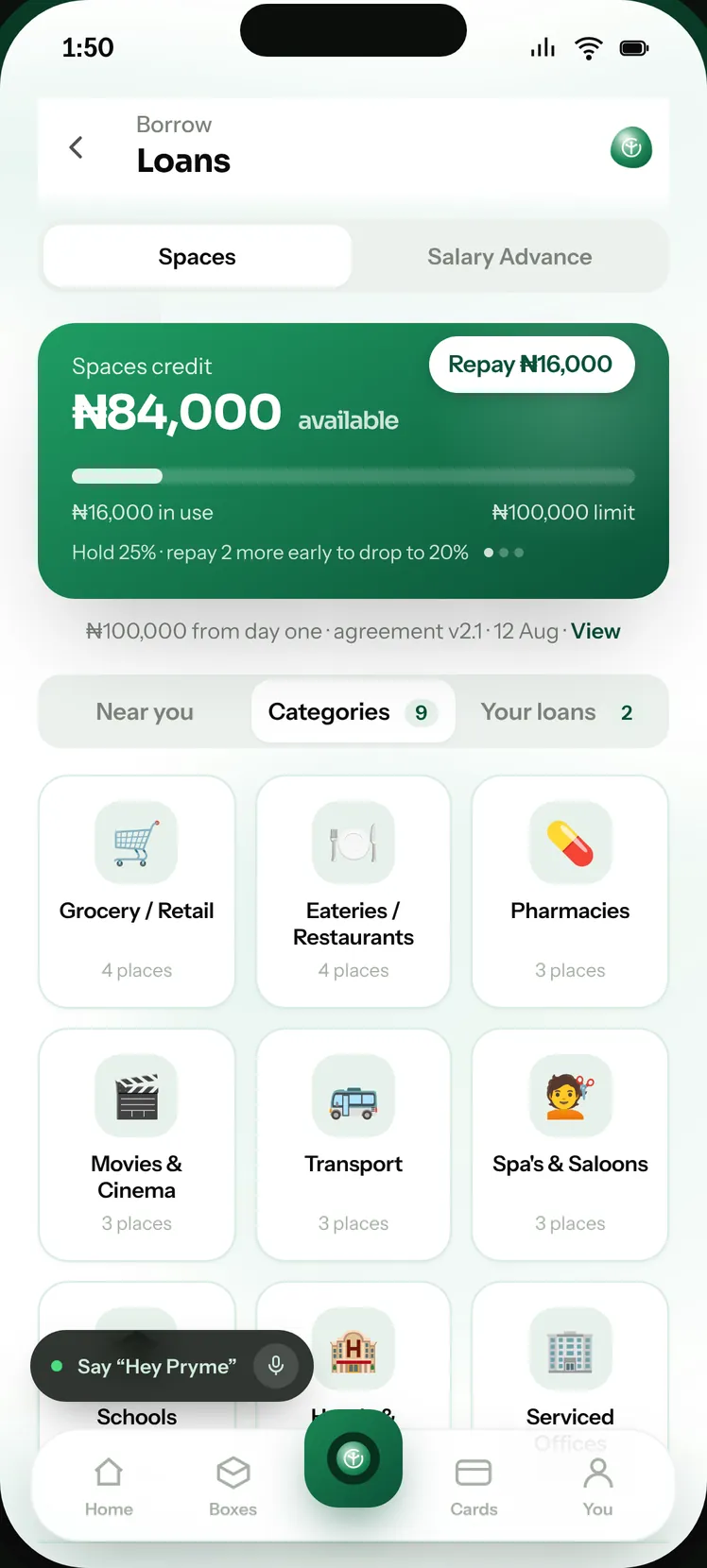
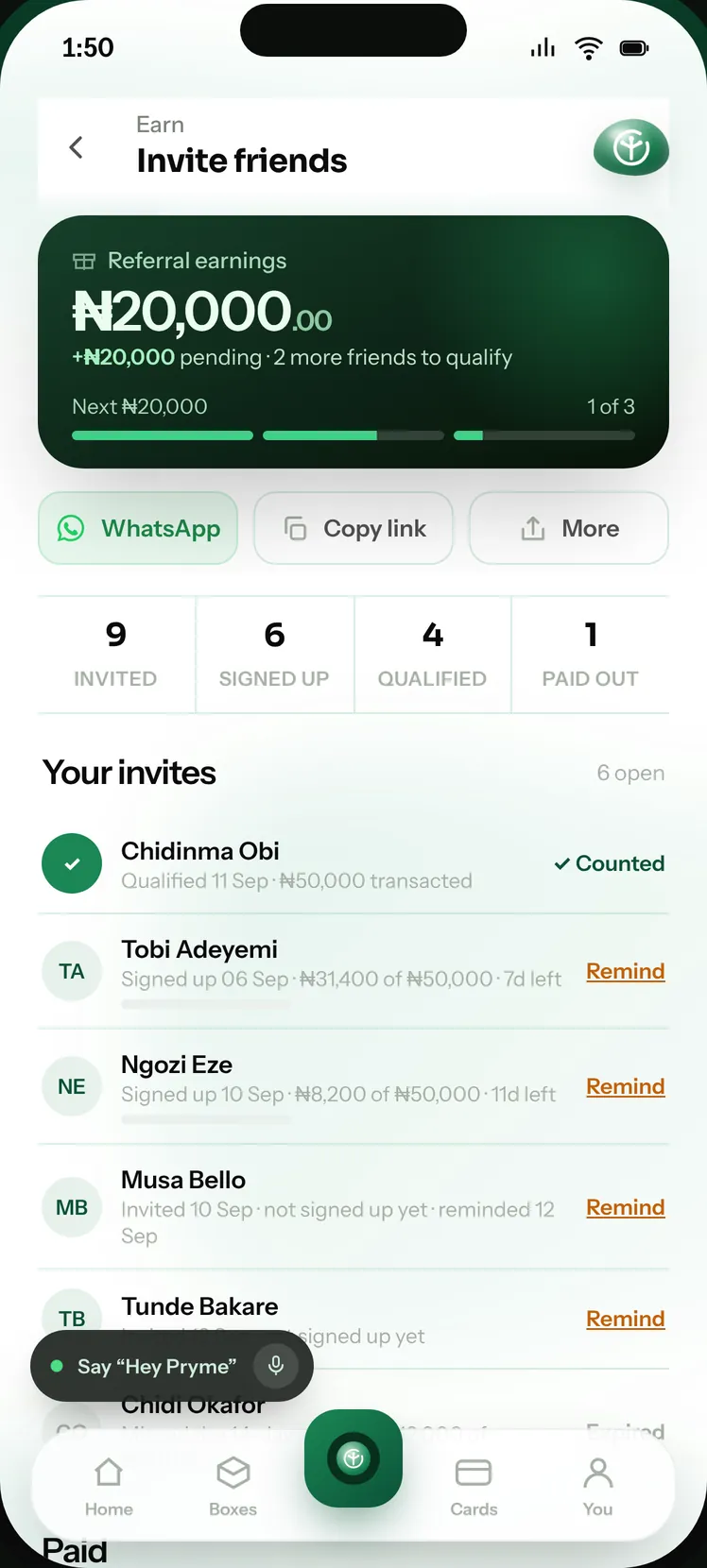
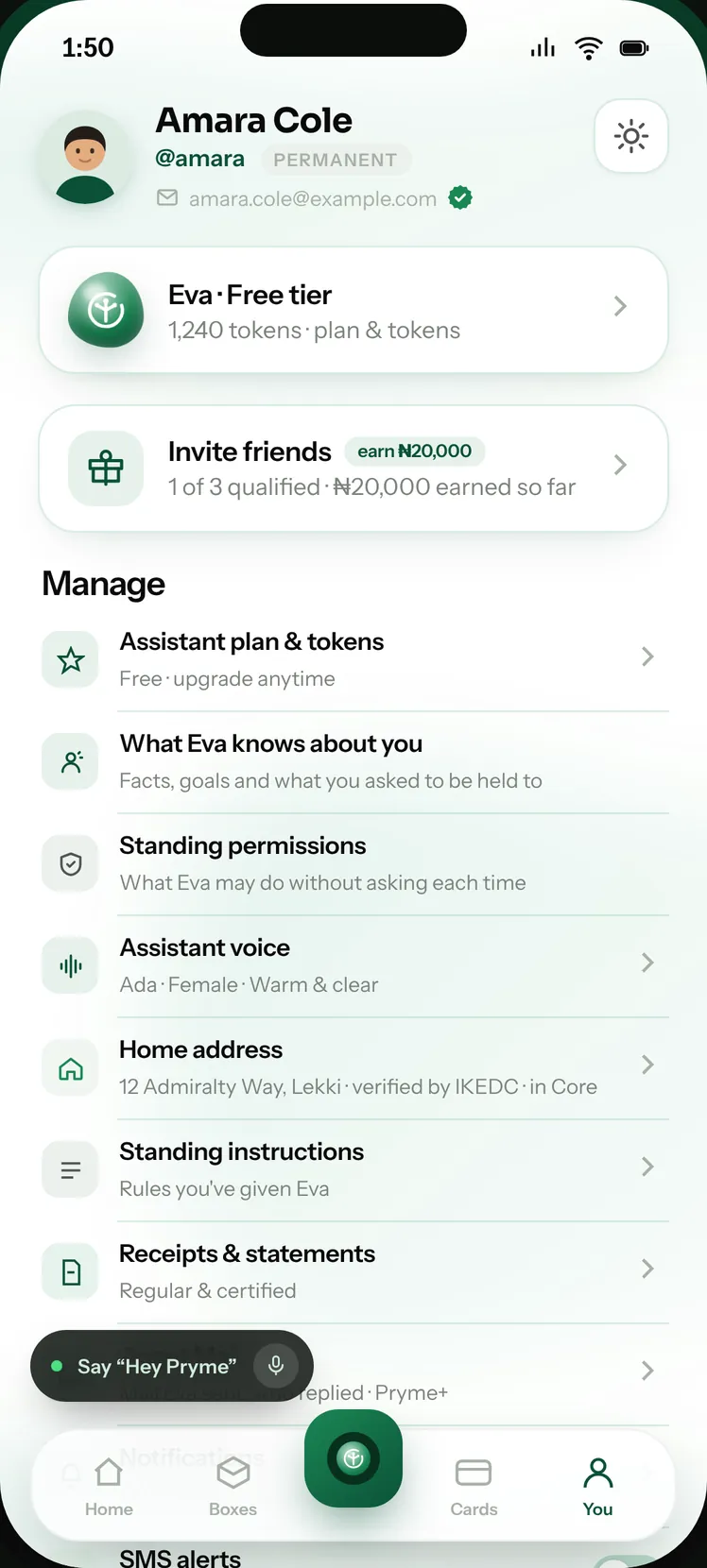
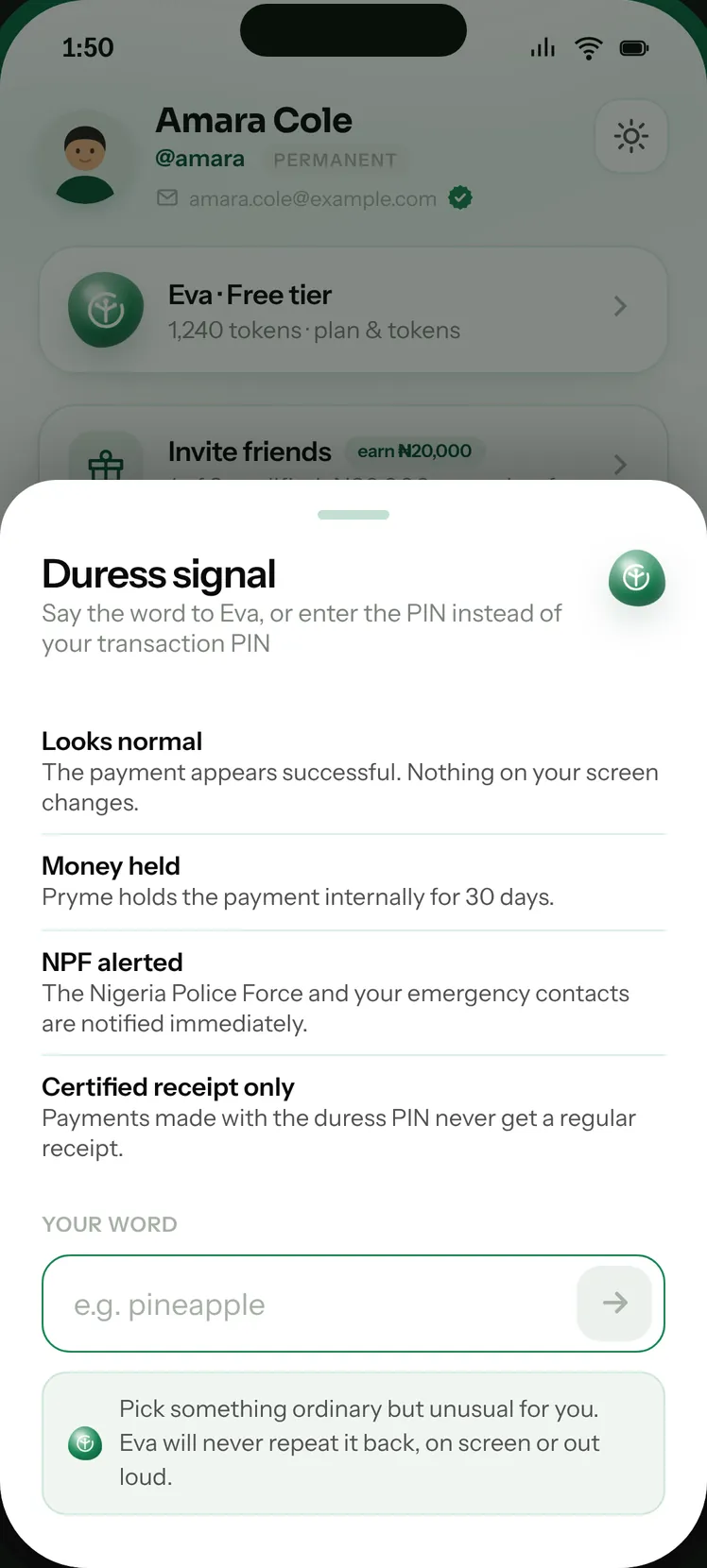
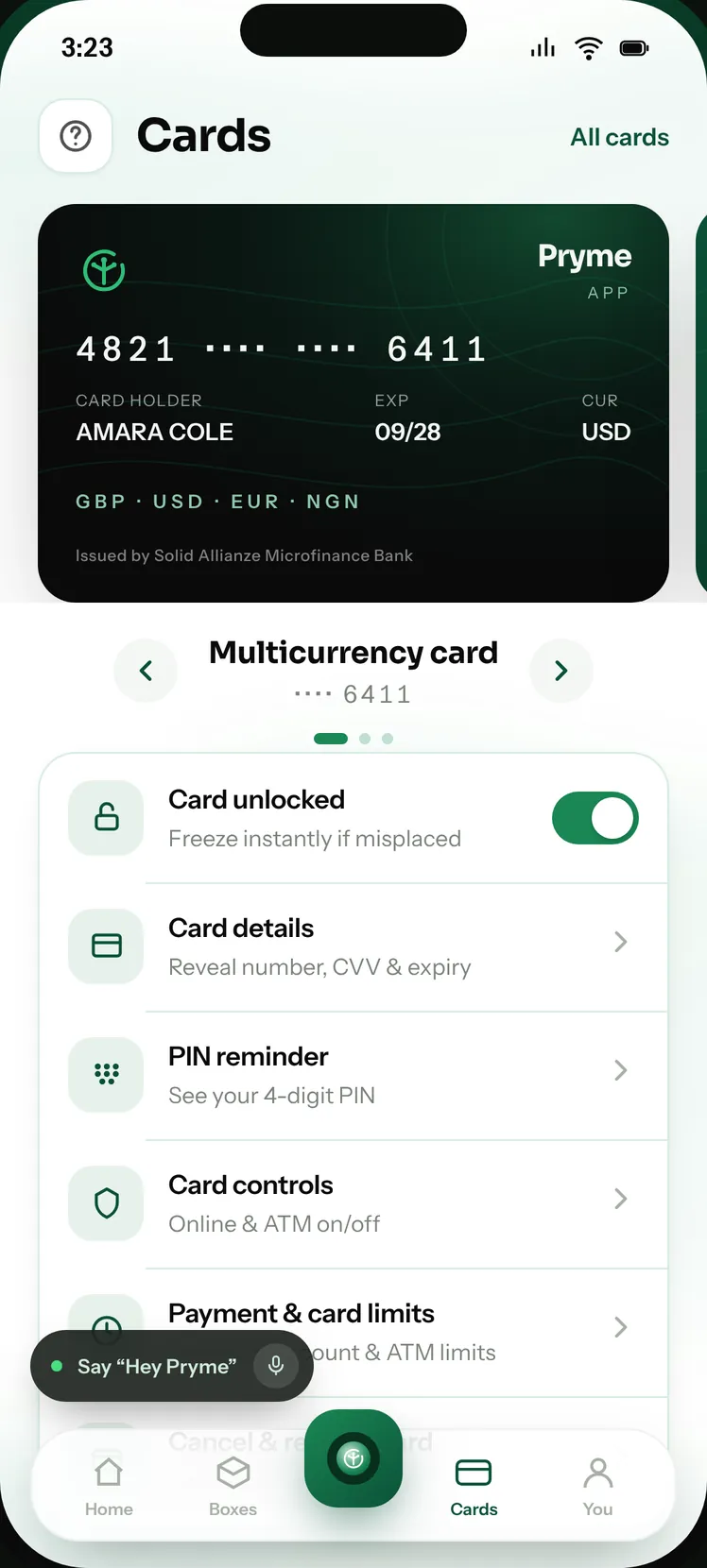
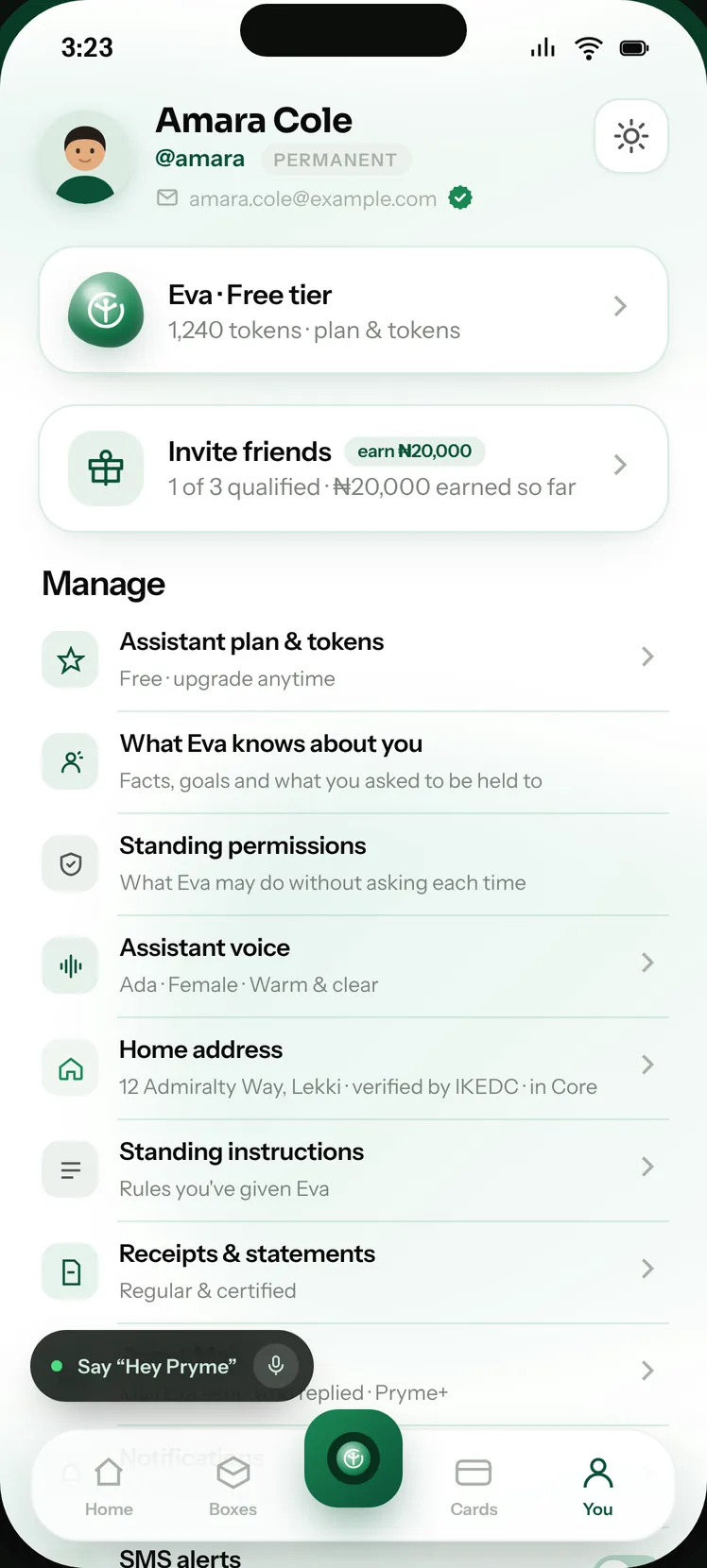
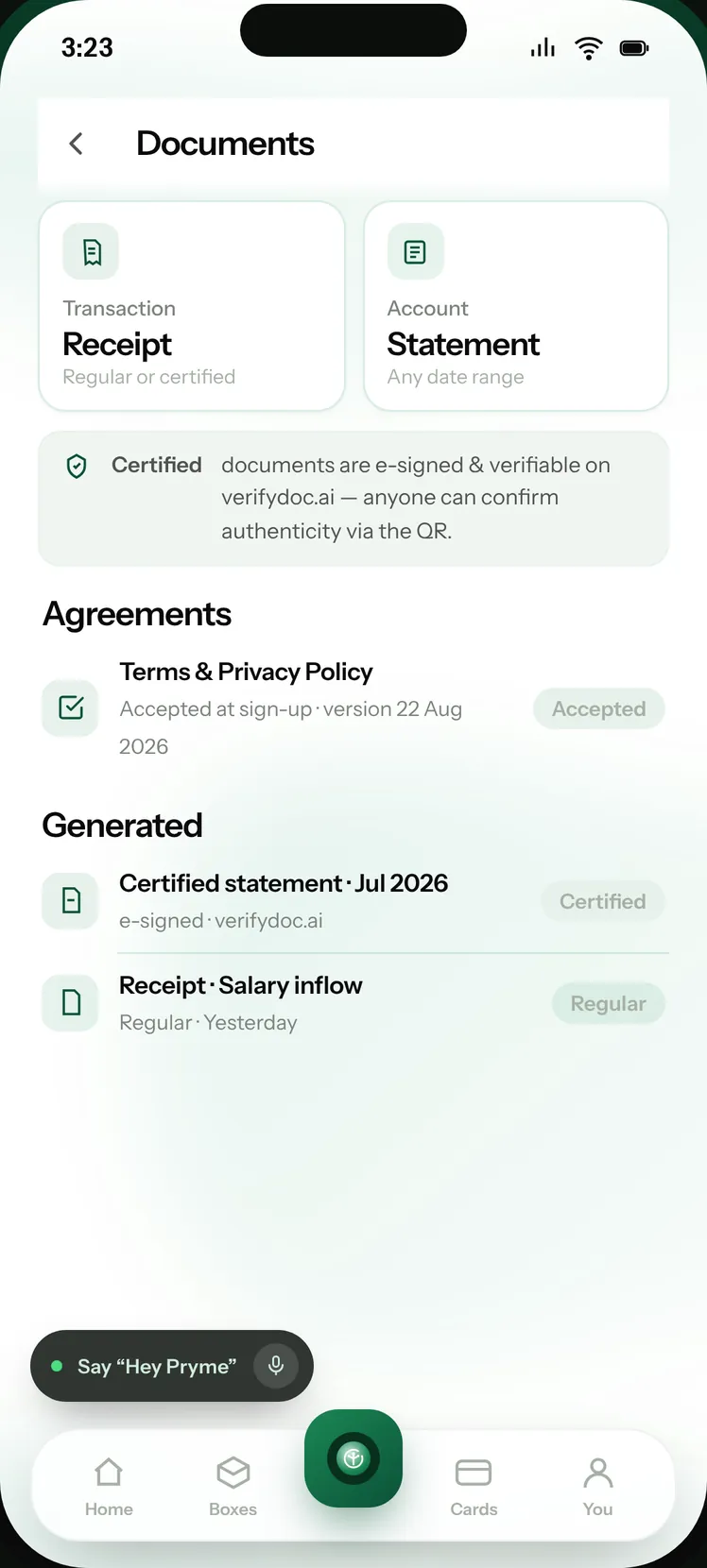
We give you a limit to spend at the shops and services you already use — and an account that works on your month while you get on with it. Dollars, pounds and euros sit beside your Naira, and an assistant handles the running of it, asking you first every single time.
One global account for your money and business. Move across currencies, automate everyday operations and put AI agents to work — with you in control of every important decision.


 Evayour assistant
 DanielChief of Staff
 BenFinance
 BruceCare
Your competitor down the road sells the same thing you sell. The difference is who walks in. We put money in people’s hands that can only be spent in businesses like yours — and then we point them at you.
You are not borrowing. You are selling to somebody who already has the money — and that money can only be spent with a business like yours.
₦100,000 from day one · agreement v2.1 · 12 Aug · View
Eva waits for your rate and asks before she moves anything.
No card, no OTP, nothing for the buyer to type in. They transfer from the bank app they already use, and the money lands in the same account your agents are running — already matched to the order, already in your books.
We give the buyer a one-time account number. They transfer to it from any bank app or by USSD — no card, no OTP, nothing to type in.
Get the account numberTo this account, from any bank app. We watch it, and the page updates itself.
₦26,767.50 from GTBank · John D., matched to order ORD‑1042.
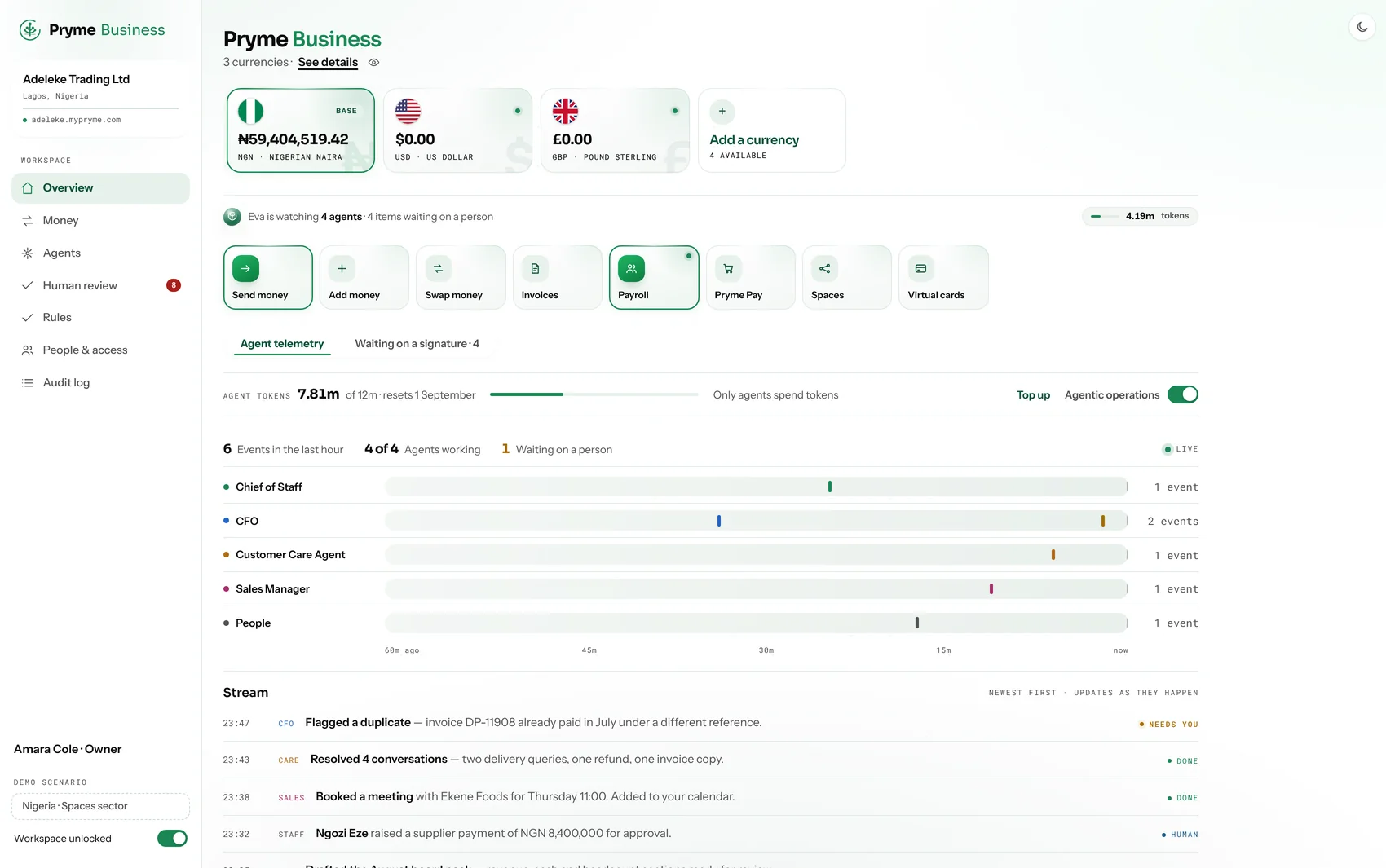
Five agents come with the account. Each one has a job description, a budget and a ceiling you set. They do the work and bring it to you — nothing leaves the account without your signature.
Knows what is stuck, who is waiting and what you promised — and keeps all three moving.
Booked a meeting with John Doe Foods for Thursday 11:00.Keeps the books as you trade and tells you the moment something does not add up.
Flagged a duplicate — invoice DP‑11908 was already paid in July.Holds every filing to its own clock and screens names and payments against your policy — and logs what it refuses.
Screened 412 payments overnight and refused two of them.Goes back to the buyers who went quiet, with the receipt already attached.
Recovered ₦410,000 across three overdue invoices.Replies, follows up on what they asked for and hands you only the ones that need you.
Resolved 4 conversations — two deliveries, one refund.Issue a dedicated Naira account number to each of your own customers, collect into it and reconcile against it. The same rails the Business Account runs on, with the licence behind them.
Dollars, pounds and euros beside a Naira account, on one ledger and one set of books. Five agents come with it and run the account — nothing leaves without your signature.
Five agents come with the account. Each has a job description, a budget and a ceiling you set. They do the work and bring it to you — they propose, you approve.
Knows what is stuck, who is waiting and what you promised, and keeps all three moving.
Booked the quarterly review with your auditor for Thursday.Keeps the books in every currency you hold and flags the moment something does not add up.
Flagged a duplicate — invoice DP‑11908 was already paid in July.Holds every filing to its own clock and screens names and payments against your policy — and logs what it refuses.
Screened 412 payments overnight and refused two of them.Goes back to the buyers who went quiet, with the invoice and the receipt already attached.
Recovered $12,400 across three overdue invoices.Replies, follows up on what they asked for and hands you only the ones that need you.
Resolved 4 conversations — two deliveries, one refund.The business has changed shape four times and never changed what it was rooted in. Each version was built out of what the last one could not do.
An online grocery store, built out of a faulty tab. Selling the food was the easy part — taking the money for it, and moving it, turned out to be the business.
A prepaid card. The first time the company issued rather than resold, and the first time it carried the obligations that come with holding somebody else’s money.
Solid Allianze acquired — an existing bank with an existing licence. The perimeter stopped being someone else’s to draw.
More than one currency on one balance, and the rebrand to Pryme. A Nigerian business could hold dollars without holding a second institution.
Accounts that do the work rather than only hold value. Five agents on the account, inside a policy you write — which is where the new mark starts.
Pryme is a financial technology company. It gives people and businesses in Nigeria one account that holds Naira alongside dollars, pounds and euros, and a set of agents that do the running of it — keeping the books, chasing what is owed, answering customers and paying bills. Nothing leaves an account without the owner’s approval.
Yes. A Pryme account holds Naira, US dollars, pounds sterling and euros side by side on one ledger, each with its own account details — a Nigerian account number, a US account number, a UK sort code and an IBAN for the euro area. You can swap between them at a rate you set, and every currency has its own statement.
Spaces is available in Nigeria. It gives a shopper money to spend that can only be spent with a participating business. The business is paid into its Naira account whether or not the shopper repays, because Pryme carries the credit. For the business it is free to join, there is nothing monthly, and the customer’s identity is never shown — only a reference and what it is worth.
Five agents come with the account. The Chief of Staff runs the week and keeps what is stuck moving. Finance watches the money and keeps the books as you trade. Compliance keeps the filings on time and screens what moves. Sales chases what you are owed. Customer Support answers your customers and follows up. Each has a job description, a budget and a ceiling you set, and each one proposes rather than acts — nothing leaves the account without your signature.
Pryme Pay takes payments on your own site or on a checkout page you control. The buyer is given a one-time account number and transfers to it from any bank app or by USSD — no card, no OTP, nothing to type in. The money lands in the same account your agents are running, already matched to the order and already in your books.
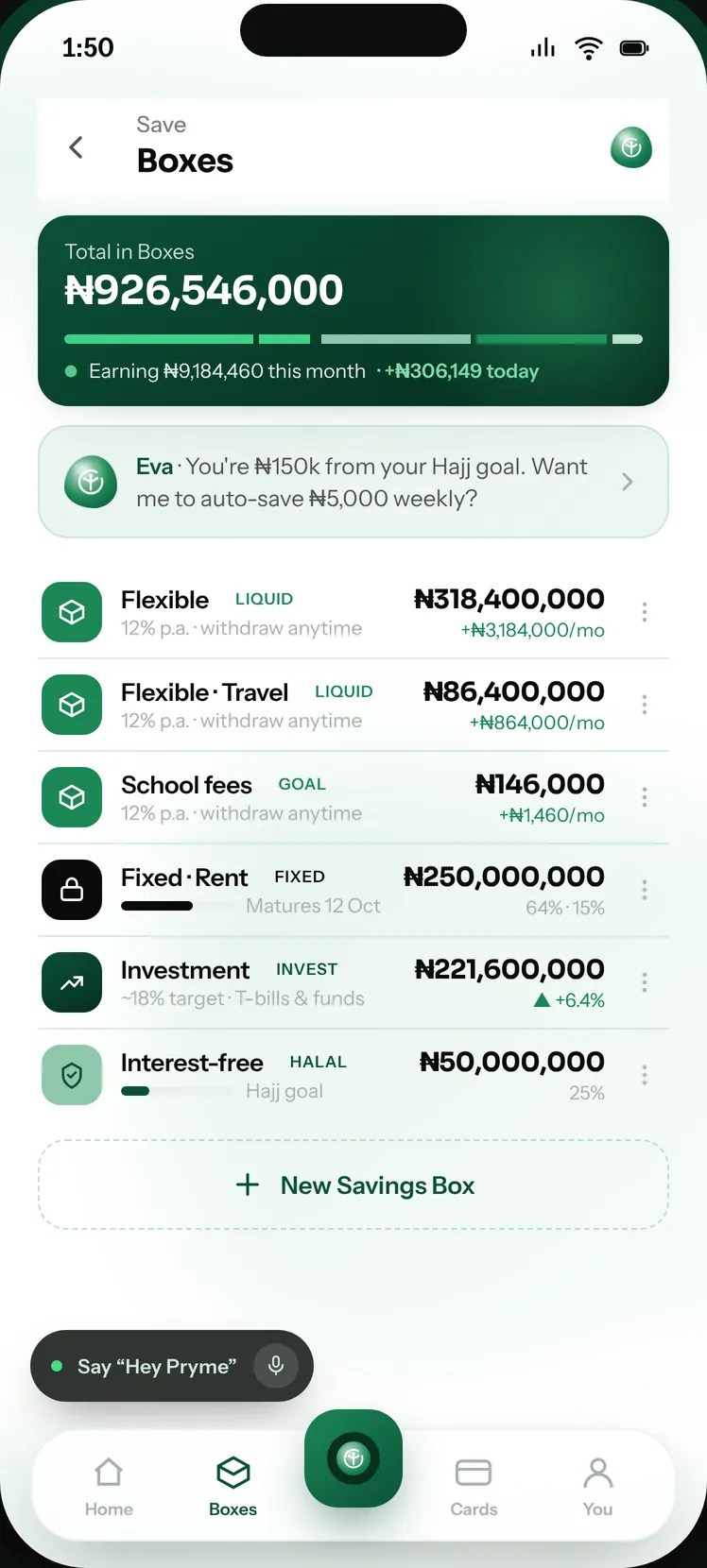
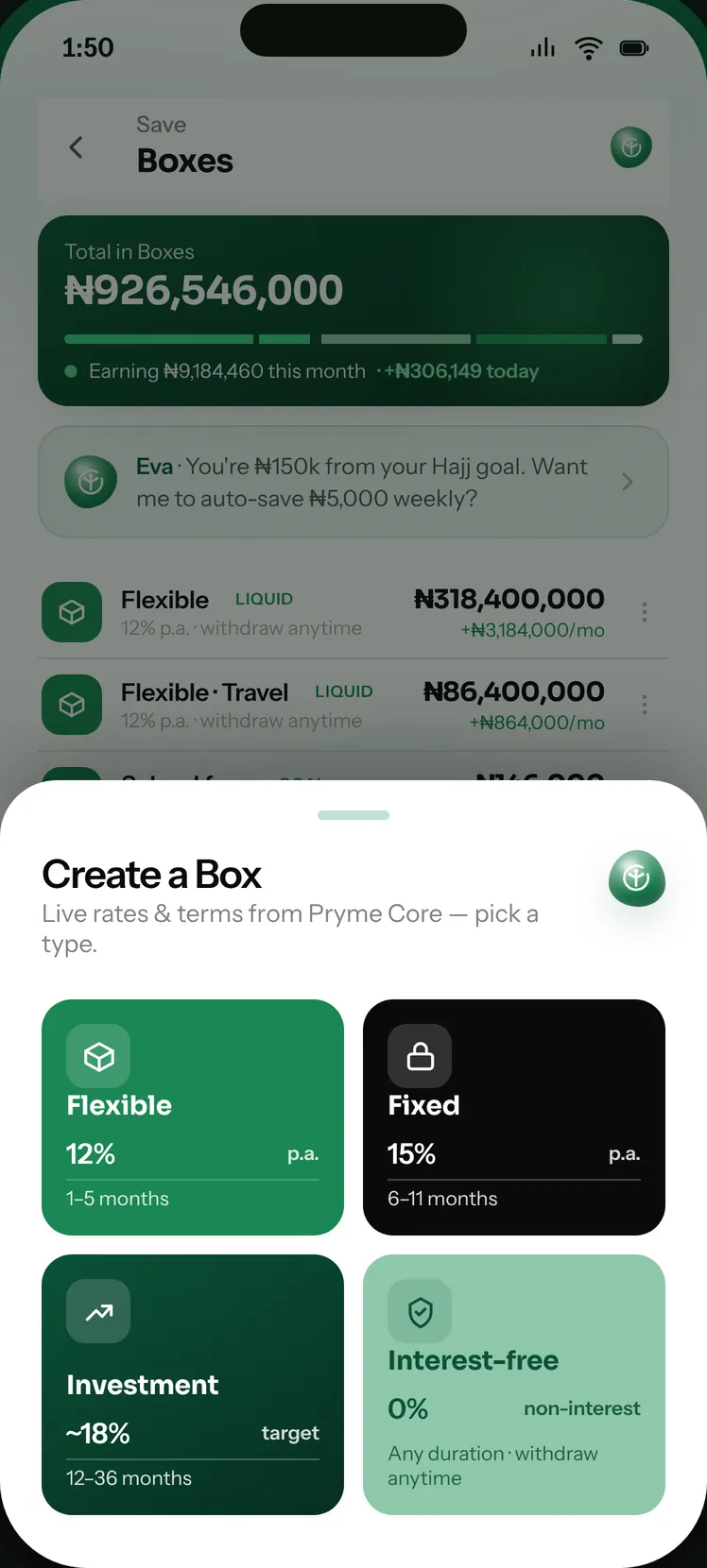
Savings Boxes are separate pots inside a Pryme account, held in Naira. Flexible Boxes can be withdrawn at any time, Fixed Boxes hold to a date, Investment Boxes hold for longer, and Interest-free Boxes earn nothing by design. A business can use them to ring-fence payroll and the tax it withholds, so that money cannot be spent by accident.
Pryme is a financial technology company, not a bank. Accounts and deposits are provided by Solid Allianze Microfinance Bank Limited, which is licensed by the Central Bank of Nigeria and is a member of the Nigeria Deposit Insurance Corporation.
Yes. Pryme Rails lets a platform issue a dedicated Naira account number to each of its own customers, collect into it and reconcile against it, over one API — the same rails the Pryme Business Account runs on.
Pryme is a financial technology company. It gives you one account that holds US dollars, pounds sterling and euros beside Naira, with an assistant that runs the account for you and asks before anything moves. Accounts are provided in Nigeria today, and further markets open as each licence lands.
Accounts are provided in Nigeria today, subject to verification and approval. Foreign-currency balances are held and converted inside that account, so you can hold, receive and swap dollars, pounds and euros wherever you are.
Naira, US dollars, pounds sterling and euros, side by side on one ledger. Each has its own details — a Nigerian account number, a US account number, a UK sort code and an IBAN for the euro area — and each has its own statement.
Swap at a rate you set rather than the rate of the day, then send to any Pryme username or to a Nigerian bank account. There is no fee to send to another Pryme account.
Eva is the assistant inside the Pryme app. She opens accounts, moves money, saves toward your goals, pays what is due and follows up what is owed to you — and asks you before anything moves.
Pryme Rails lets a platform issue a dedicated Naira account number to each of its own customers, collect into it and reconcile against it, over one API — the same rails the Pryme Business Account runs on.
Notes on money that does the work: what we are building, what the regulation actually says, and how we think about letting software act on money. Read the Ledger
What AI agents can do in bookkeeping, close, collections and compliance today, where a person must stay in charge, and how to judge a product.
How multi-currency business accounts work: local details vs SWIFT, payment rails, the real cost of FX, safeguarding vs deposit protection, and hedging.
How UK, US, Canadian and European firms pay Nigerian suppliers and get paid by Nigerian clients: FX, Form A and M, tax, compliance and payout routes.
What it really costs to send money to Nigeria from the UK, US, Canada and Europe: fees, exchange-rate margins, CBN naira rules, BVN, speed and scams.
What AI can and cannot do in day-to-day bookkeeping, how much time it saves on real numbers, and which jobs must stay with you or your accountant.
What we are building, what the regulation actually says, and how we think about letting software act on money.
All of United KingdomStart or run a company · 116 articles
How the £90,000 VAT threshold works for a new business: the rolling 12-month test, the 30-day test, deadlines, effective dates and voluntary registration.
Buying laptops, ovens or machinery for your new company? How the £1m Annual Investment Allowance works, what qualifies and when it is cut.
Since March 2024 a UK registered office must be an appropriate address: no PO boxes, someone to receive post, and proof of delivery.
How to register as a childminder in England: which Ofsted register, the £35 or £103 fee, DBS for household members, good character abroad and costs.
Indefinite leave to remain lifts the work limits of your old visa. What that means for starting a business, and the steps to take.
Programmes for Black-led UK businesses, what they offer, who qualifies and what an application asks for. With dates checked in October 2026.
What UK banks check when a director is on a visa: right to remain, UK residence, ID and address, and the company's documents.
When part of your home becomes liable for business rates, who decides, and how small business rate relief can bring the bill to nothing.
If you own or control a Nigerian company from the UK, CAC must know. Who counts as a PSC, the 7-day and one-month deadlines, and UK companies.
Town union, alumni body or women's group? How a CIO and an unincorporated association differ on liability, staff, premises, bank accounts and registration.
Gift Aid adds 25p to every £1 a UK taxpayer gives. How a Nigerian community charity gets HMRC recognition, collects declarations and claims online.
Strike-off costs £18 but only suits a company that has stopped trading; otherwise it is liquidation. The order of steps before you relocate.
A community interest company suits projects that trade for social good. Fees, the community interest test, the asset lock and the annual report.
Every new UK company director must now verify their identity. The routes open to a Nigerian director, the deadlines and what happens if you skip it.
Missed your accounts deadline? The £150 to £1,500 penalty scale, the doubling rule, why being abroad rarely wins an appeal, and the appeal route.
Every UK company must give Companies House a registered email address. It is not published. What counts, and what to use.
How UK Corporation Tax works. Small firms pay 19% up to £50,000 and 25% over £250,000, with marginal relief between. Examples.
You can register for Corporation Tax when you incorporate, or later through a business tax account. The window, the dates and the first return.
Which kinds of crowdfunding the FCA regulates, the promotion rules for selling shares to backers, and what changes when your community wants equity.
Stopped trading but kept the company? A dormant UK company still files accounts and a confirmation statement. What counts as dormant and what to tell HMRC.
Compulsory from the day you employ someone: at least £5m cover from an authorised insurer, a £2,500-a-day fine without it, and the family exemption.
Hiring a sibling, cousin or child? What HMRC expects on pay, how the right to work check applies to relatives, and the payroll steps that still apply.
Up to £10,500 off employer National Insurance. Who can claim, why a sole-director company usually cannot, and a worked example for two staff.
To post a UK employee to your Nigerian company you need expatriate quota, an STR visa and CERPAC. The sequence, documents and 2025 reforms.
Where UK public contracts are advertised since the Procurement Act 2023: Find a Tender, what is left on Contracts Finder, and the notice thresholds.
What a small UK company costs in year one: Companies House fees, ID checks, a registered office, accounts, insurance and tax.
Inspectors score food handling, the building and your food safety management from 0 to 5. How a Nigerian takeaway prepares for a 5.
Who may give immigration advice in the UK: the regulator formerly called the OISC, the criminal offence, the three levels and the professions exempt.
How Nigerian tech founders use the Global Talent visa: Tech Nation endorsement, the £766 fee, timelines and how it compares.
The Graduate visa lets you be self-employed and work in most jobs, but it cannot be extended. How to trade on it and plan your next visa.
Register as an employer before the first payday, run payroll through RTI, enrol staff into a pension and check right to work. The order, the costs, an example.
Why employers need no sponsor licence to hire Graduate visa holders, how the right to work check works, and when the visa ends: 2 years or 18 months.
How a UK LLP works for Nigerian professionals: two designated members, the £100 fee, a UK registered office, ID checks and tax.
What the UK Innovator Founder visa costs a Nigerian founder as at October 2026: Home Office fee, endorsement, check-in meetings and the extras.
The Innovator Founder visa needs an endorsement that your idea is innovative, viable and scalable. What each test means and the costs.
A UK company stays UK resident, but run from Lagos it can also become a Nigerian company for tax. What changes and how to manage it.
A UK company cannot simply open a Lagos branch: Nigerian law expects a local company. Subsidiary, serviced office and NIPC steps compared.
Profits between £50,000 and £250,000? How Corporation Tax marginal relief works, the 3/200 fraction, a worked example and the traps that shrink the limits.
CAMA sets ₦100,000 for a private company. The ₦100m foreign-participation rule was announced, then paused. What to set and why it matters.
A UK company selling into Nigeria needs a Nigerian trade mark. The agent, power of attorney, search, acceptance, opposition and renewal steps.
Town unions, alumni and cultural groups need a bank account in the group's name. Documents, signatories, online approvals and what to do if refused.
Nigeria may tax fees paid to a UK-resident director; withholding applies and the UK gives credit. How the treaty, WHT and conversion fit.
CAMA sets no general residence rule for directors, but some licences, banks and filings work better with someone on the ground. When it matters.
A Nigerian company with a UK place of business must register within a month on form OS IN01 (£124). Documents, accounts and the subsidiary option.
What an African hair salon costs to open in the UK: premises, fit-out, licences, rates and insurance, with a labelled example budget.
The label goes to a Nigerian company under 10 years old, in digital technology and majority held by Nigerians. What that means for UK-based founders.
Any Nigerian company with a foreign shareholder must register with NIPC: the documents, the ₦150,000 fee, the 48-hour target and renewal.
What it costs to open an African grocery in Manchester: lease, fit-out, first stock, registrations and insurance, with a budget you can adapt.
How salary and dividends are taxed in 2026 to 2027, with a labelled example: Personal Allowance, NI thresholds, the £500 dividend allowance.
Putting your husband or wife on payroll: what HMRC accepts as a fair salary, the tax and NI at common pay levels, and the Employment Allowance angle.
The fee ban, the paperwork before you place anyone, and paying temps when the client pays late: what a new UK agency founder must know.
The £5,000 registration threshold, the CIO option, trustees, and the Charity Commission rules on sending money to projects in Nigeria.
Forming a UK company from Lagos or Abuja is possible. The address, ID checks and banking hurdles a Nigeria-based founder meets, in the order they come.
New to the UK and starting to trade? The £1,000 line, the 5 October deadline, what to keep, and what your visa allows.
How to register a CAC business name while living in the UK: the online portal, current fees, the Nigerian address you need, NIN and annual returns.
A church in England or Wales must register with the Charity Commission once income reaches £5,000, or at any income as a CIO. Structures, documents, steps.
How a Nigerian company sets up a UK subsidiary: incorporation, identity checks for directors, and why the PSC register looks through to the owners.
Rent-to-rent is legal in the UK only with the right consents and licences. The risks: subletting clauses, lender consent, HMO licensing and rent repayment.
Living in the UK does not reduce a Nigerian director's duties. The CAMA filings, deadlines and duties that follow you abroad, and how to keep up.
Planning, business rates, insurance and tax for a braider working from a UK home: what the council looks at and what GOV.UK requires.
SEIS and EIS give UK investors income tax relief on shares in young companies. The limits, advance assurance and the traps for founders with Nigerian ties.
Want a suya or jollof stall in a London market? Each borough licenses its own pitches. How it works, using Lambeth's rules as a worked case.
Business Asset Disposal Relief for founders leaving the UK. The 18% rate from April 2026, the £1 million lifetime limit and the two-year tests.
What the Charity Commission expects when trustees move money to Nigeria: regulated channels, registered firms, cash rules, audit trails, incidents.
You can own and direct a UK company as a Nigerian citizen. Whether you can work for it depends on your visa. The rules, fees and checks in one place.
The Companies House SIC codes that fit importers of Nigerian food, drinks, fabrics and cosmetics, for wholesale, shops and online selling.
On a Skilled Worker visa and want your own business? The 20-hour second-job rule, what counts, and how self-sponsorship works if you want to go further.
Starting a business in the UK? How sole traders and limited companies differ on liability, tax and paperwork, and the visa point to settle first.
Want your UK company to sponsor you or hire from abroad? Who can get a sponsor licence, the fees as at October 2026 and what the Home Office checks.
Food business registration 28 days before opening, alcohol and late-night licences, insurance and rates. What a Nigerian restaurant needs and when.
The licences, notices and insurance an Afrobeats promoter in the UK needs: venue licences, Temporary Event Notices, music licensing and cover.
Lease, fit-out, insurance, business rates and the 2026 rate multipliers: how to budget for opening a barbershop in England, with a worked example.
Can a dependant partner run a business in the UK? What GOV.UK says for Skilled Worker partners, the limits, and the risks to plan for.
How to set up a UK business shipping boxes to Nigeria: company, insurance, export declarations and EORI, Lagos clearing, and pricing per kilo.
The insurance a new UK cleaning business needs, which cover is compulsory, and how to set prices that cover wages, travel, supplies and tax.
The licences an HMO landlord in England needs: mandatory licensing for 5+ tenants, council additional schemes, penalties and rent repayment orders.
Jollof, small chops and party trays from your kitchen? Register with your council at least 28 days before trading, then sort hygiene, tax and insurance.
When a nursing agency in England needs CQC registration and when it is just an employment business: who takes responsibility for the care decides.
When a supported living service in England must register with the CQC: personal care, the separation of care and housing, and what is excluded.
How a self-employed tutor can get an Enhanced DBS check from 2026, which roles qualify, the Update Service, and the safeguarding policies parents expect.
Why a new UK accountancy practice must have an anti-money laundering supervisor before taking clients: HMRC or professional body, and the duties.
Setting up a UK fashion label using Ankara, adire and aso-oke: company set-up, sourcing and paying in naira, and the UK fibre labelling rules.
When a UK agency selling flights to Lagos and Abuja needs an ATOL, the airline ticket agent exemption and its conditions, and when packages change it.
When a Nigerian party in the UK needs a Temporary Event Notice, the 499-person and notice-period limits, and how to give one to the council.
What UK law allows in a company or trading name: same-as and too-like names, sensitive words, trade marks, and what must appear on signs and letters.
The steps to incorporate an existing sole trade, how assets move across, incorporation relief, and a worked tax comparison at 2026 to 2027 rates.
New to the UK and no credit file? Why banks run checks on directors, what helps, and how to build a UK credit record quickly.
Declined for a UK business account and suspect Nigeria is the reason? Why providers do it, what you can ask for, and the routes founders take next.
Employers' liability is the cover the law requires once you take on staff. What else an African grocery needs: public, product, stock and more.
How small business rate relief works in England from April 2026: the £12,000 and £15,000 lines, second shops, and a worked bill.
A homecare agency in England must register with CQC before it provides personal care. The forms, the registered manager, evidence and annual fees.
A new UK company usually has 21 months from incorporation to file its first accounts. How the date is set, the penalty table and appeals.
Most small UK companies are exempt: from April 2025 meet two of turnover up to £15m, assets up to £7.5m, 50 staff. Who still needs one.
Your UK company's directors live in Nigeria. What providers' own eligibility pages say, why residency matters and the options founders use.
HMRC keeps a UK-incorporated company UK resident; Nigeria's 2025 Act looks at where it is managed. How dual residence arises and what helps.
How to vet a Nigerian company or partner from the UK: the free CAC search, status reports, Tax ID, references and payment records.
When a UK company serving Nigerian clients is taxed in Nigeria: permanent establishment, significant economic presence, withholding tax and the treaty.
Money you take from your company that is not salary, dividends or expenses is a director's loan. How the account works and when tax applies.
A UTR is HMRC's 10-digit tax reference. A new company gets one by post about 15 days after it is set up, longer if you live overseas.
A UK remittance firm to Nigeria needs HMRC money laundering registration and FCA authorisation or registration. What each covers and the order.
Companies House ignores accents, so Ọlá and Ola may clash. The same-as rule, too-like objections, sensitive words and names that imply a government.
Pepper sauce made in Lagos, sold in Leeds? Where you cook, who buys and where the money lands decide whether you register in the UK, Nigeria or both.
An angel in Lagos wants shares in your UK start-up. What their bank needs, what your bank will ask, and the filings that follow the money.
A UK company trading in Nigeria needs a Nigerian company: CAC incorporation, NIPC registration, a business permit and capital import papers.
Yes. A UK company can hold shares in a Nigerian company, but foreign participation brings NIPC registration, PSC disclosure and treaty rules.
Contractor, employee or shareholder: three ways a UK company can pay a co-founder in Nigeria, and the tax and paperwork each one brings.
Co-founding a UK company with someone in Lagos? The clauses that matter most, which law to choose, and how a deal is enforced across two countries.
Structure, trading name, the 14-day cancellation right, VAT and paying suppliers in Lagos: the set-up checklist for a UK online shop.
Start Up Loans lend £500 to £25,000 to new UK businesses. Residence, right to work, credit checks and what visa holders should check before applying.
Once you live in Nigeria, the UK taxes only UK income and Nigeria taxes your worldwide income. How the treaty splits board fees, salary and dividends.
Every UK company files a confirmation statement at least once a year, with 14 days to file. The £50 online fee, what to check and what to fix first.
Every UK company needs a registered office. If you have no UK address you are happy to publish, a service may help. The rules and what to check first.
A Nigerian registration does not protect your brand in the UK. UKIPO fees, classes, timelines and the opposition period, checked October 2026.
When GOV.UK One Login will not work, an Authorised Corporate Service Provider can verify you for Companies House. How it works.
A London address looks good on a website, but it can trigger UK registration and tax questions. What a virtual office can and cannot do.
How a small firm sells to the NHS: NHS Supply Chain frameworks, Find a Tender, the central digital platform and the certificates buyers expect.
You can add the other type later — many of our customers hold both.
The business first, then you. Nothing is submitted until you review it.
Ideal customer profiles
Generated from your website by VerifiedLead.ai
Pick the ones that look right. Your Sales agent works these first, and you can change them at any time after opening.
We ask this because you have not given us a website. It helps us set the right limits from day one.
Which of these represents you?
Officers listed against this company on the UK register.
We have sent a six-digit code to your email address. Enter it below to confirm the address is yours.
Wrong address? Go back and change it — nothing is created until this step passes. We never ask for a code by phone or email; anyone who does is not us.
Last step. Each time you sign in we email you a six-digit code — we never send codes by SMS.