AI agents for business finance: what they can and can't do
What AI agents can do in bookkeeping, close, collections and compliance today, where a person must stay in charge, and how to judge a product.
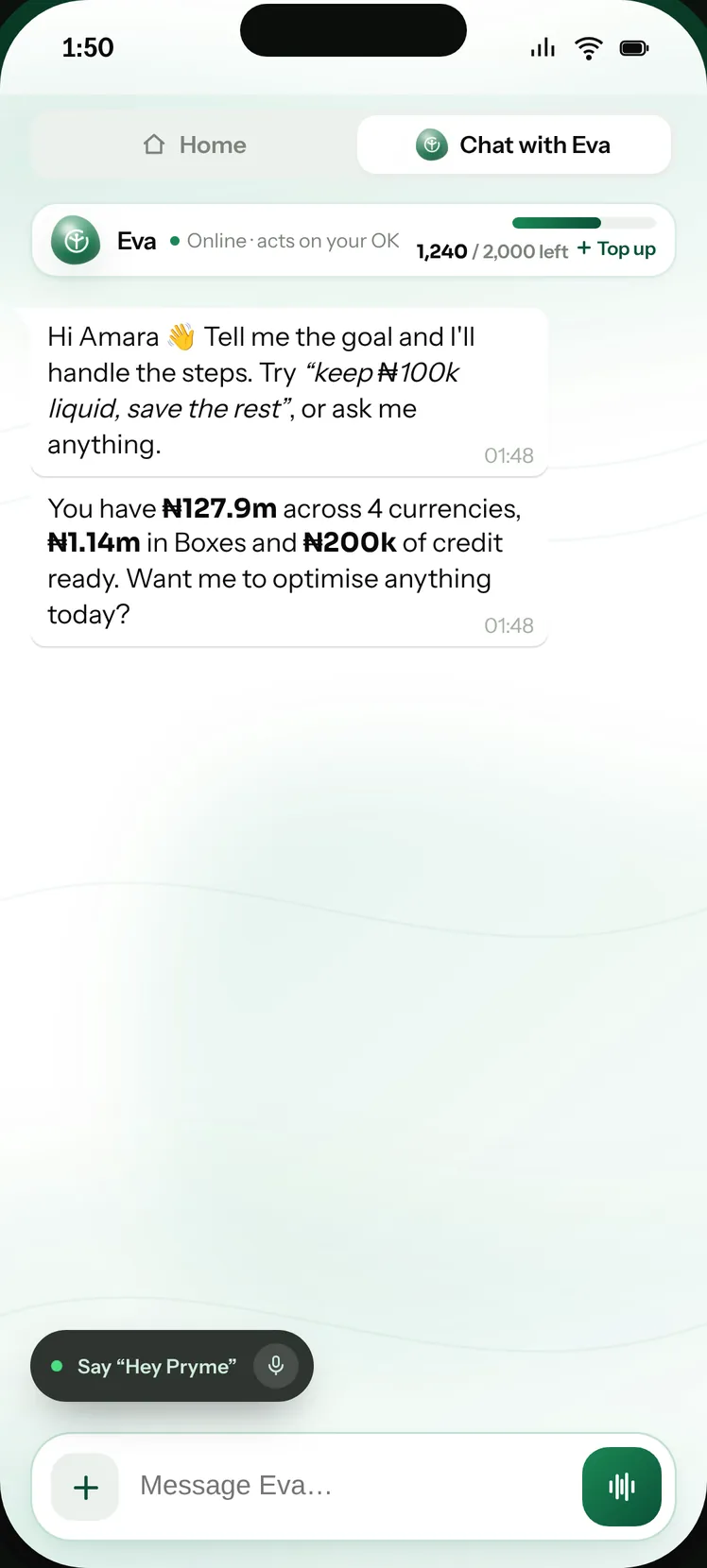
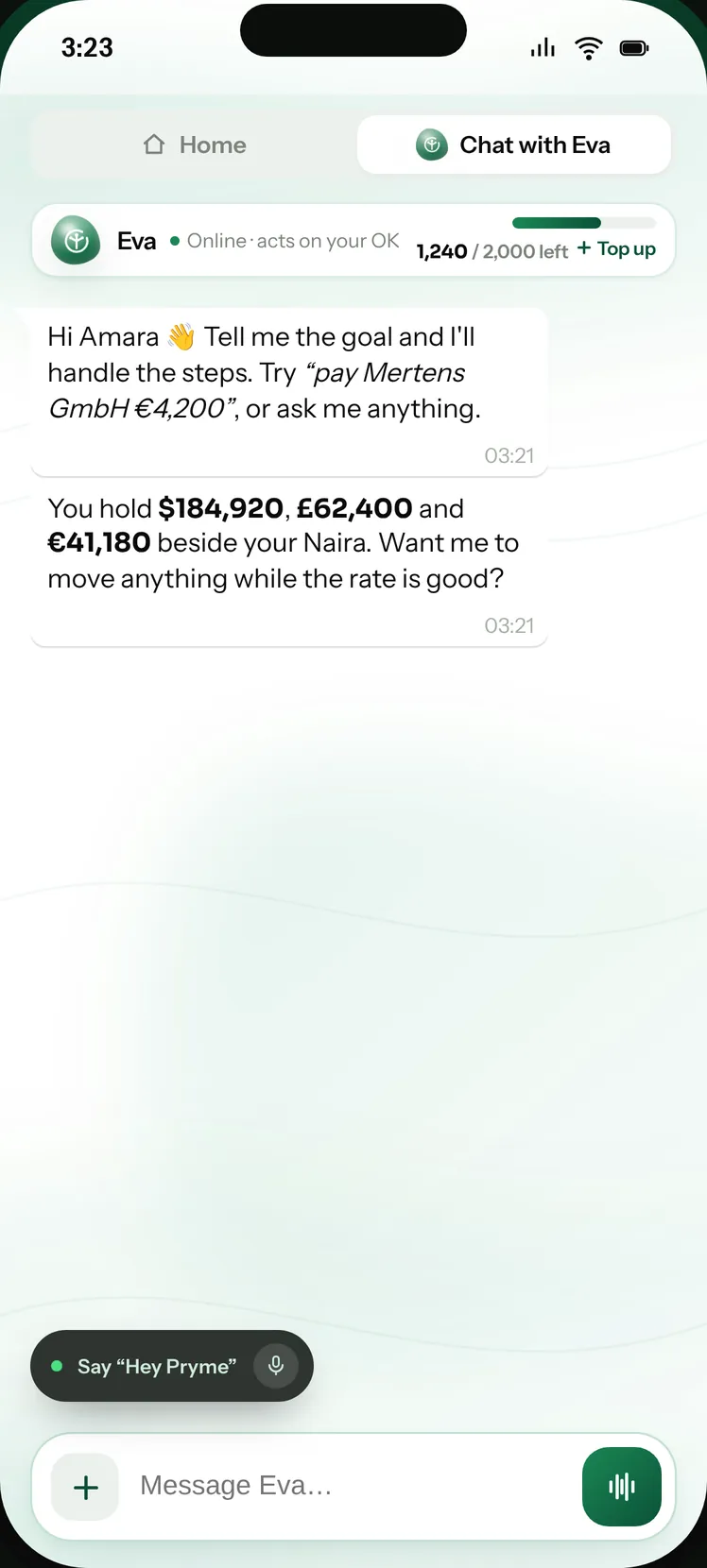
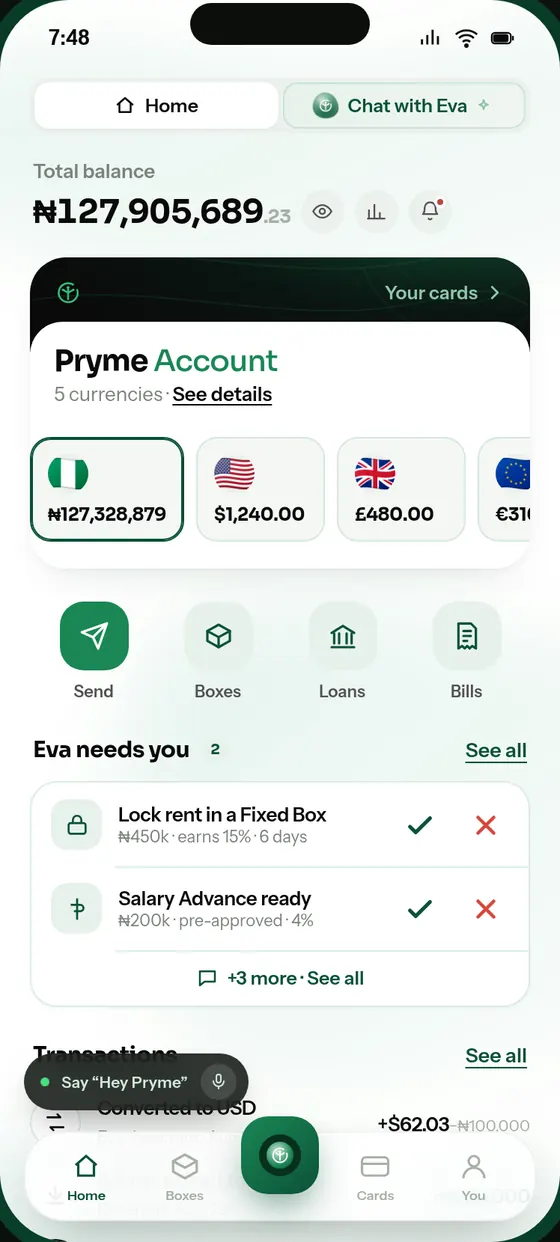
Meet Eva, the assistant inside the Pryme app. She opens accounts, moves money, saves toward your goals and follows up. Nothing leaves your account without your approval.
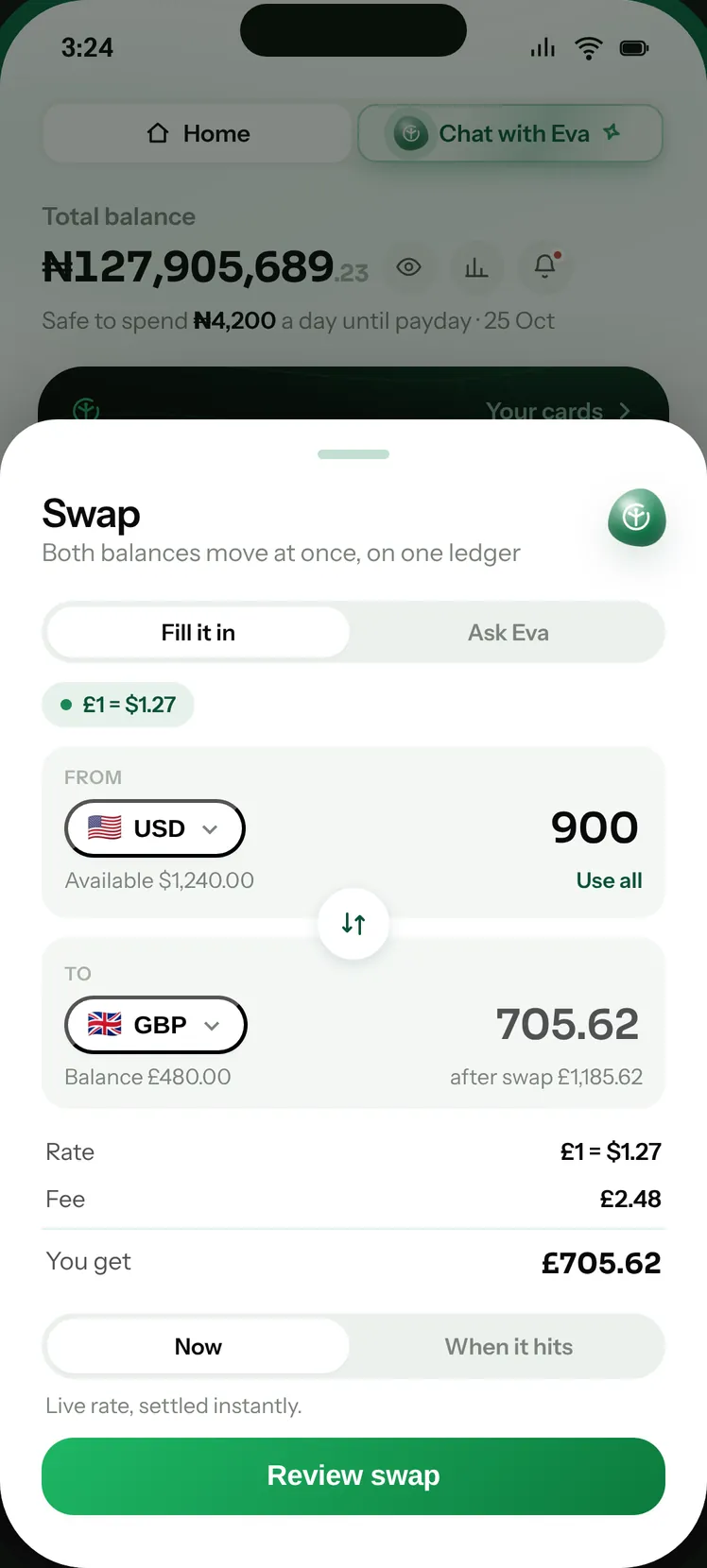
Meet Eva, the assistant inside the Pryme app. She holds dollars, pounds, euros and Naira side by side, swaps at a locked rate, pays bills in any of them and sends anywhere, asking before anything moves.
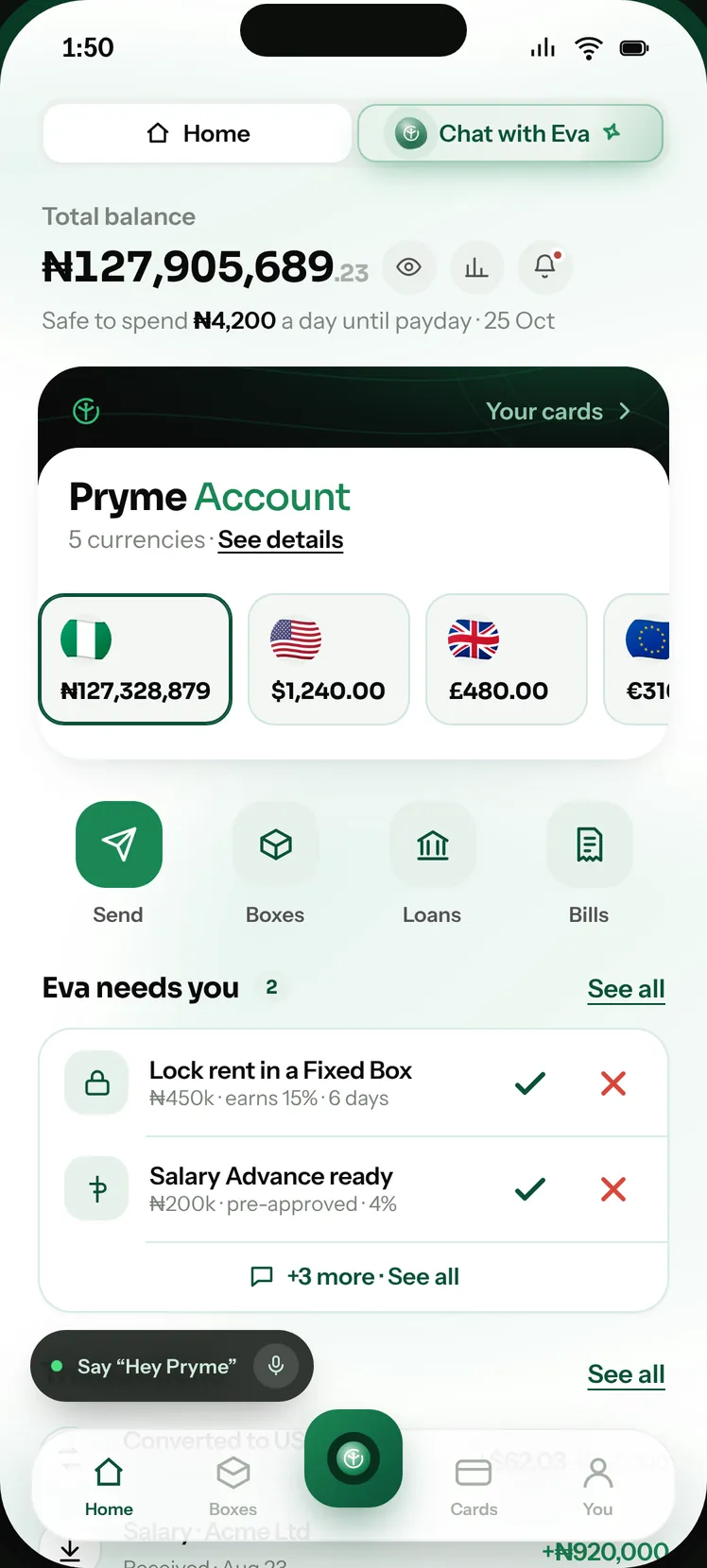
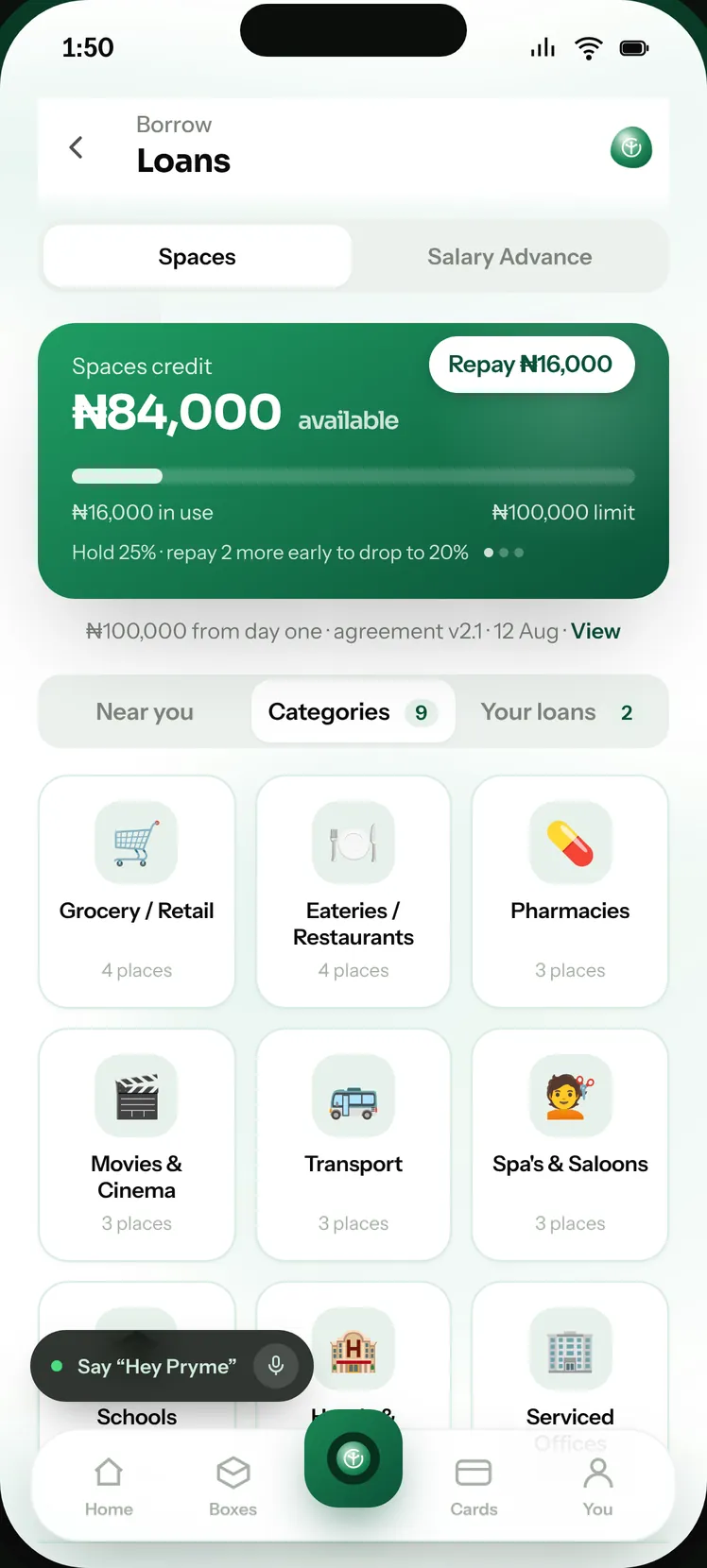
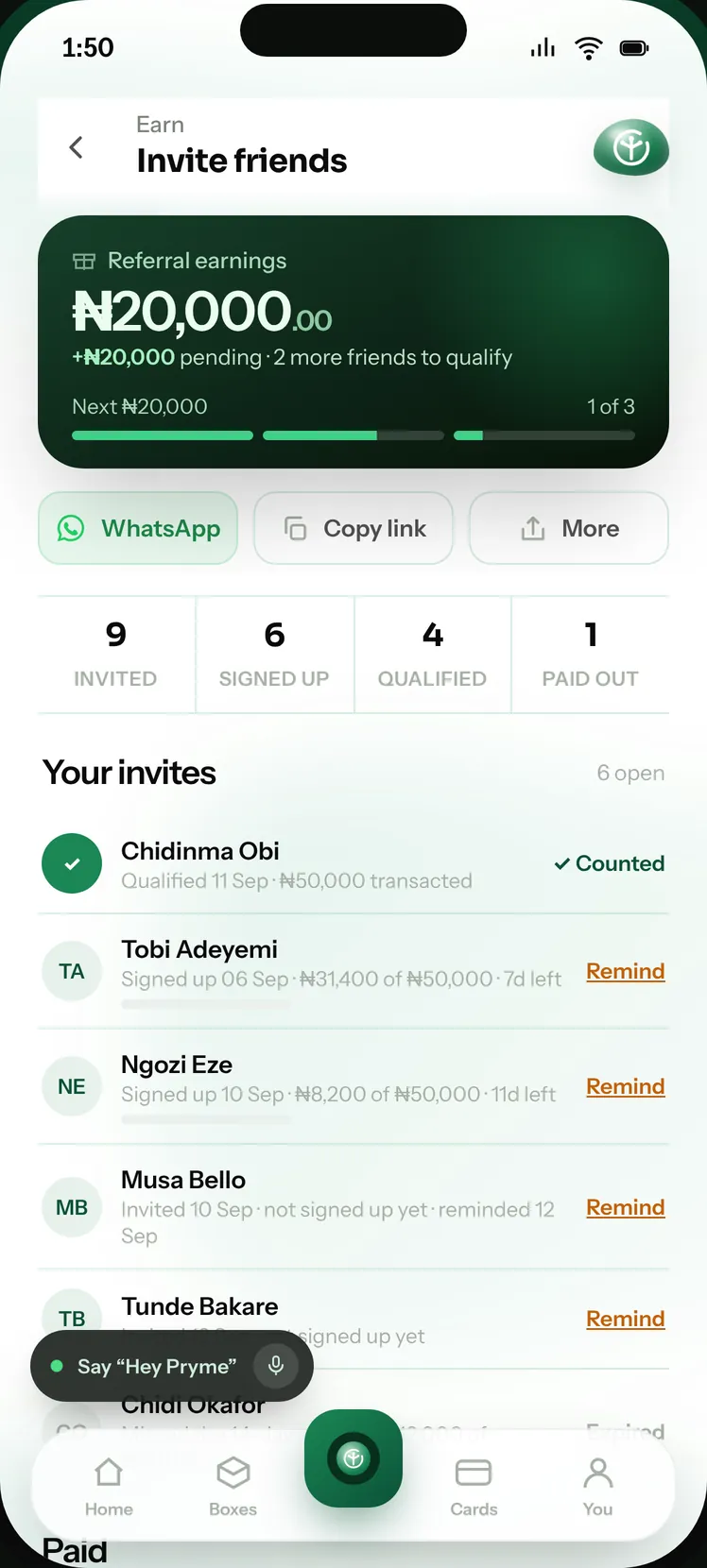
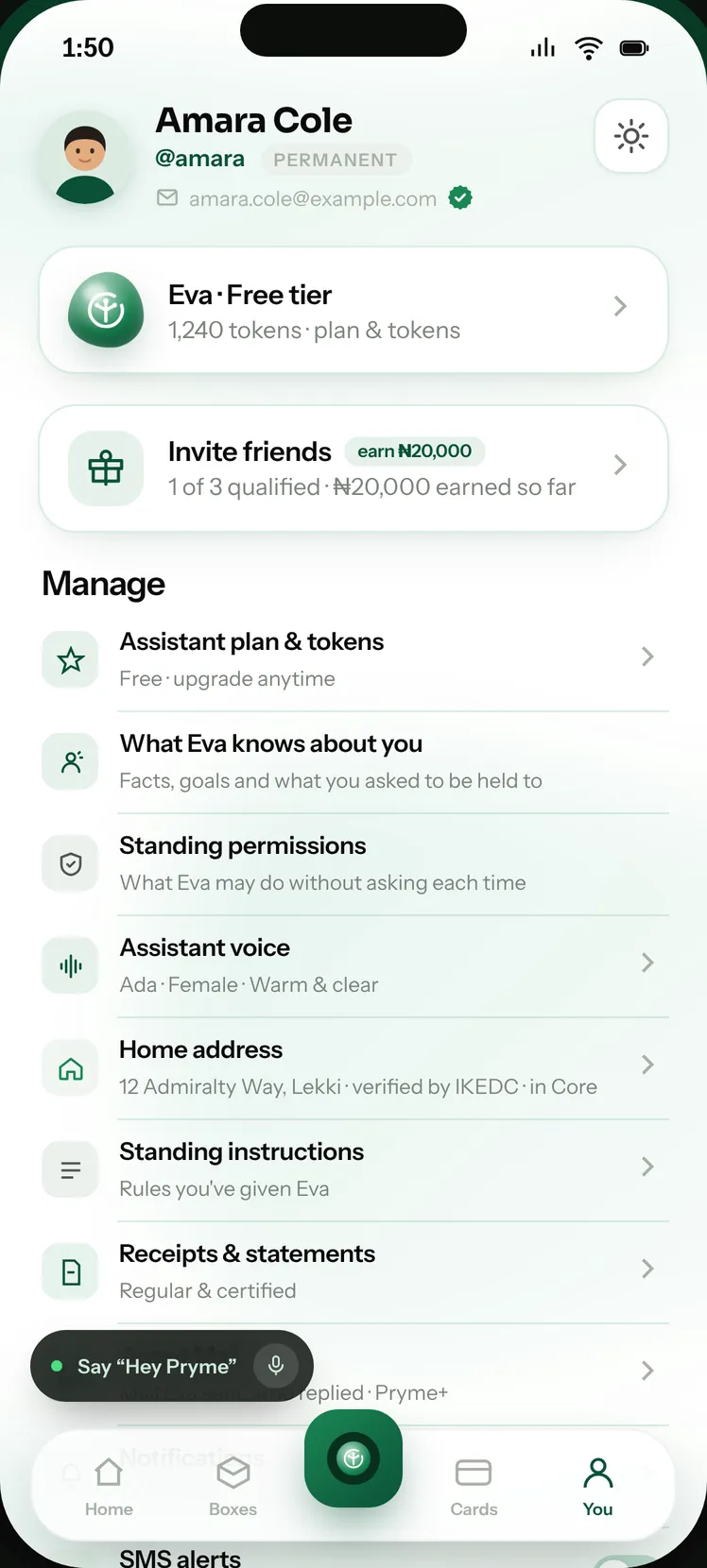
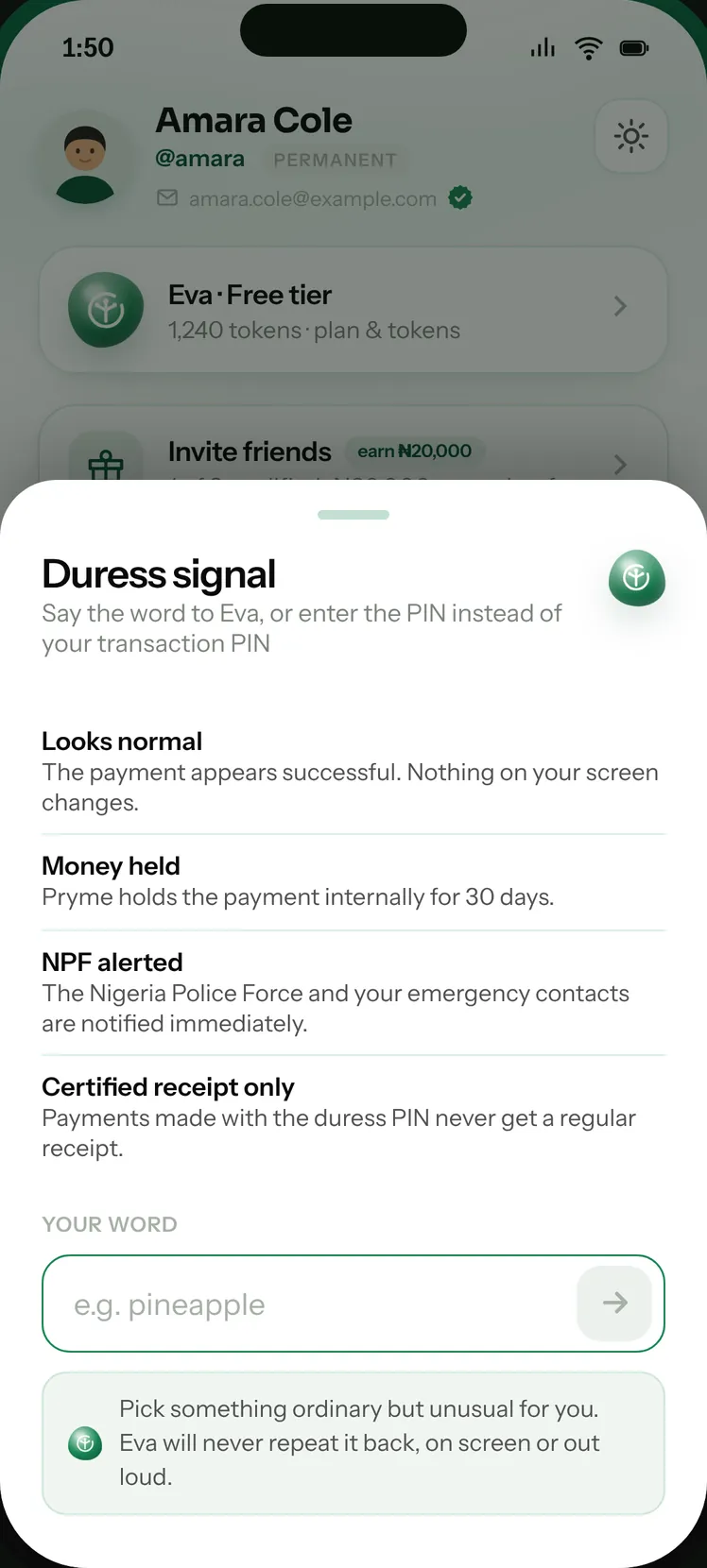
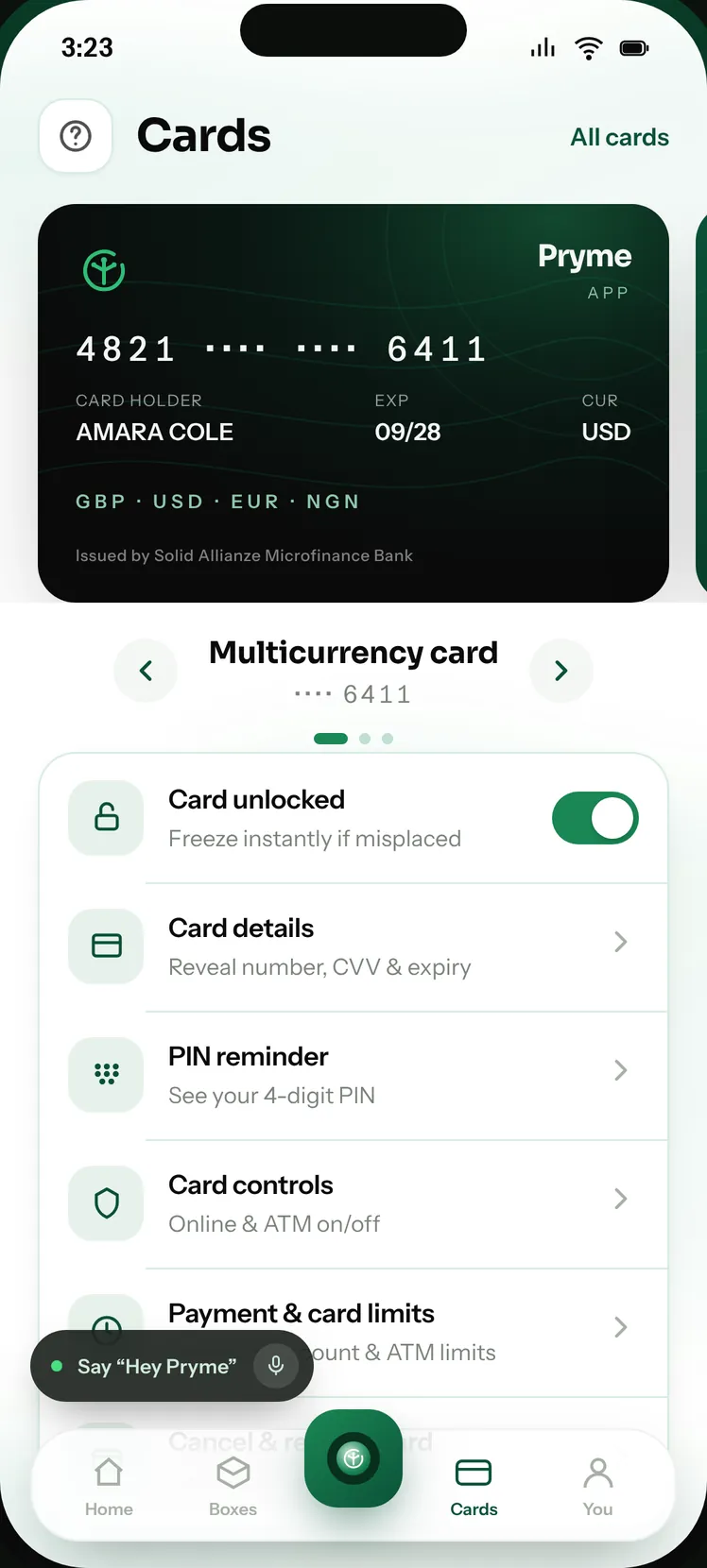
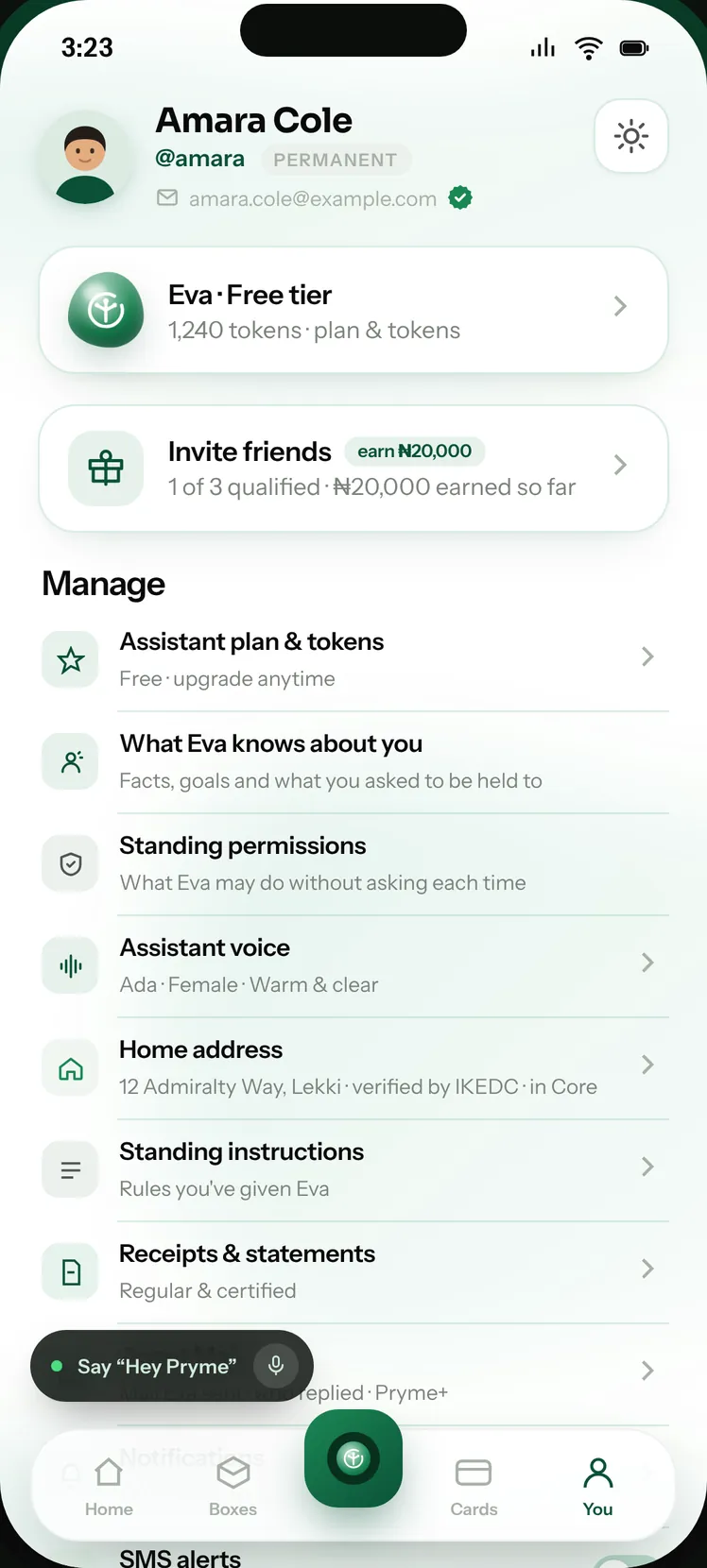
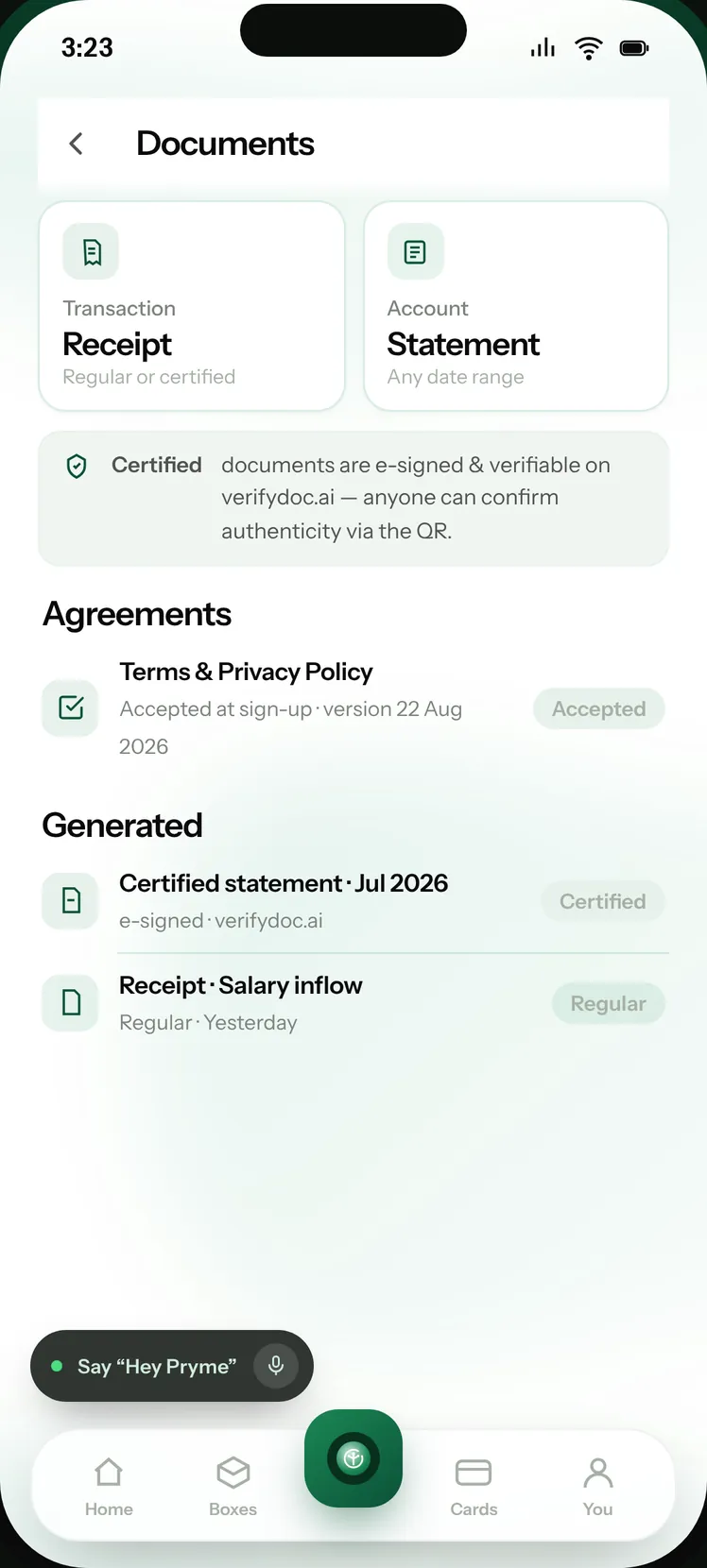
We give you a limit to spend at the shops and services you already use — and an account that works on your month while you get on with it. Dollars, pounds and euros sit beside your Naira, and an assistant handles the running of it, asking you first every single time.
One global account for your money and business. Move across currencies, automate everyday operations and put AI agents to work — with you in control of every important decision.


 Evayour assistant
 DanielChief of Staff
 BenFinance
 BruceCare
Your competitor down the road sells the same thing you sell. The difference is who walks in. We put money in people’s hands that can only be spent in businesses like yours — and then we point them at you.
You are not borrowing. You are selling to somebody who already has the money — and that money can only be spent with a business like yours.
₦100,000 from day one · agreement v2.1 · 12 Aug · View
Eva waits for your rate and asks before she moves anything.
No card, no OTP, nothing for the buyer to type in. They transfer from the bank app they already use, and the money lands in the same account your agents are running — already matched to the order, already in your books.
We give the buyer a one-time account number. They transfer to it from any bank app or by USSD — no card, no OTP, nothing to type in.
Get the account numberTo this account, from any bank app. We watch it, and the page updates itself.
₦26,767.50 from GTBank · John D., matched to order ORD‑1042.
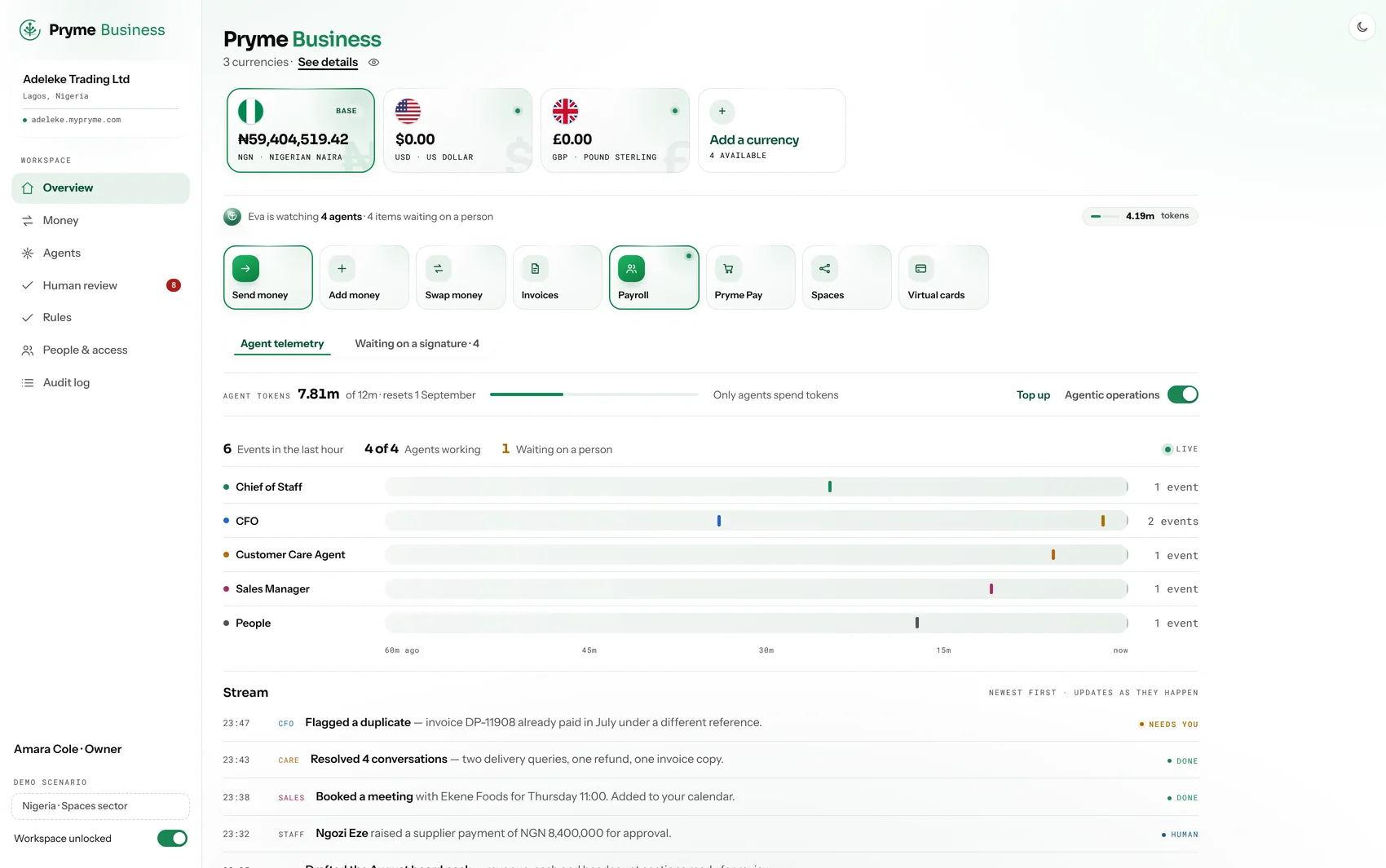
Five agents come with the account. Each one has a job description, a budget and a ceiling you set. They do the work and bring it to you — nothing leaves the account without your signature.
Knows what is stuck, who is waiting and what you promised — and keeps all three moving.
Booked a meeting with John Doe Foods for Thursday 11:00.Keeps the books as you trade and tells you the moment something does not add up.
Flagged a duplicate — invoice DP‑11908 was already paid in July.Holds every filing to its own clock and screens names and payments against your policy — and logs what it refuses.
Screened 412 payments overnight and refused two of them.Goes back to the buyers who went quiet, with the receipt already attached.
Recovered ₦410,000 across three overdue invoices.Replies, follows up on what they asked for and hands you only the ones that need you.
Resolved 4 conversations — two deliveries, one refund.Issue a dedicated Naira account number to each of your own customers, collect into it and reconcile against it. The same rails the Business Account runs on, with the licence behind them.
Dollars, pounds and euros beside a Naira account, on one ledger and one set of books. Five agents come with it and run the account — nothing leaves without your signature.
Five agents come with the account. Each has a job description, a budget and a ceiling you set. They do the work and bring it to you — they propose, you approve.
Knows what is stuck, who is waiting and what you promised, and keeps all three moving.
Booked the quarterly review with your auditor for Thursday.Keeps the books in every currency you hold and flags the moment something does not add up.
Flagged a duplicate — invoice DP‑11908 was already paid in July.Holds every filing to its own clock and screens names and payments against your policy — and logs what it refuses.
Screened 412 payments overnight and refused two of them.Goes back to the buyers who went quiet, with the invoice and the receipt already attached.
Recovered $12,400 across three overdue invoices.Replies, follows up on what they asked for and hands you only the ones that need you.
Resolved 4 conversations — two deliveries, one refund.The business has changed shape four times and never changed what it was rooted in. Each version was built out of what the last one could not do.
An online grocery store, built out of a faulty tab. Selling the food was the easy part — taking the money for it, and moving it, turned out to be the business.
A prepaid card. The first time the company issued rather than resold, and the first time it carried the obligations that come with holding somebody else’s money.
Solid Allianze acquired — an existing bank with an existing licence. The perimeter stopped being someone else’s to draw.
More than one currency on one balance, and the rebrand to Pryme. A Nigerian business could hold dollars without holding a second institution.
Accounts that do the work rather than only hold value. Five agents on the account, inside a policy you write — which is where the new mark starts.
Pryme is a financial technology company. It gives people and businesses in Nigeria one account that holds Naira alongside dollars, pounds and euros, and a set of agents that do the running of it — keeping the books, chasing what is owed, answering customers and paying bills. Nothing leaves an account without the owner’s approval.
Yes. A Pryme account holds Naira, US dollars, pounds sterling and euros side by side on one ledger, each with its own account details — a Nigerian account number, a US account number, a UK sort code and an IBAN for the euro area. You can swap between them at a rate you set, and every currency has its own statement.
Spaces is available in Nigeria. It gives a shopper money to spend that can only be spent with a participating business. The business is paid into its Naira account whether or not the shopper repays, because Pryme carries the credit. For the business it is free to join, there is nothing monthly, and the customer’s identity is never shown — only a reference and what it is worth.
Five agents come with the account. The Chief of Staff runs the week and keeps what is stuck moving. Finance watches the money and keeps the books as you trade. Compliance keeps the filings on time and screens what moves. Sales chases what you are owed. Customer Support answers your customers and follows up. Each has a job description, a budget and a ceiling you set, and each one proposes rather than acts — nothing leaves the account without your signature.
Pryme Pay takes payments on your own site or on a checkout page you control. The buyer is given a one-time account number and transfers to it from any bank app or by USSD — no card, no OTP, nothing to type in. The money lands in the same account your agents are running, already matched to the order and already in your books.
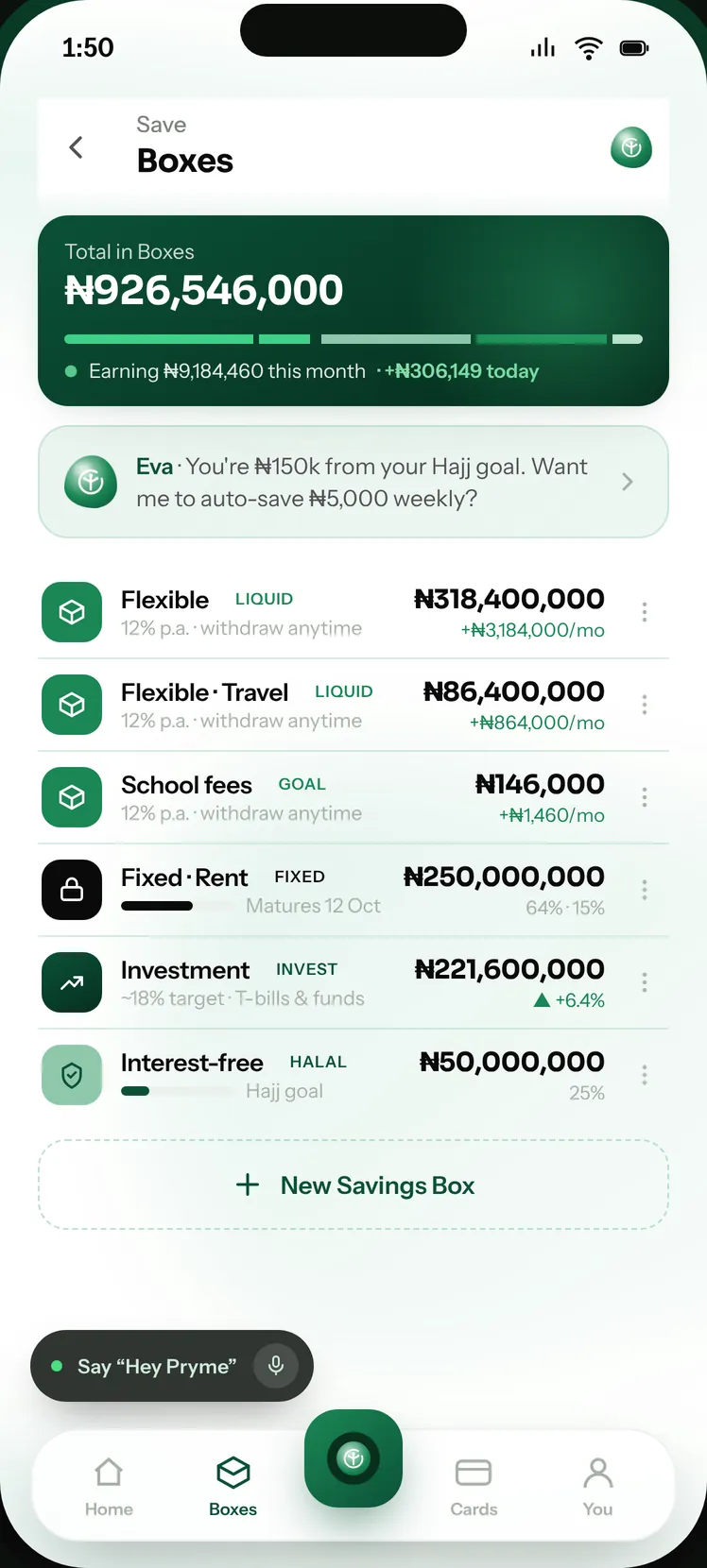
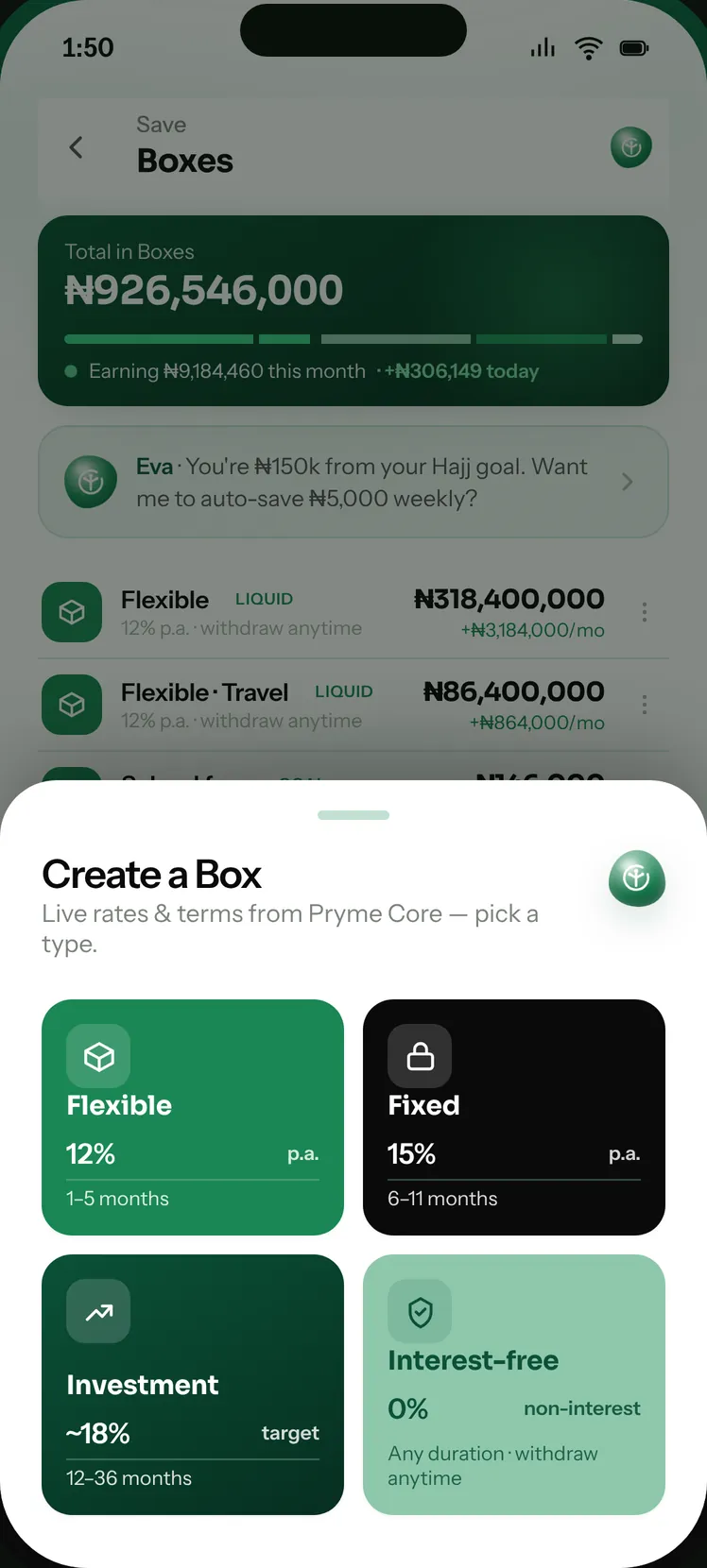
Savings Boxes are separate pots inside a Pryme account, held in Naira. Flexible Boxes can be withdrawn at any time, Fixed Boxes hold to a date, Investment Boxes hold for longer, and Interest-free Boxes earn nothing by design. A business can use them to ring-fence payroll and the tax it withholds, so that money cannot be spent by accident.
Pryme is a financial technology company, not a bank. Accounts and deposits are provided by Solid Allianze Microfinance Bank Limited, which is licensed by the Central Bank of Nigeria and is a member of the Nigeria Deposit Insurance Corporation.
Yes. Pryme Rails lets a platform issue a dedicated Naira account number to each of its own customers, collect into it and reconcile against it, over one API — the same rails the Pryme Business Account runs on.
Pryme is a financial technology company. It gives you one account that holds US dollars, pounds sterling and euros beside Naira, with an assistant that runs the account for you and asks before anything moves. Accounts are provided in Nigeria today, and further markets open as each licence lands.
Accounts are provided in Nigeria today, subject to verification and approval. Foreign-currency balances are held and converted inside that account, so you can hold, receive and swap dollars, pounds and euros wherever you are.
Naira, US dollars, pounds sterling and euros, side by side on one ledger. Each has its own details — a Nigerian account number, a US account number, a UK sort code and an IBAN for the euro area — and each has its own statement.
Swap at a rate you set rather than the rate of the day, then send to any Pryme username or to a Nigerian bank account. There is no fee to send to another Pryme account.
Eva is the assistant inside the Pryme app. She opens accounts, moves money, saves toward your goals, pays what is due and follows up what is owed to you — and asks you before anything moves.
Pryme Rails lets a platform issue a dedicated Naira account number to each of its own customers, collect into it and reconcile against it, over one API — the same rails the Pryme Business Account runs on.
Notes on money that does the work: what we are building, what the regulation actually says, and how we think about letting software act on money. Read the Ledger
What AI agents can do in bookkeeping, close, collections and compliance today, where a person must stay in charge, and how to judge a product.
How multi-currency business accounts work: local details vs SWIFT, payment rails, the real cost of FX, safeguarding vs deposit protection, and hedging.
How UK, US, Canadian and European firms pay Nigerian suppliers and get paid by Nigerian clients: FX, Form A and M, tax, compliance and payout routes.
What it really costs to send money to Nigeria from the UK, US, Canada and Europe: fees, exchange-rate margins, CBN naira rules, BVN, speed and scams.
What AI can and cannot do in day-to-day bookkeeping, how much time it saves on real numbers, and which jobs must stay with you or your accountant.
What we are building, what the regulation actually says, and how we think about letting software act on money.
Follow The Ledger by RSSNew articles as they are published. There is no mailing list yet.
Which admin tasks a Nigerian small business can hand to AI agents, which need a person, and how approval limits and records keep you in control.
The records Nigerian law expects you to keep, a weekly routine that takes under an hour, and a template you can start today in a notebook or sheet.
Business name or private limited company? How liability, tax, CAC filings and credibility differ, and which suits a small Nigerian business.
The new unified Tax ID replaced TINs from January 2026. How businesses and owners get or retrieve theirs, and where it is now asked for.
When companies and business names must file CAC annual returns, what happens if you miss them, and how to catch up before you are struck off.
Why profitable Nigerian businesses still run out of money, how to build a 13-week cash flow forecast, and ten ways to keep more cash in hand.
Deposits, clear terms, fast invoices and a calm follow-up routine: practical ways Nigerian small businesses cut late payment without losing customers.
Contracts, minimum wage, notice, leave, PAYE and pension: the legal and practical steps for a Nigerian small business taking on its first staff.
A practical pricing method for Nigerian small businesses: full cost, margin, competitor checks, inflation reviews and how VAT changes the sums.
A practical walk-through of registering a business name with the Corporate Affairs Commission, what you need, and what to do the week after approval.
The documents, decisions and CAC steps to incorporate a private limited company in Nigeria, plus the duties that start the day you are registered.
Why mixing money hides your profit, how to set up separate accounts, and how to pay yourself a regular amount from a Nigerian small business.
When a Nigerian small business must charge 7.5% VAT, the ₦100 million turnover exemption under the 2025 reforms, and when opting in can make sense.
Who counts as a small company under Nigeria's 2025 tax reforms, what 0% tax really covers, and the records and returns you still owe.
If you trade under a business name or as yourself, your profit is personal income. How it is taxed after the 2025 reforms, with a worked example.
Licence classes, the age-26 rule, NURTW or employer letters, yearly recertification and driver badges: what transport owners should check.
Who can own a community pharmacy, the PCN documents, premises size and distance rules, inspection fees and the renewal deadlines to plan around.
What a PPMV licence is, the shop size and distance rules PCN inspectors use, how it differs from a pharmacy and the steps to apply.
The two NFVCB licences a cinema needs, the published fees by hall size, renewal rules and the practical steps from site to first screening.
Choosing a building, power and internet, membership plans, contracts and pricing for a co-working space or serviced office business in Nigeria.
Registration, premises checks, fire safety, film screening licences and pricing for a new event hall or venue in Nigeria, with a booking checklist.
Hotel licensing, state tourism registration, fire and food safety, staffing, room pricing and occupancy for a new guest house or small hotel in Nigeria.
When a home kitchen needs NAFDAC registration, which documents the agency asks for, the published fees, and how long registration usually takes.
How private school approval works in Nigeria, using Lagos as the example: registration, inspections, provisional approval and what follows after.
The registrations, permits, food safety checks and setup steps for opening a restaurant or eatery in Nigeria, with what to confirm locally.
Registration, choosing a shop, equipment, chair rental versus salaried staff, hygiene and pricing for a new hair salon or barbershop in Nigeria.
Owning versus subletting, landlord and estate consent, registration, furnishing, pricing by night and guest safety for a shortlet business in Nigeria.
Choosing services, registering, fitting out treatment rooms, hiring therapists, hygiene and pricing for a new spa or wellness studio in Nigeria.
Registration, location, stock, suppliers and cash control for a new supermarket or mini-mart in Nigeria, step by step and without guesswork.
Registering a transport company, vehicle papers, commercial plates, driver rules and route planning for buses, taxis or haulage in Nigeria.
The five agents in a Pryme Business Account, the kind of work each prepares, and why a person still approves anything above the ceiling you set.
The details a Nigerian business receipt should carry, what consumer law says about transaction records, and how verifiable receipts reduce disputes.
A counter procedure for Nigerian shops: how staff should confirm a bank transfer has landed before goods leave, and what to do when it has not.
What the FCCPA says about refunds, returns and 'no refund' notices in Nigeria, and a refund process that is fair to customers and safe for you.
How tailors, caterers, event vendors and furniture makers in Nigeria can take deposits fairly, record part-payments and handle cancellations.
A daily close routine for Nigerian shops that take transfers, POS and cash: what to count, what to match, how to record differences and who signs off.
A support process for Nigerian businesses drowning in 'I have paid, confirm' messages: matching, templates, response times and data care.
The details a Nigerian invoice needs under the Nigeria Tax Act 2025, plus the extras that get you paid faster: terms, references and account details.
How Nigerian businesses with two or more branches can collect, control and reconcile money per branch while keeping one clear view at head office.
What the Labour Act says about paying daily, weekly and casual workers in Nigeria, cash versus transfer, deductions, and keeping records that hold up.
A safe process for paying dozens of suppliers in one run: clean supplier records, bank detail checks, approvals, payment advice and reconciliation.
How Nigerian small businesses can set payment approval limits, split preparing from approving, and keep control when the owner is away.
Setting up a petty cash float, vouchers and top-ups that hold up, and how the CBN's 2026 cash withdrawal limits change how much cash you keep.
How Nigerian businesses lose sales when staff give customers personal account numbers, the warning signs, and the controls that stop it.
Common supplier payment terms in Nigeria, from cash on delivery to 30-day credit, how to negotiate better ones, and how to keep your side of the deal.
You can add the other type later — many of our customers hold both.
The business first, then you. Nothing is submitted until you review it.
Ideal customer profiles
Generated from your website by VerifiedLead.ai
Pick the ones that look right. Your Sales agent works these first, and you can change them at any time after opening.
We ask this because you have not given us a website. It helps us set the right limits from day one.
Which of these represents you?
Officers listed against this company on the UK register.
We have sent a six-digit code to your email address. Enter it below to confirm the address is yours.
Wrong address? Go back and change it — nothing is created until this step passes. We never ask for a code by phone or email; anyone who does is not us.
Last step. Each time you sign in we email you a six-digit code — we never send codes by SMS.