AI agents for business finance: what they can and can't do
What AI agents can do in bookkeeping, close, collections and compliance today, where a person must stay in charge, and how to judge a product.
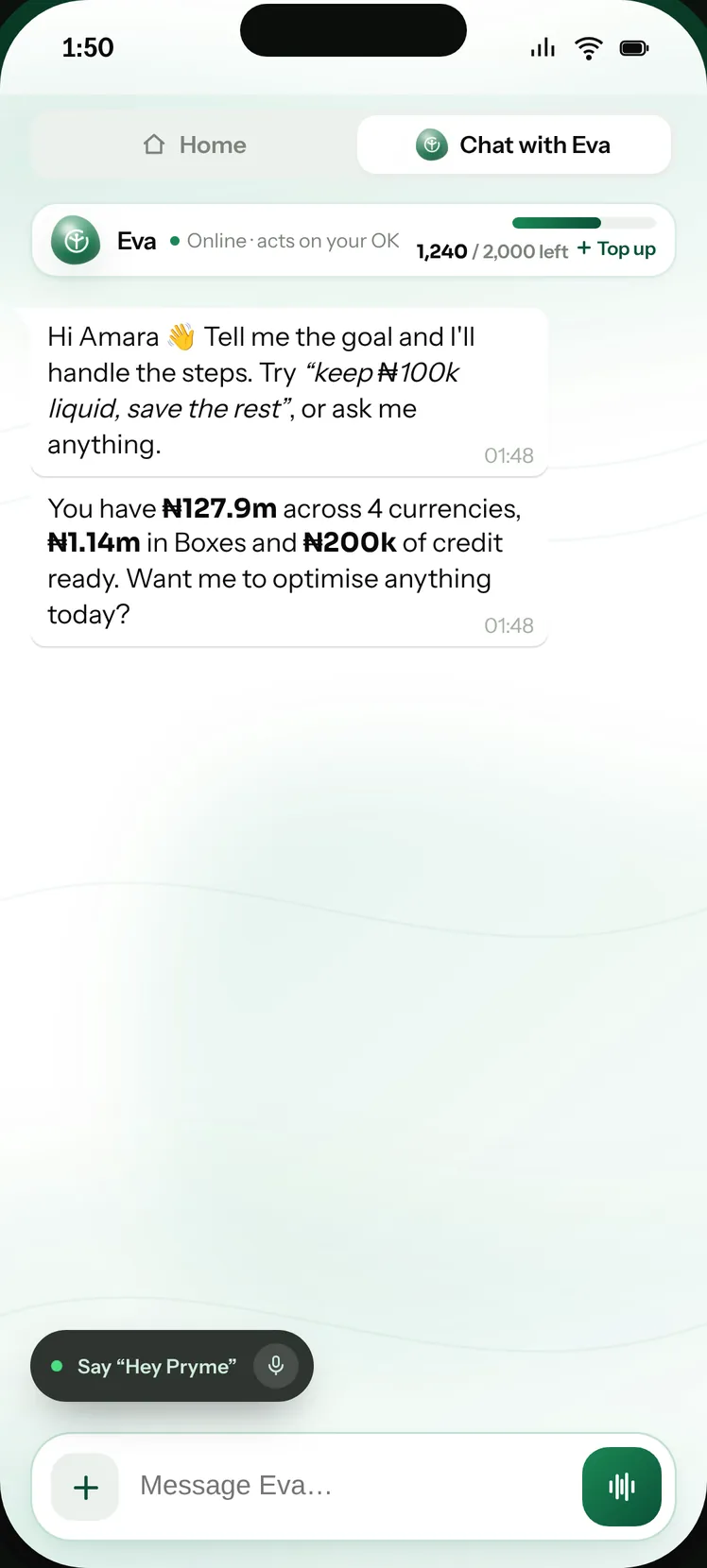
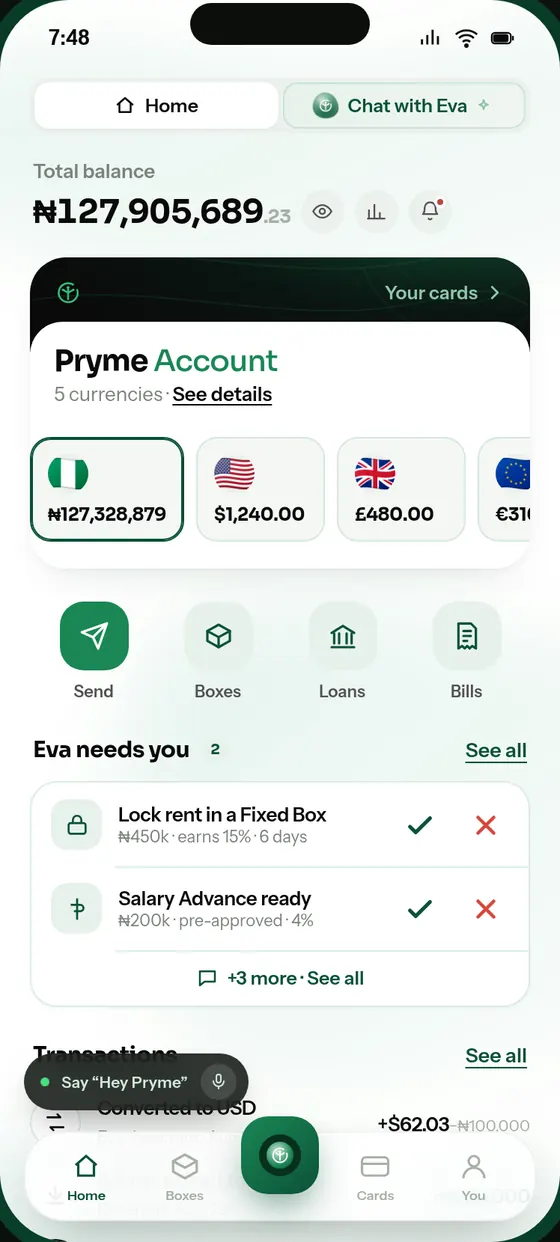
Meet Eva, the assistant inside the Pryme app. She opens accounts, moves money, saves toward your goals and follows up. Nothing leaves your account without your approval.
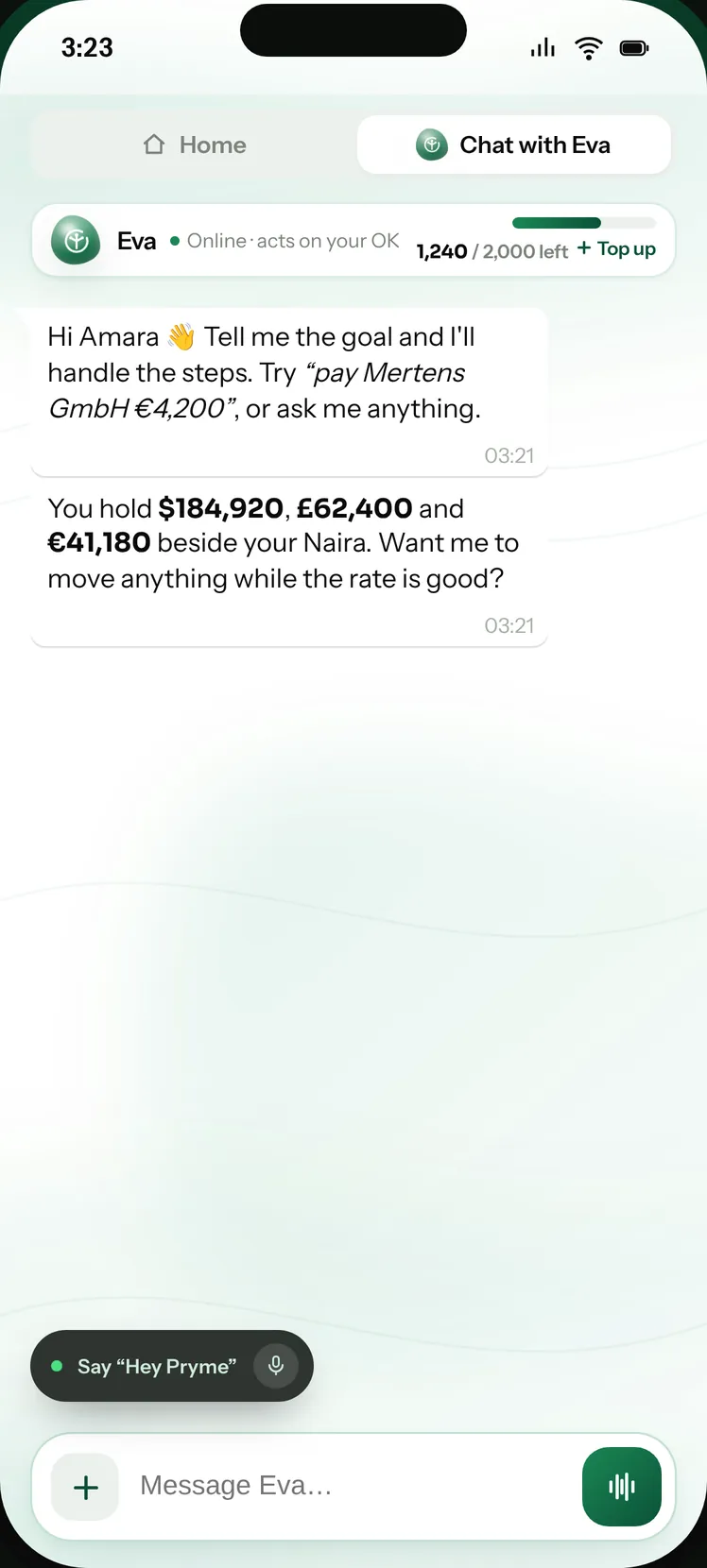
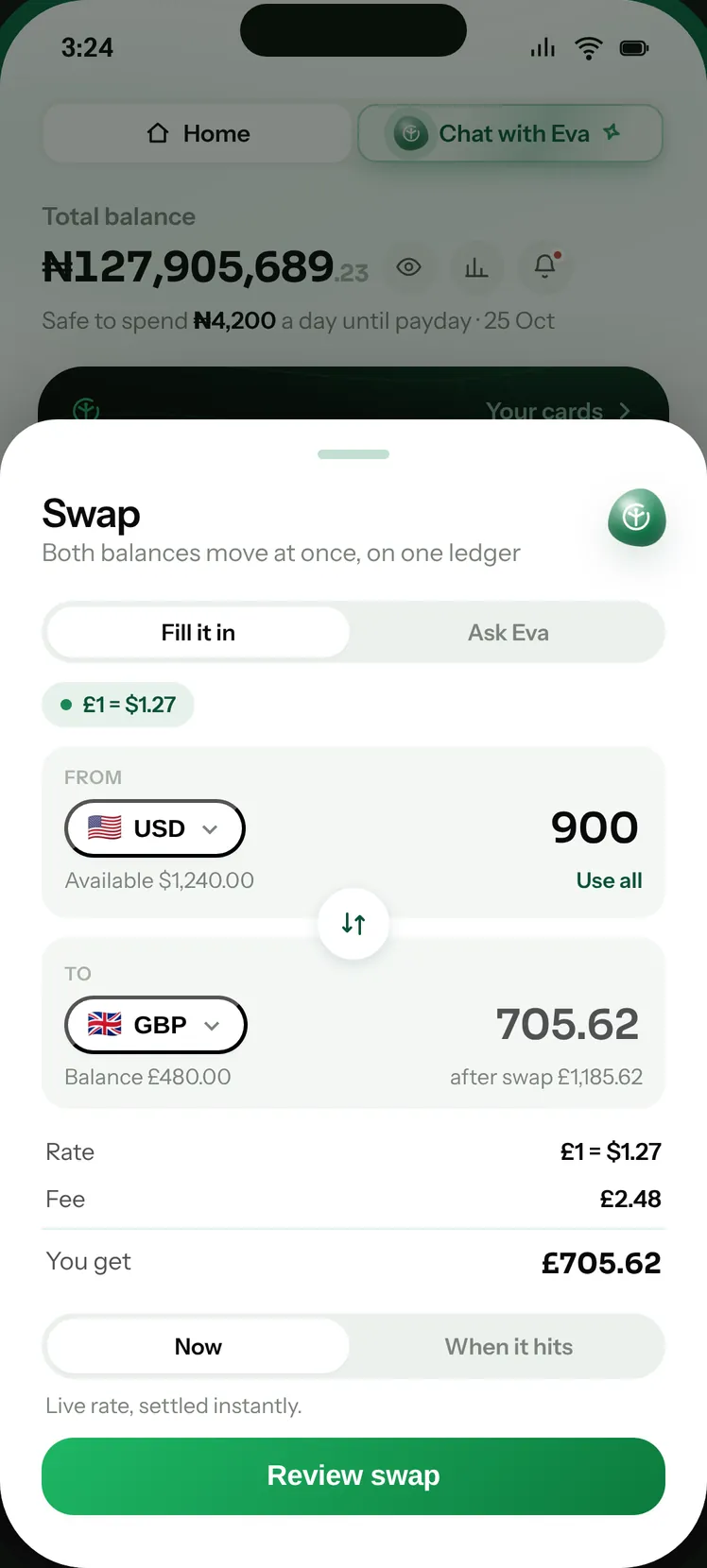
Meet Eva, the assistant inside the Pryme app. She holds dollars, pounds, euros and Naira side by side, swaps at a locked rate, pays bills in any of them and sends anywhere, asking before anything moves.
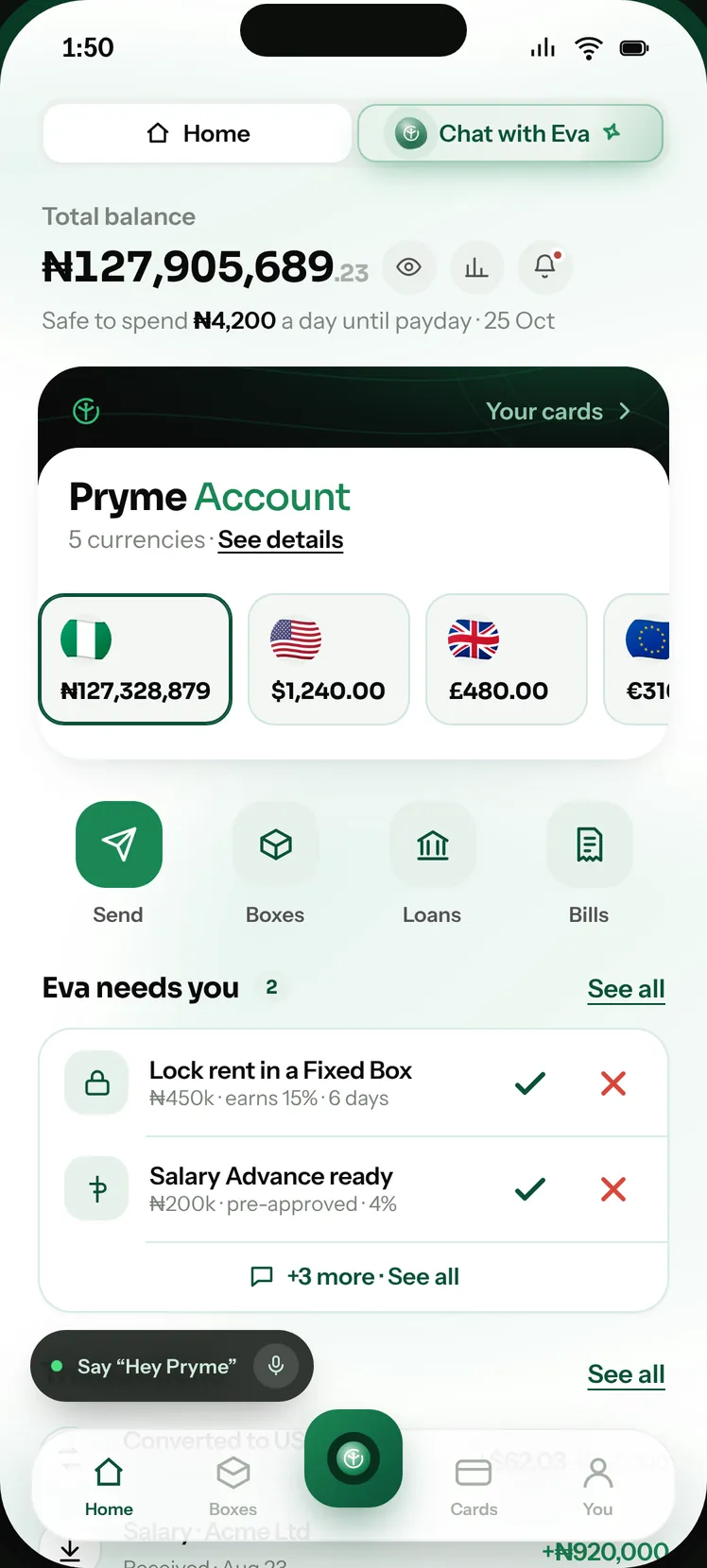
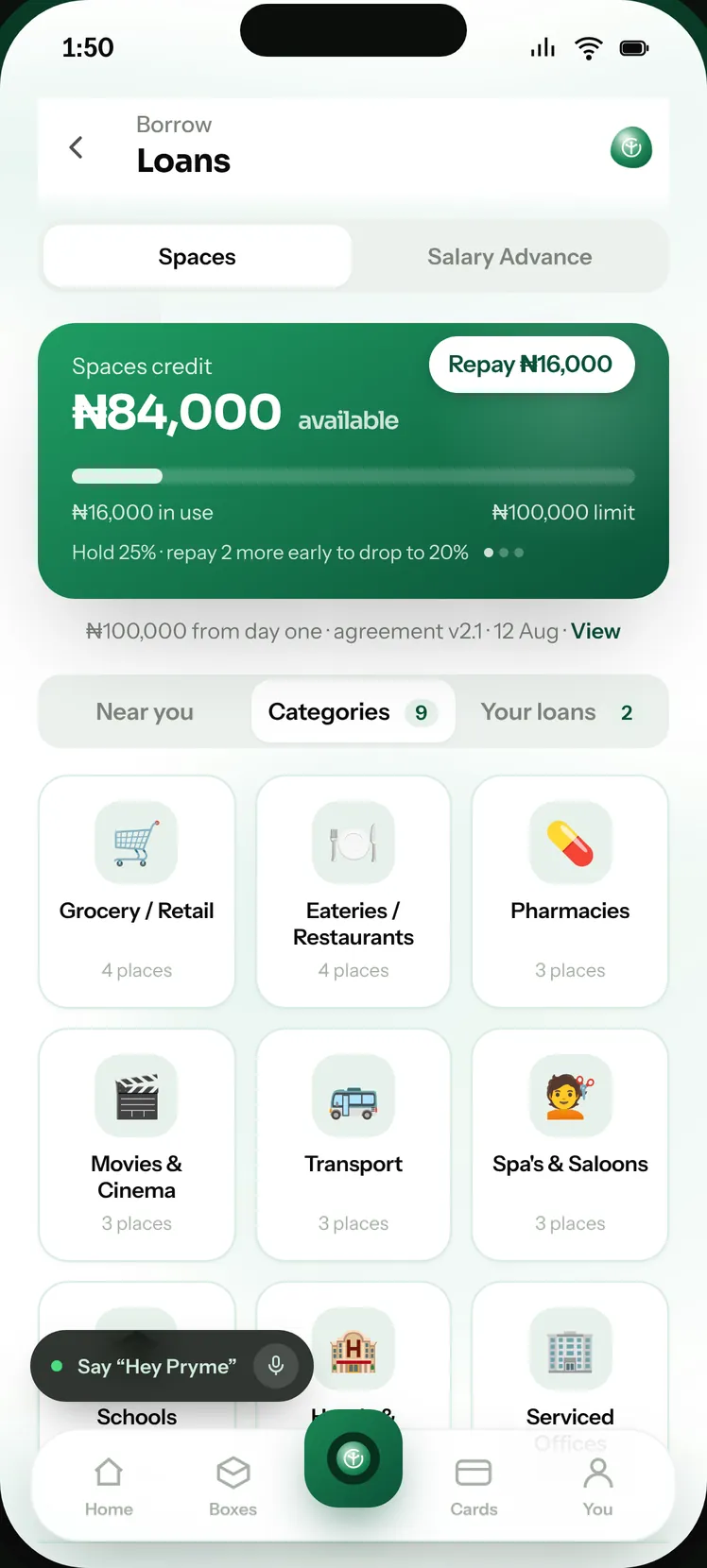
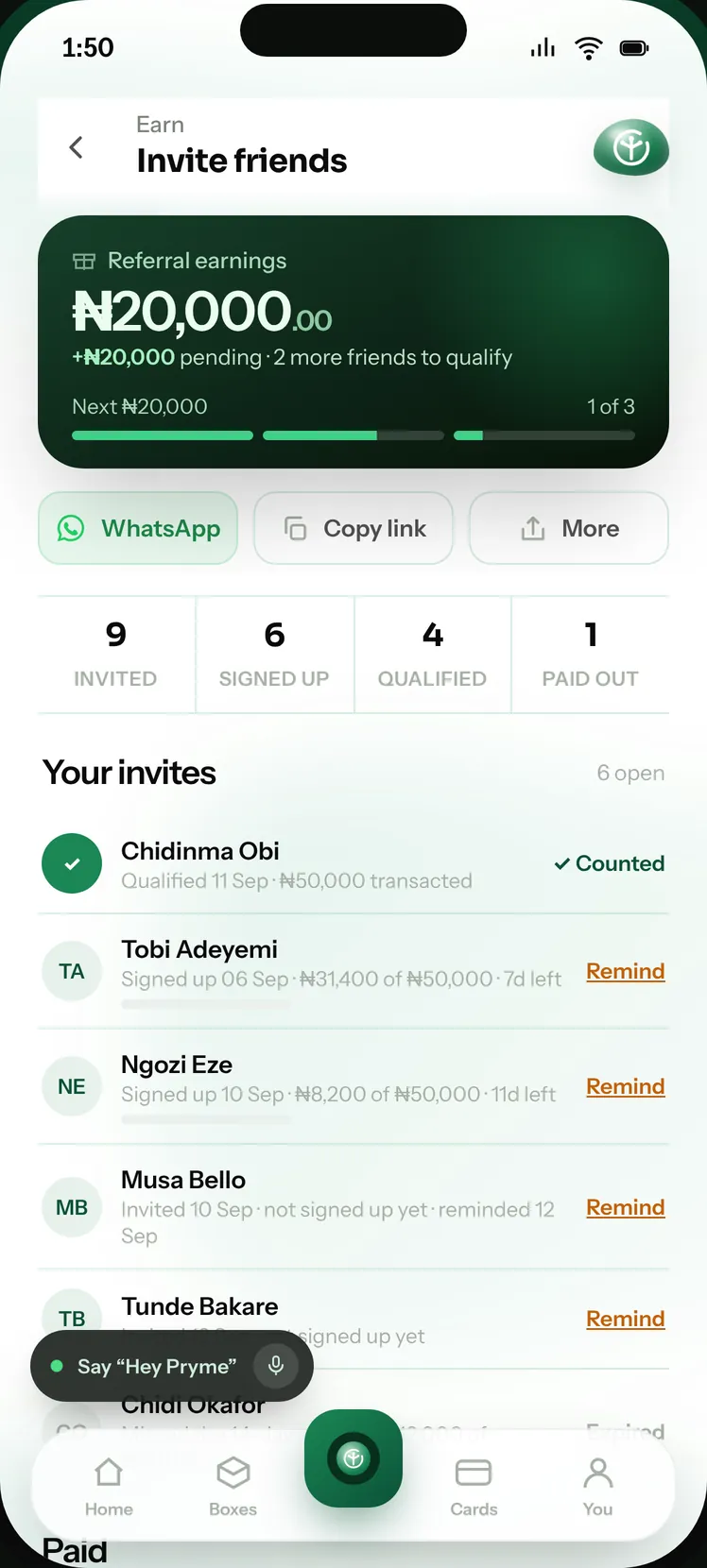
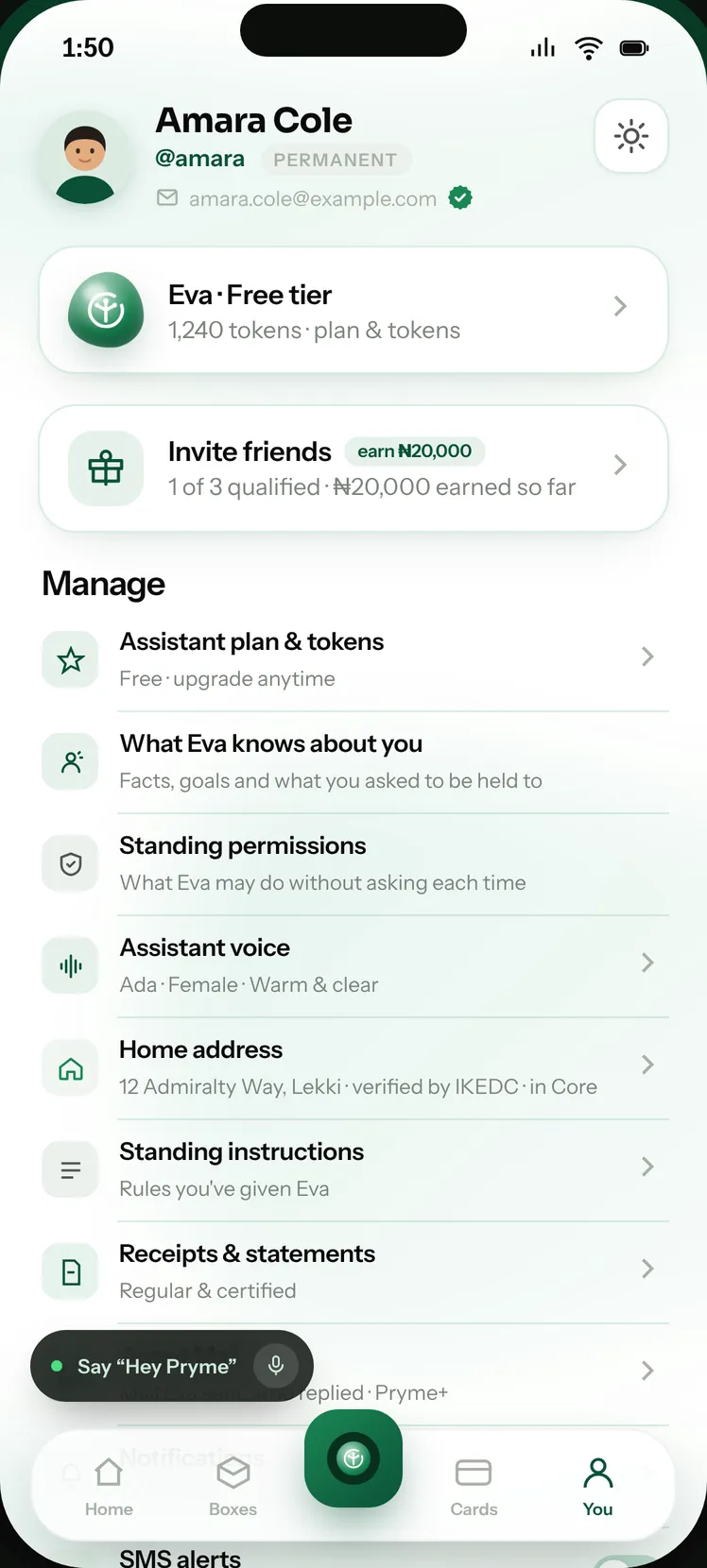
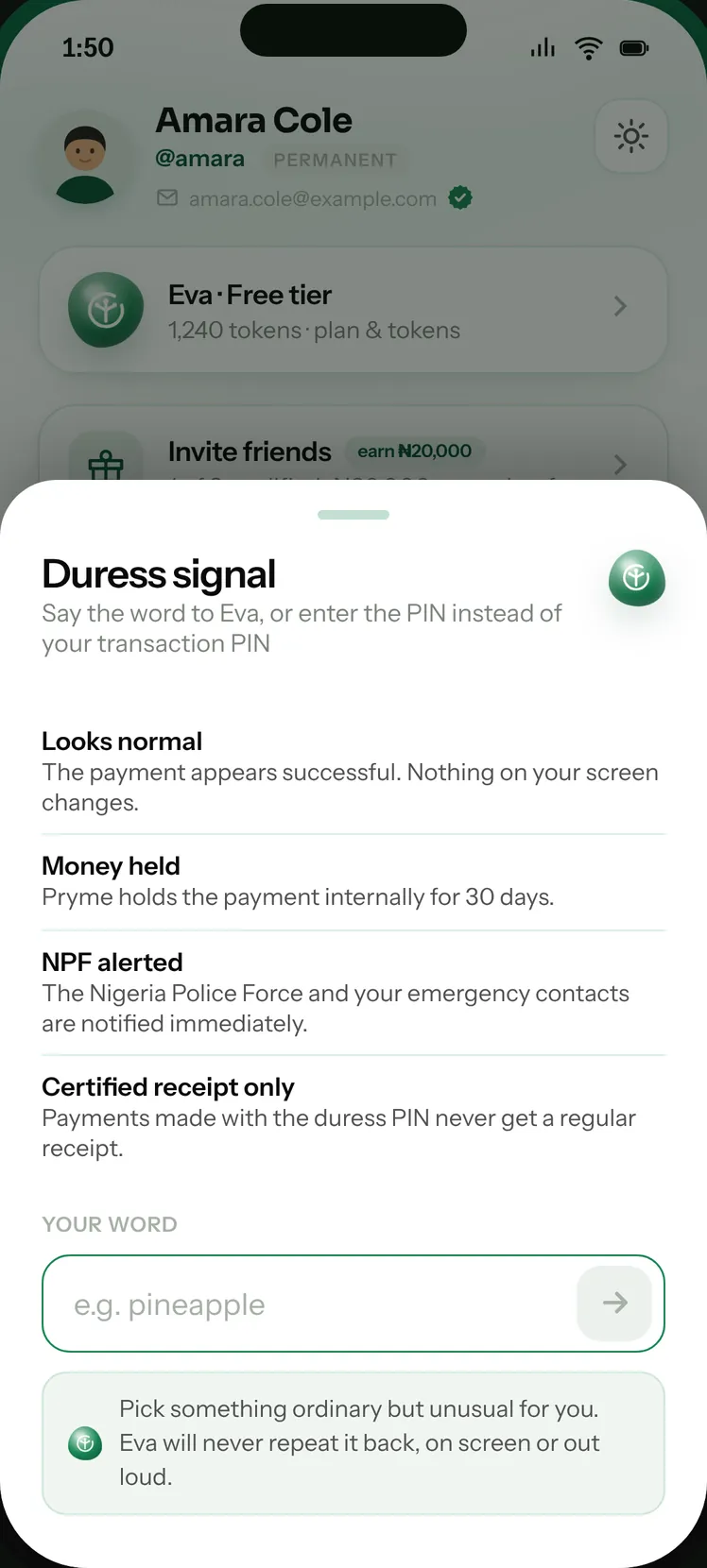
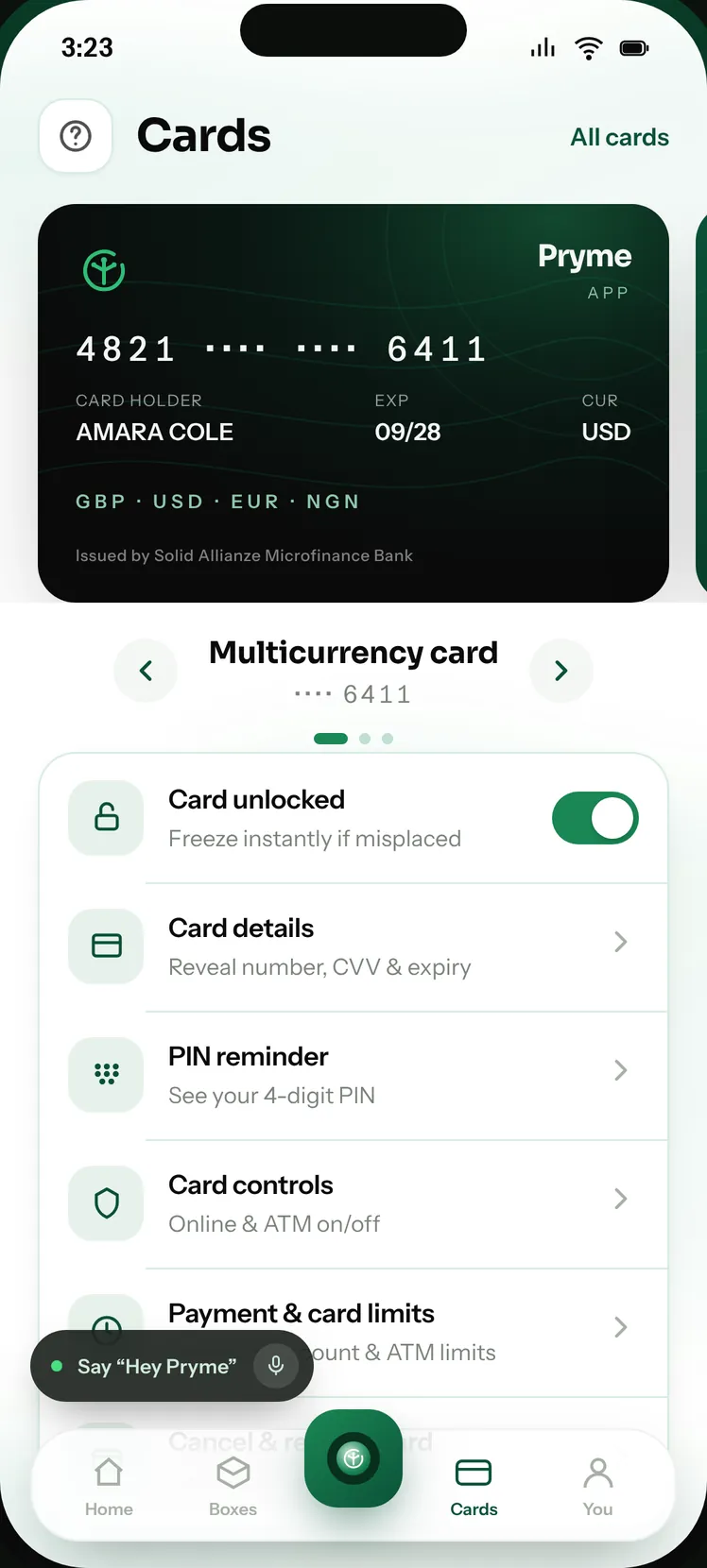
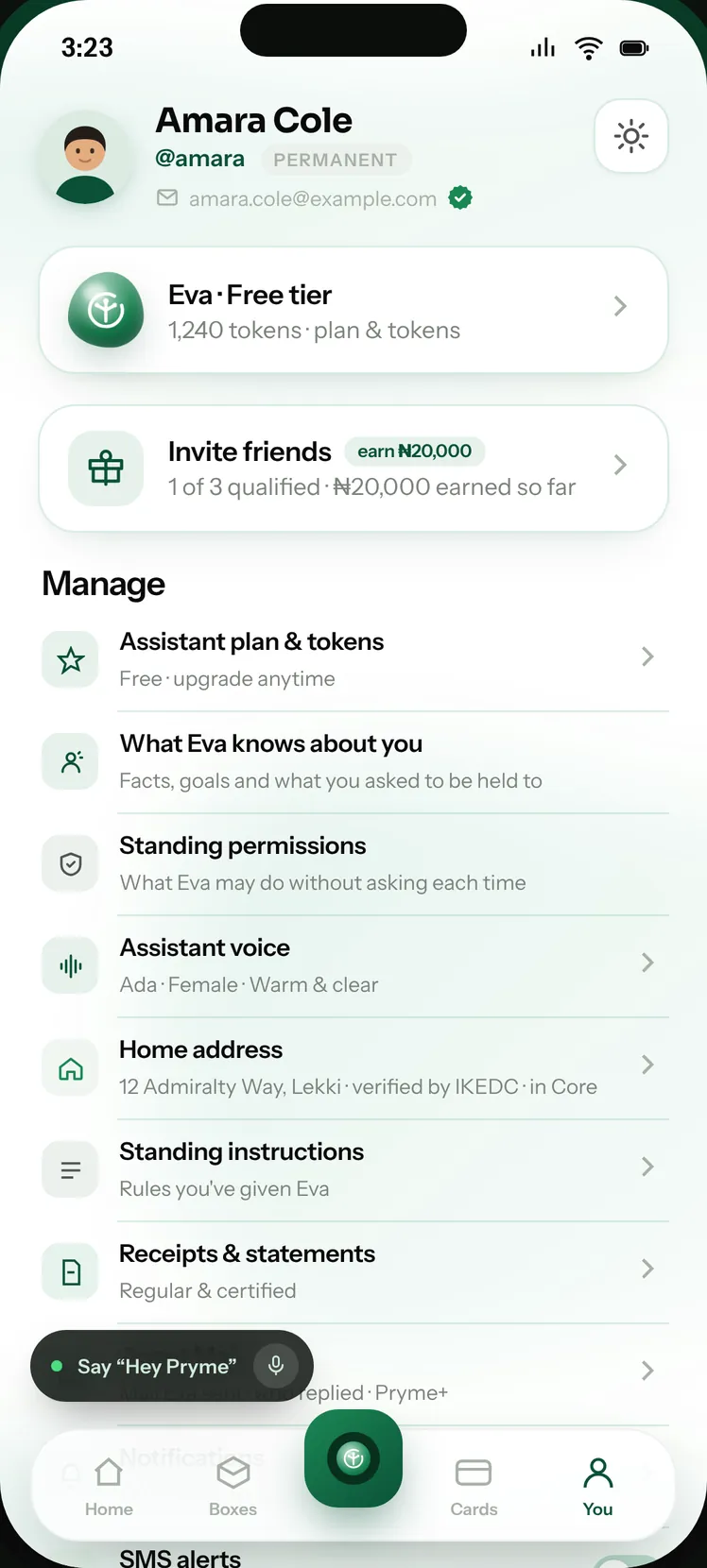
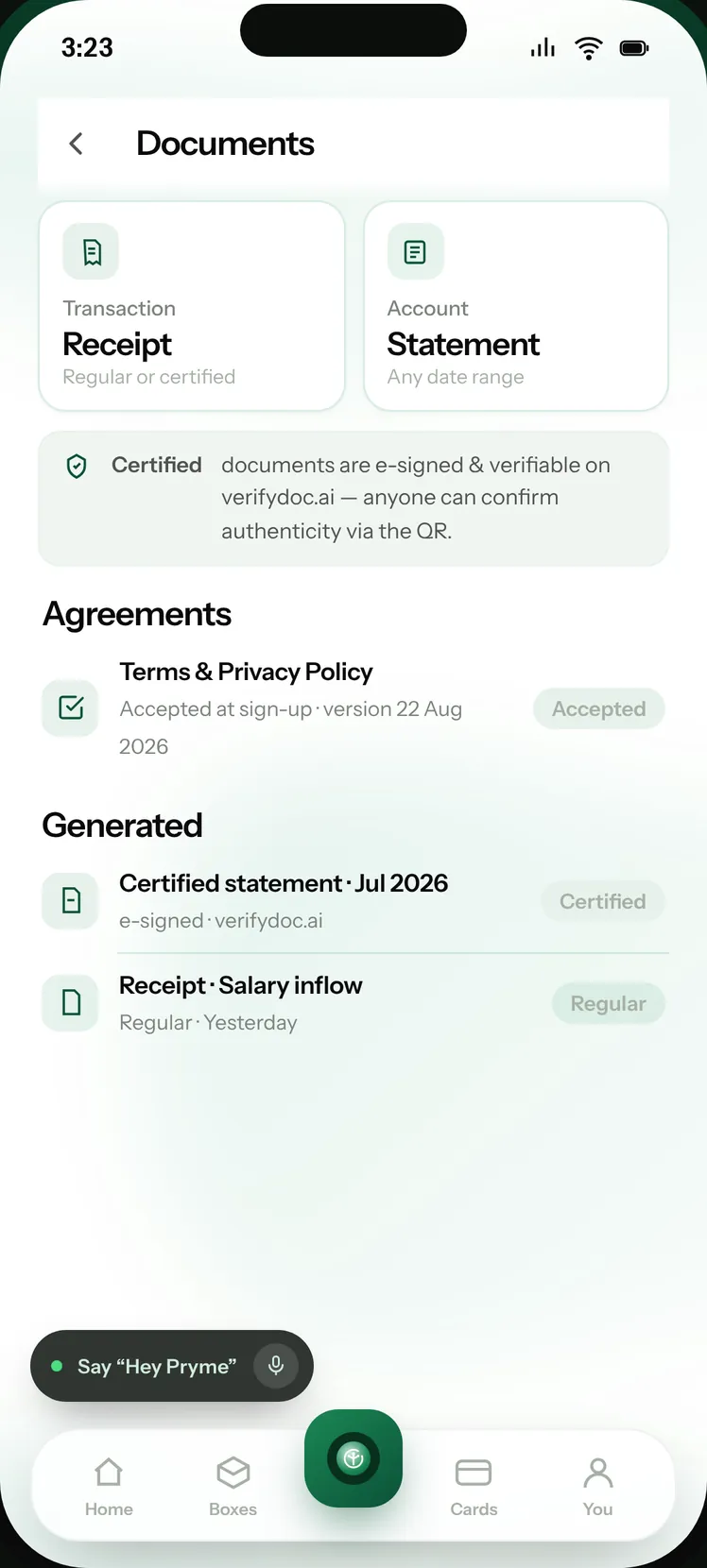
We give you a limit to spend at the shops and services you already use — and an account that works on your month while you get on with it. Dollars, pounds and euros sit beside your Naira, and an assistant handles the running of it, asking you first every single time.
One global account for your money and business. Move across currencies, automate everyday operations and put AI agents to work — with you in control of every important decision.


 Evayour assistant
 DanielChief of Staff
 BenFinance
 BruceCare
Your competitor down the road sells the same thing you sell. The difference is who walks in. We put money in people’s hands that can only be spent in businesses like yours — and then we point them at you.
You are not borrowing. You are selling to somebody who already has the money — and that money can only be spent with a business like yours.
₦100,000 from day one · agreement v2.1 · 12 Aug · View
Eva waits for your rate and asks before she moves anything.
No card, no OTP, nothing for the buyer to type in. They transfer from the bank app they already use, and the money lands in the same account your agents are running — already matched to the order, already in your books.
We give the buyer a one-time account number. They transfer to it from any bank app or by USSD — no card, no OTP, nothing to type in.
Get the account numberTo this account, from any bank app. We watch it, and the page updates itself.
₦26,767.50 from GTBank · John D., matched to order ORD‑1042.
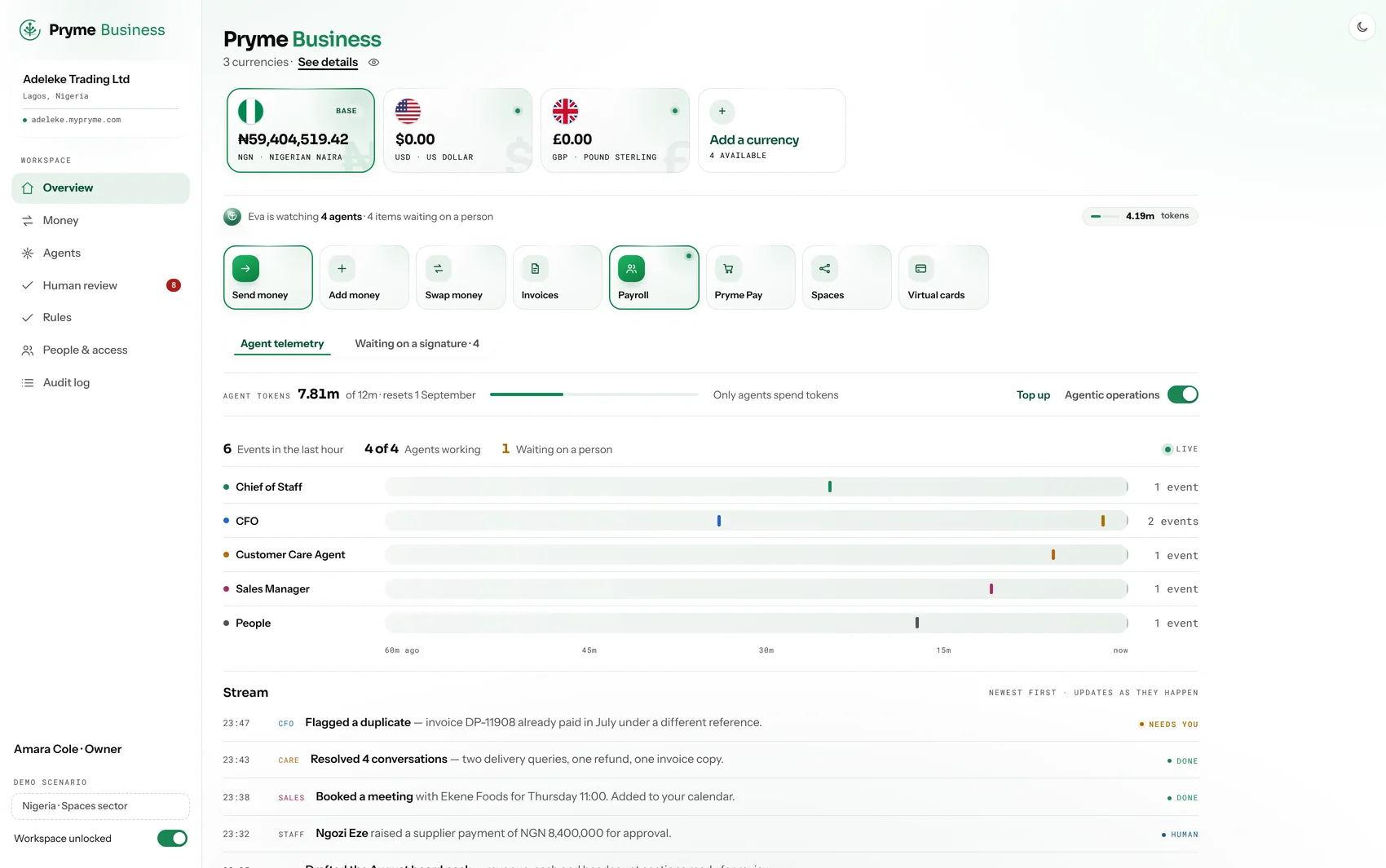
Five agents come with the account. Each one has a job description, a budget and a ceiling you set. They do the work and bring it to you — nothing leaves the account without your signature.
Knows what is stuck, who is waiting and what you promised — and keeps all three moving.
Booked a meeting with John Doe Foods for Thursday 11:00.Keeps the books as you trade and tells you the moment something does not add up.
Flagged a duplicate — invoice DP‑11908 was already paid in July.Holds every filing to its own clock and screens names and payments against your policy — and logs what it refuses.
Screened 412 payments overnight and refused two of them.Goes back to the buyers who went quiet, with the receipt already attached.
Recovered ₦410,000 across three overdue invoices.Replies, follows up on what they asked for and hands you only the ones that need you.
Resolved 4 conversations — two deliveries, one refund.Issue a dedicated Naira account number to each of your own customers, collect into it and reconcile against it. The same rails the Business Account runs on, with the licence behind them.
Dollars, pounds and euros beside a Naira account, on one ledger and one set of books. Five agents come with it and run the account — nothing leaves without your signature.
Five agents come with the account. Each has a job description, a budget and a ceiling you set. They do the work and bring it to you — they propose, you approve.
Knows what is stuck, who is waiting and what you promised, and keeps all three moving.
Booked the quarterly review with your auditor for Thursday.Keeps the books in every currency you hold and flags the moment something does not add up.
Flagged a duplicate — invoice DP‑11908 was already paid in July.Holds every filing to its own clock and screens names and payments against your policy — and logs what it refuses.
Screened 412 payments overnight and refused two of them.Goes back to the buyers who went quiet, with the invoice and the receipt already attached.
Recovered $12,400 across three overdue invoices.Replies, follows up on what they asked for and hands you only the ones that need you.
Resolved 4 conversations — two deliveries, one refund.The business has changed shape four times and never changed what it was rooted in. Each version was built out of what the last one could not do.
An online grocery store, built out of a faulty tab. Selling the food was the easy part — taking the money for it, and moving it, turned out to be the business.
A prepaid card. The first time the company issued rather than resold, and the first time it carried the obligations that come with holding somebody else’s money.
Solid Allianze acquired — an existing bank with an existing licence. The perimeter stopped being someone else’s to draw.
More than one currency on one balance, and the rebrand to Pryme. A Nigerian business could hold dollars without holding a second institution.
Accounts that do the work rather than only hold value. Five agents on the account, inside a policy you write — which is where the new mark starts.
Pryme is a financial technology company. It gives people and businesses in Nigeria one account that holds Naira alongside dollars, pounds and euros, and a set of agents that do the running of it — keeping the books, chasing what is owed, answering customers and paying bills. Nothing leaves an account without the owner’s approval.
Yes. A Pryme account holds Naira, US dollars, pounds sterling and euros side by side on one ledger, each with its own account details — a Nigerian account number, a US account number, a UK sort code and an IBAN for the euro area. You can swap between them at a rate you set, and every currency has its own statement.
Spaces is available in Nigeria. It gives a shopper money to spend that can only be spent with a participating business. The business is paid into its Naira account whether or not the shopper repays, because Pryme carries the credit. For the business it is free to join, there is nothing monthly, and the customer’s identity is never shown — only a reference and what it is worth.
Five agents come with the account. The Chief of Staff runs the week and keeps what is stuck moving. Finance watches the money and keeps the books as you trade. Compliance keeps the filings on time and screens what moves. Sales chases what you are owed. Customer Support answers your customers and follows up. Each has a job description, a budget and a ceiling you set, and each one proposes rather than acts — nothing leaves the account without your signature.
Pryme Pay takes payments on your own site or on a checkout page you control. The buyer is given a one-time account number and transfers to it from any bank app or by USSD — no card, no OTP, nothing to type in. The money lands in the same account your agents are running, already matched to the order and already in your books.
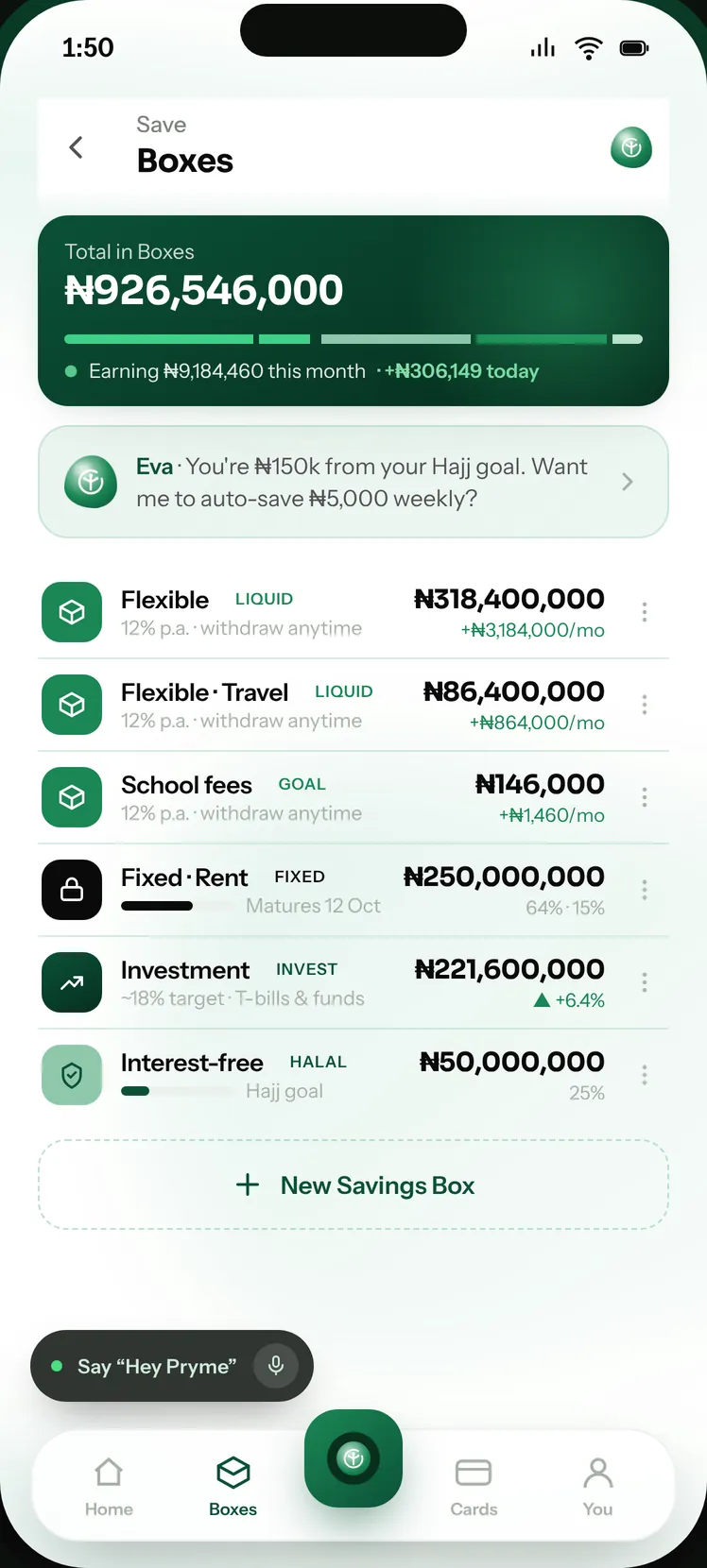
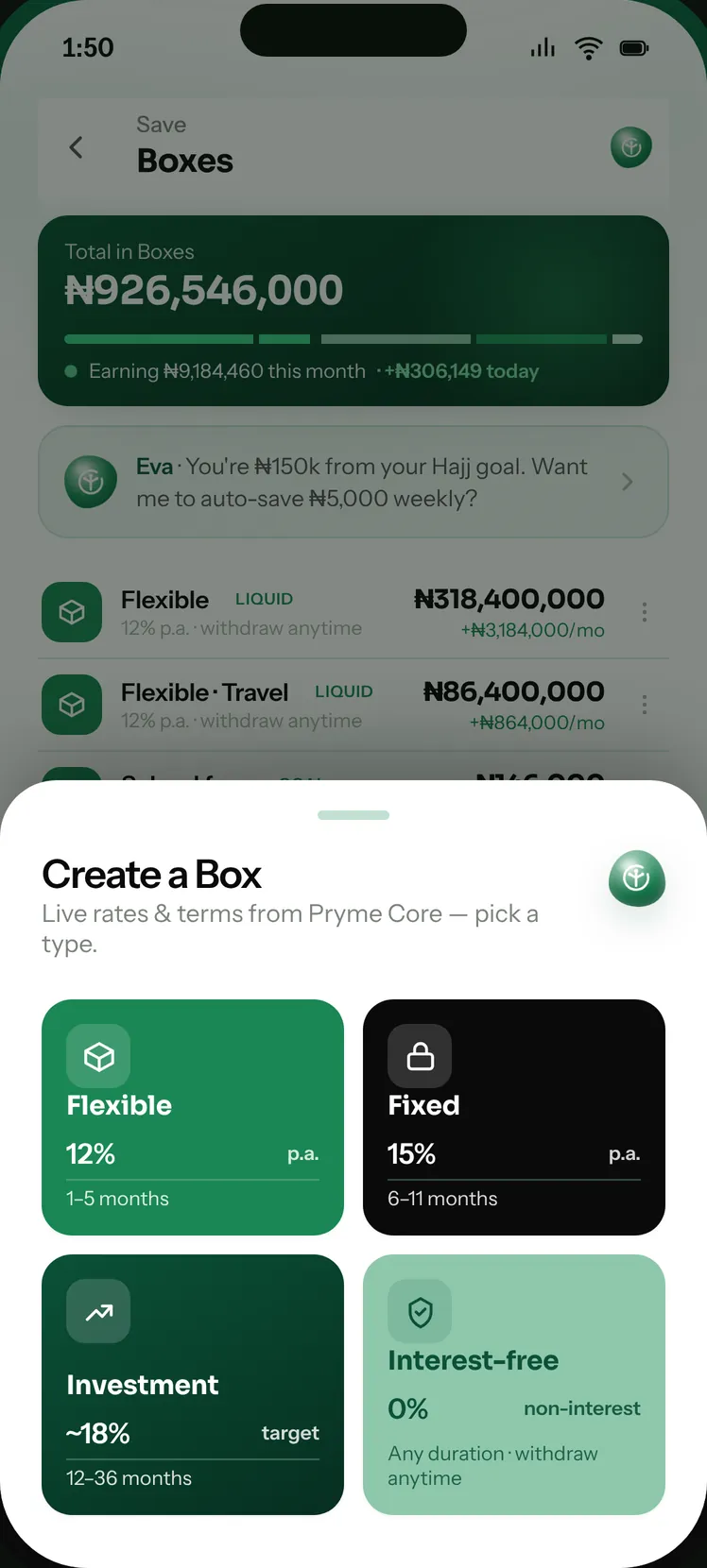
Savings Boxes are separate pots inside a Pryme account, held in Naira. Flexible Boxes can be withdrawn at any time, Fixed Boxes hold to a date, Investment Boxes hold for longer, and Interest-free Boxes earn nothing by design. A business can use them to ring-fence payroll and the tax it withholds, so that money cannot be spent by accident.
Pryme is a financial technology company, not a bank. Accounts and deposits are provided by Solid Allianze Microfinance Bank Limited, which is licensed by the Central Bank of Nigeria and is a member of the Nigeria Deposit Insurance Corporation.
Yes. Pryme Rails lets a platform issue a dedicated Naira account number to each of its own customers, collect into it and reconcile against it, over one API — the same rails the Pryme Business Account runs on.
Pryme is a financial technology company. It gives you one account that holds US dollars, pounds sterling and euros beside Naira, with an assistant that runs the account for you and asks before anything moves. Accounts are provided in Nigeria today, and further markets open as each licence lands.
Accounts are provided in Nigeria today, subject to verification and approval. Foreign-currency balances are held and converted inside that account, so you can hold, receive and swap dollars, pounds and euros wherever you are.
Naira, US dollars, pounds sterling and euros, side by side on one ledger. Each has its own details — a Nigerian account number, a US account number, a UK sort code and an IBAN for the euro area — and each has its own statement.
Swap at a rate you set rather than the rate of the day, then send to any Pryme username or to a Nigerian bank account. There is no fee to send to another Pryme account.
Eva is the assistant inside the Pryme app. She opens accounts, moves money, saves toward your goals, pays what is due and follows up what is owed to you — and asks you before anything moves.
Pryme Rails lets a platform issue a dedicated Naira account number to each of its own customers, collect into it and reconcile against it, over one API — the same rails the Pryme Business Account runs on.
Notes on money that does the work: what we are building, what the regulation actually says, and how we think about letting software act on money. Read the Ledger
What AI agents can do in bookkeeping, close, collections and compliance today, where a person must stay in charge, and how to judge a product.
How multi-currency business accounts work: local details vs SWIFT, payment rails, the real cost of FX, safeguarding vs deposit protection, and hedging.
How UK, US, Canadian and European firms pay Nigerian suppliers and get paid by Nigerian clients: FX, Form A and M, tax, compliance and payout routes.
What it really costs to send money to Nigeria from the UK, US, Canada and Europe: fees, exchange-rate margins, CBN naira rules, BVN, speed and scams.
What AI can and cannot do in day-to-day bookkeeping, how much time it saves on real numbers, and which jobs must stay with you or your accountant.
Dated timeline of the 2022 naira redesign: the announcement, new ₦200, ₦500 and ₦1,000 notes, deadlines, cash shortage and Supreme Court rulings.
The CBN announced on 26 October 2022 that it would redesign the ₦200, ₦500 and ₦1,000 notes, released them on 15 December 2022 and set a 31 January 2023 deadline for old notes, later moved to 10 February. A cash shortage followed, and on 3 March 2023 the Supreme Court ruled that the old notes stay legal tender alongside the new ones until 31 December 2023; a later order kept them valid beyond that date.
The redesign was one of the most disruptive currency events in Nigeria since the 1984 colour change. This page sets out what happened and when, so the sequence can be cited accurately.
| Date | Event |
|---|---|
| 26 October 2022 | CBN Governor Godwin Emefiele announces that the ₦200, ₦500 and ₦1,000 notes will be redesigned and that old notes will cease to be legal tender after 31 January 2023 |
| 23 November 2022 | President Muhammadu Buhari unveils the new notes |
| 6 December 2022 | CBN issues a revised cash withdrawal policy, sharply lowering weekly over-the-counter cash limits (later revised on 21 December 2022) |
| 15 December 2022 | New notes released into circulation through banks |
| 29 January 2023 | CBN extends the deadline for old notes to 10 February 2023, with a further seven days to deposit old notes at the CBN |
| Early February 2023 | Long queues at banks and ATMs; POS operators charge high fees for cash; several states go to court |
| 8 February 2023 | Supreme Court grants an interim order stopping the FG and CBN from enforcing the 10 February deadline pending the case |
| 16 February 2023 | In a national broadcast, President Buhari says old ₦200 notes stay in circulation until 10 April 2023, but old ₦500 and ₦1,000 notes cease to be legal tender |
| 25 February 2023 | Presidential and National Assembly elections held amid the cash shortage |
| 3 March 2023 | Supreme Court rules that old ₦200, ₦500 and ₦1,000 notes remain legal tender alongside the new ones until 31 December 2023 |
| 13 March 2023 | CBN directs banks to comply with the ruling and to issue and accept old notes |
| 29 November 2023 | Supreme Court order, following an application by the FG and states, keeps the old notes valid beyond 31 December 2023 until further notice; the CBN confirms this in December 2023 |
The CBN gave three main reasons in its October 2022 announcement: a large share of currency in circulation was held outside the banking system, which weakened monetary policy; the notes had not been redesigned for about 20 years and were easier to counterfeit; and cash was linked to ransom payments and other crime. The redesign also tied into the CBN's long-running cashless policy and the eNaira, which had launched in October 2021.
The new notes kept the same portraits and broadly the same imagery as the old ones, with new colour schemes and updated security features. Old and new versions are easy to tell apart by colour. The ₦5 to ₦100 notes were not changed.
The CBN printed far fewer new notes than the value of old notes withdrawn. Combined with the lower withdrawal limits and a short deadline, this led to a sharp shortage of cash in January to March 2023. People queued for hours at banks and ATMs, and POS agents charged high premiums to give out cash. Small traders and rural households, who depend on cash, were hit hardest. At the same time, use of bank transfers through NIP, USSD and POS payments jumped. For how those transfers work, see NIP instant payments explained.
On 6 December 2022 the CBN cut the maximum weekly over-the-counter cash withdrawal to ₦100,000 for individuals and ₦500,000 for corporate customers, capped ATM and POS cash withdrawals at ₦20,000 a day, and set processing fees of 5% and 10% on withdrawals above the limits. After an outcry, a revised circular on 21 December 2022 raised the weekly limits to ₦500,000 for individuals and ₦5 million for corporates, effective 9 January 2023. These limits ran alongside the redesign and made the shortage of new notes harder to work around.
Several state governments, led by Kaduna, Kogi and Zamfara, sued the Federal Government at the Supreme Court, arguing that the short deadline breached the constitution and harmed their citizens. Other states joined. The court's 3 March 2023 judgment found that the policy had been carried out without adequate notice and consultation, as required under the CBN Act.
Dates come from CBN press releases and circulars, the 16 February 2023 presidential broadcast and Supreme Court judgments as reported at the time. Where the precise date of an order differs between reports, we used the date given in the CBN's own statement. We did not include estimates of currency in circulation because published figures changed between CBN statements.
Yes. Following Supreme Court orders, old and new ₦200, ₦500 and ₦1,000 notes remain legal tender side by side until the courts or the CBN, following due process, decide otherwise.
The CBN announced the redesign on 26 October 2022, President Buhari unveiled the notes on 23 November 2022 and they entered circulation on 15 December 2022.
Only the ₦200, ₦500 and ₦1,000 notes. The ₦5, ₦10, ₦20, ₦50 and ₦100 notes were not changed.
States argued that the short deadline caused hardship and was done without proper notice. On 3 March 2023 the court ruled the old notes remain legal tender, initially until 31 December 2023.
This article is general information, not financial, legal or tax advice. Products described are provided under the terms on this site and are subject to regulation and eligibility.
How the Nigeria Deposit Insurance Corporation began in 1988, the laws behind it, how cover has grown, and the bank failures it has handled since.
How the 2004–2005 ₦25 billion capital rule cut Nigeria's banks from 89 to 25, which banks merged into which, and what became of each bank since.
The CBN's 2024 minimum capital rules by licence type, the 31 March 2026 deadline, how banks raised money, and where to check which banks complied.
You can add the other type later — many of our customers hold both.
The business first, then you. Nothing is submitted until you review it.
Ideal customer profiles
Generated from your website by VerifiedLead.ai
Pick the ones that look right. Your Sales agent works these first, and you can change them at any time after opening.
We ask this because you have not given us a website. It helps us set the right limits from day one.
Which of these represents you?
Officers listed against this company on the UK register.
We have sent a six-digit code to your email address. Enter it below to confirm the address is yours.
Wrong address? Go back and change it — nothing is created until this step passes. We never ask for a code by phone or email; anyone who does is not us.
Last step. Each time you sign in we email you a six-digit code — we never send codes by SMS.