AI agents for business finance: what they can and can't do
What AI agents can do in bookkeeping, close, collections and compliance today, where a person must stay in charge, and how to judge a product.
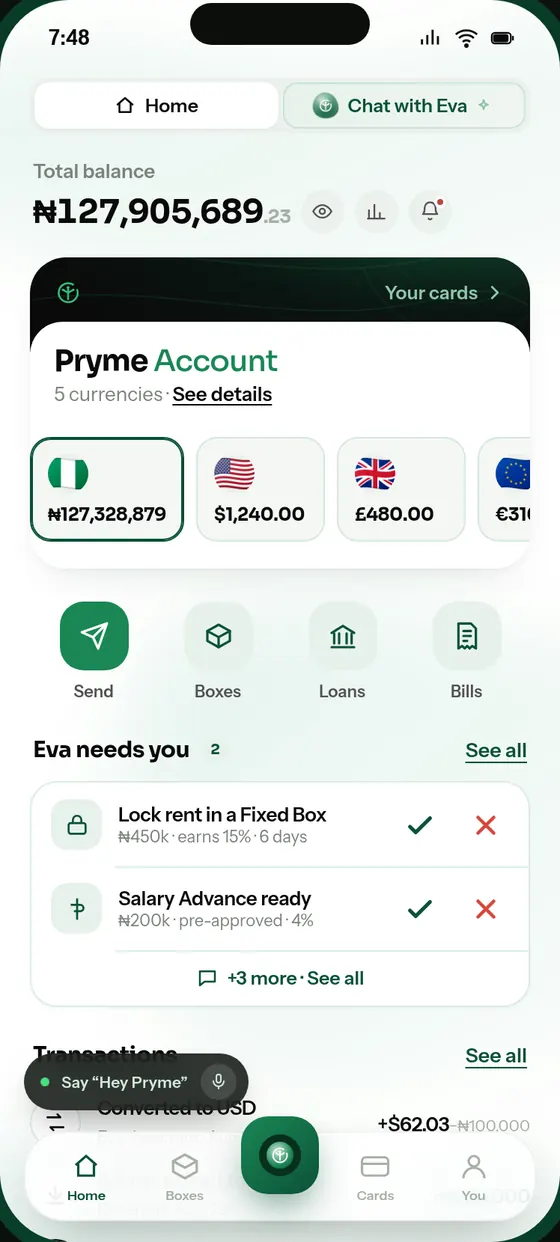
Meet Eva, the assistant inside the Pryme app. She opens accounts, moves money, saves toward your goals and follows up. Nothing leaves your account without your approval.
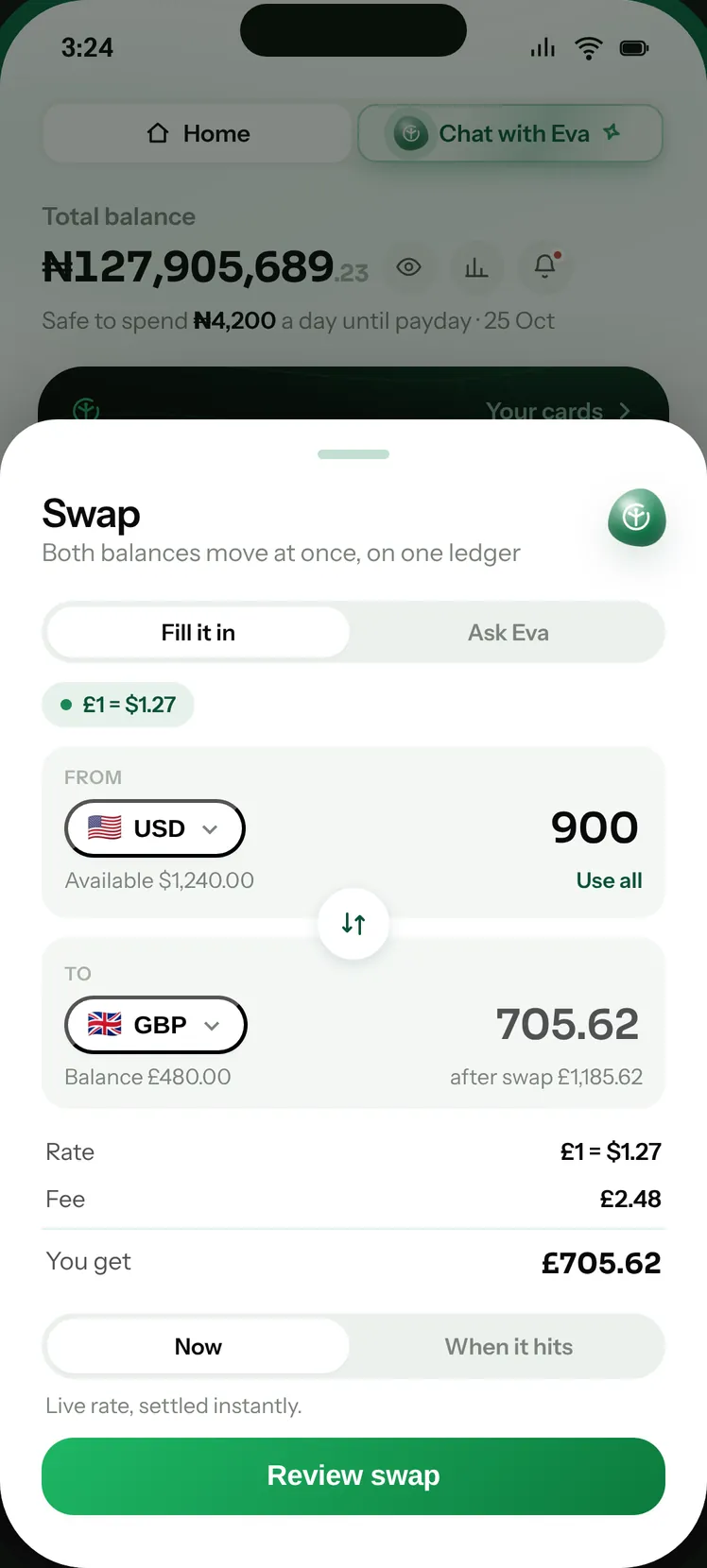
Meet Eva, the assistant inside the Pryme app. She holds dollars, pounds, euros and Naira side by side, swaps at a locked rate, pays bills in any of them and sends anywhere, asking before anything moves.
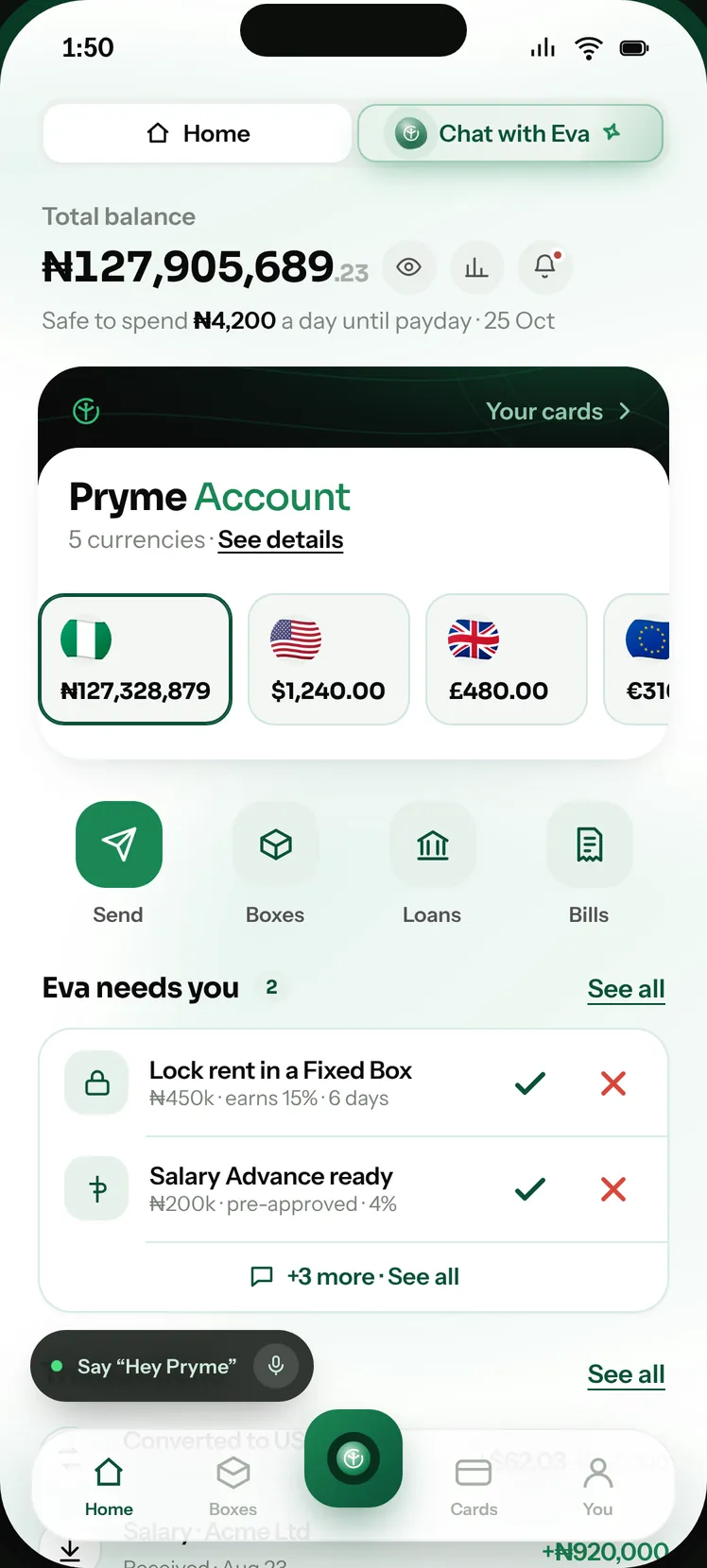
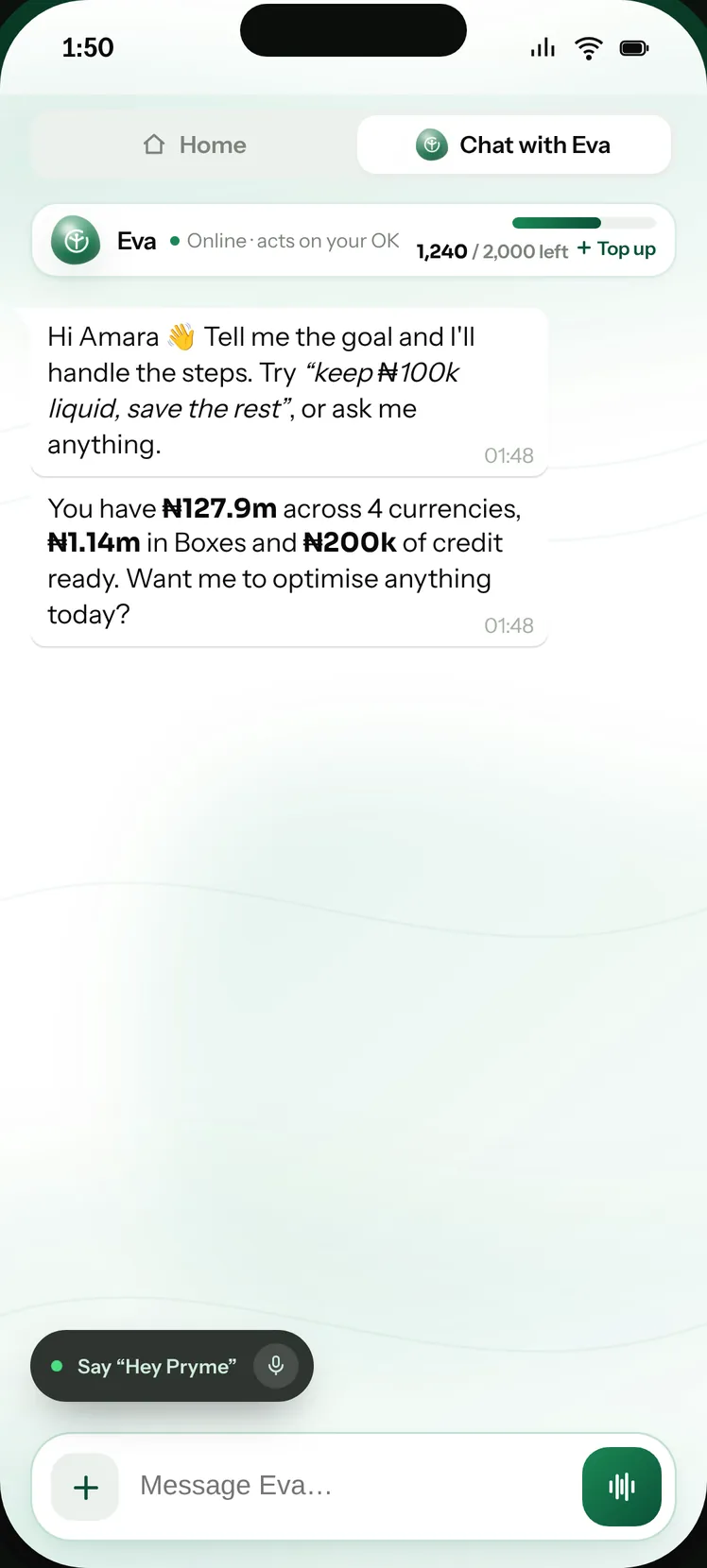
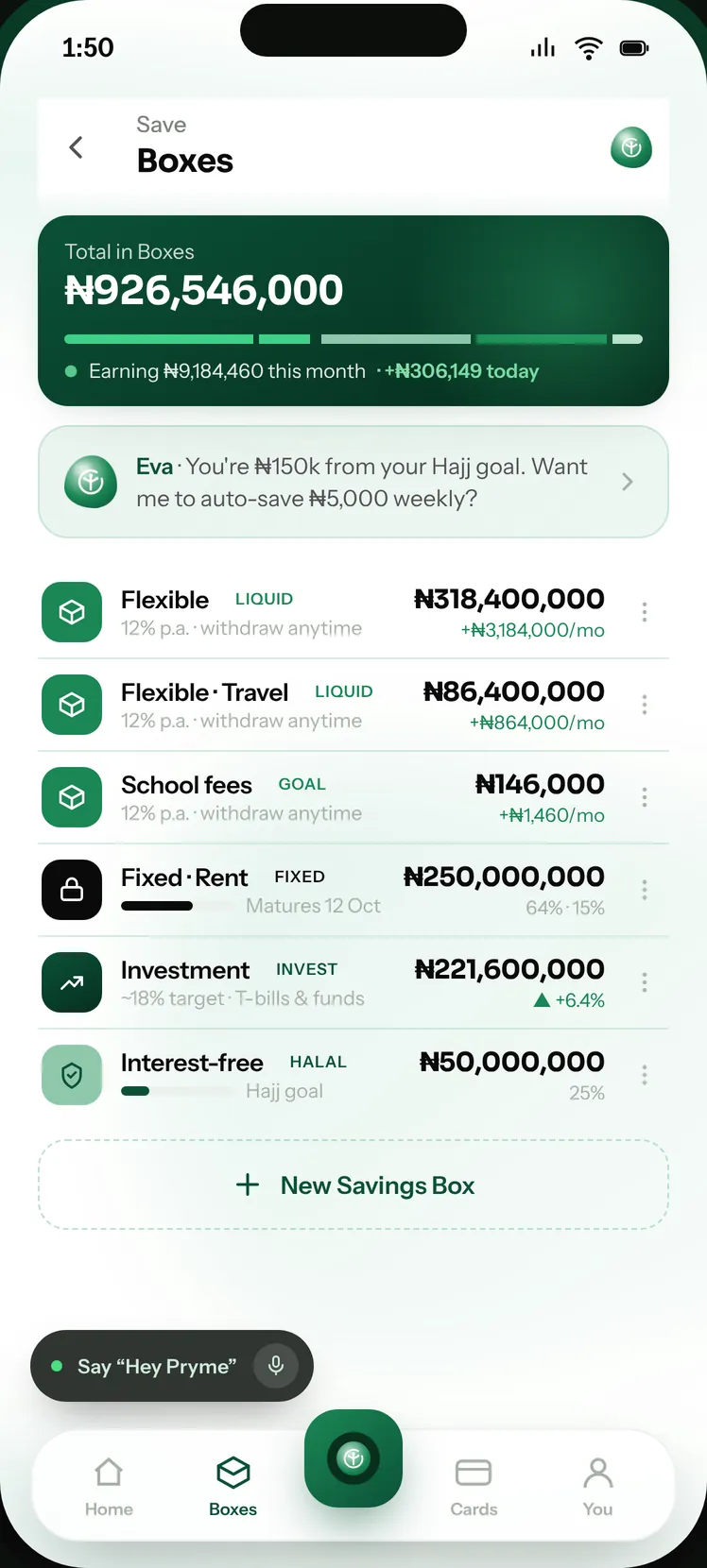
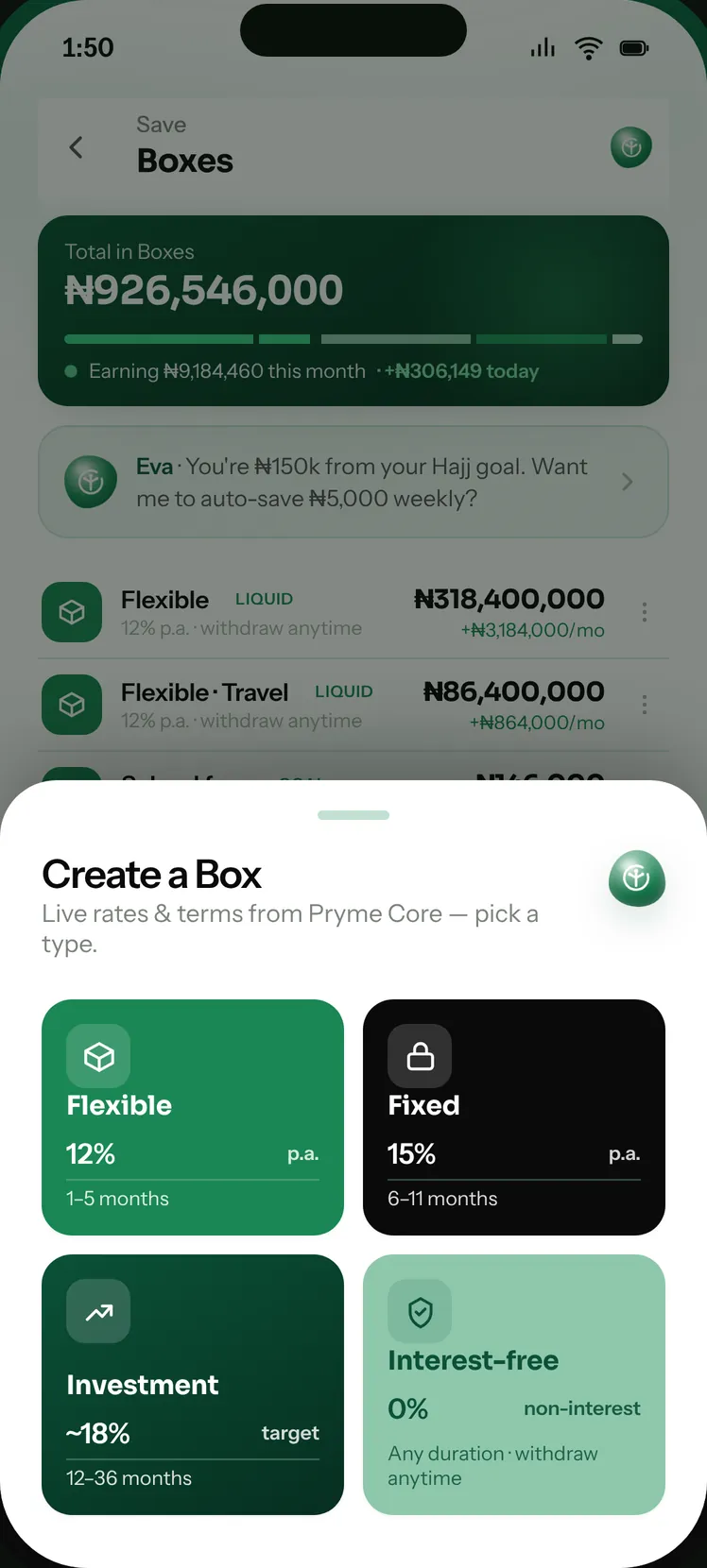
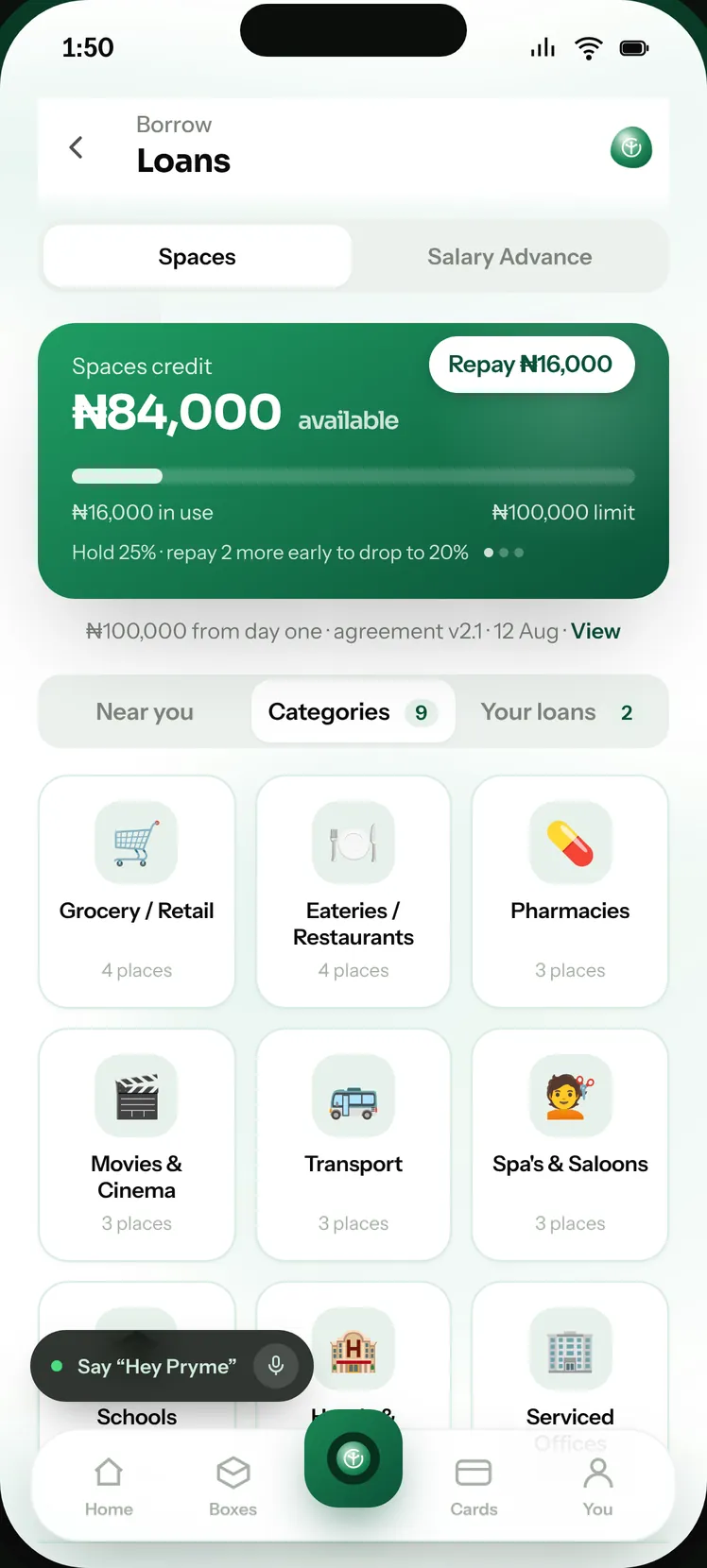
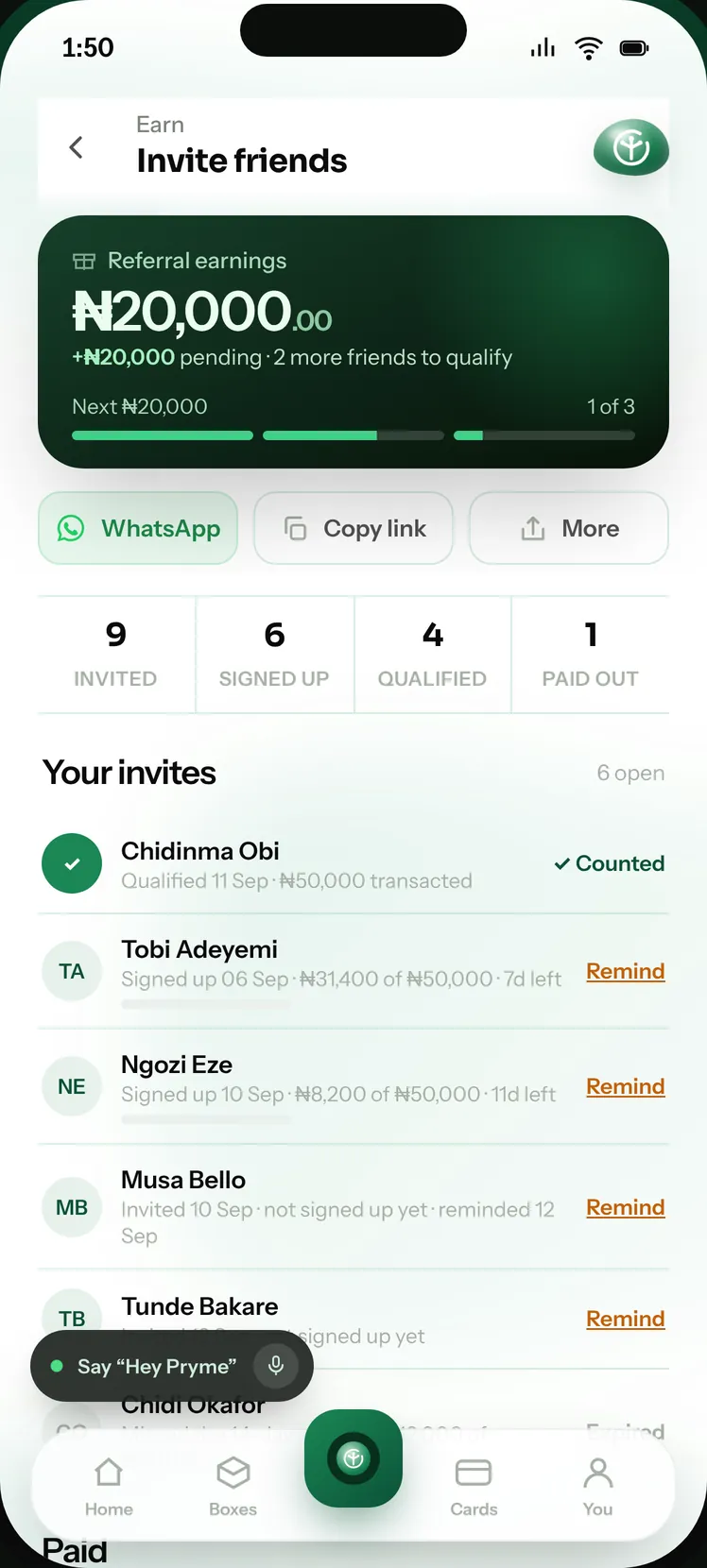
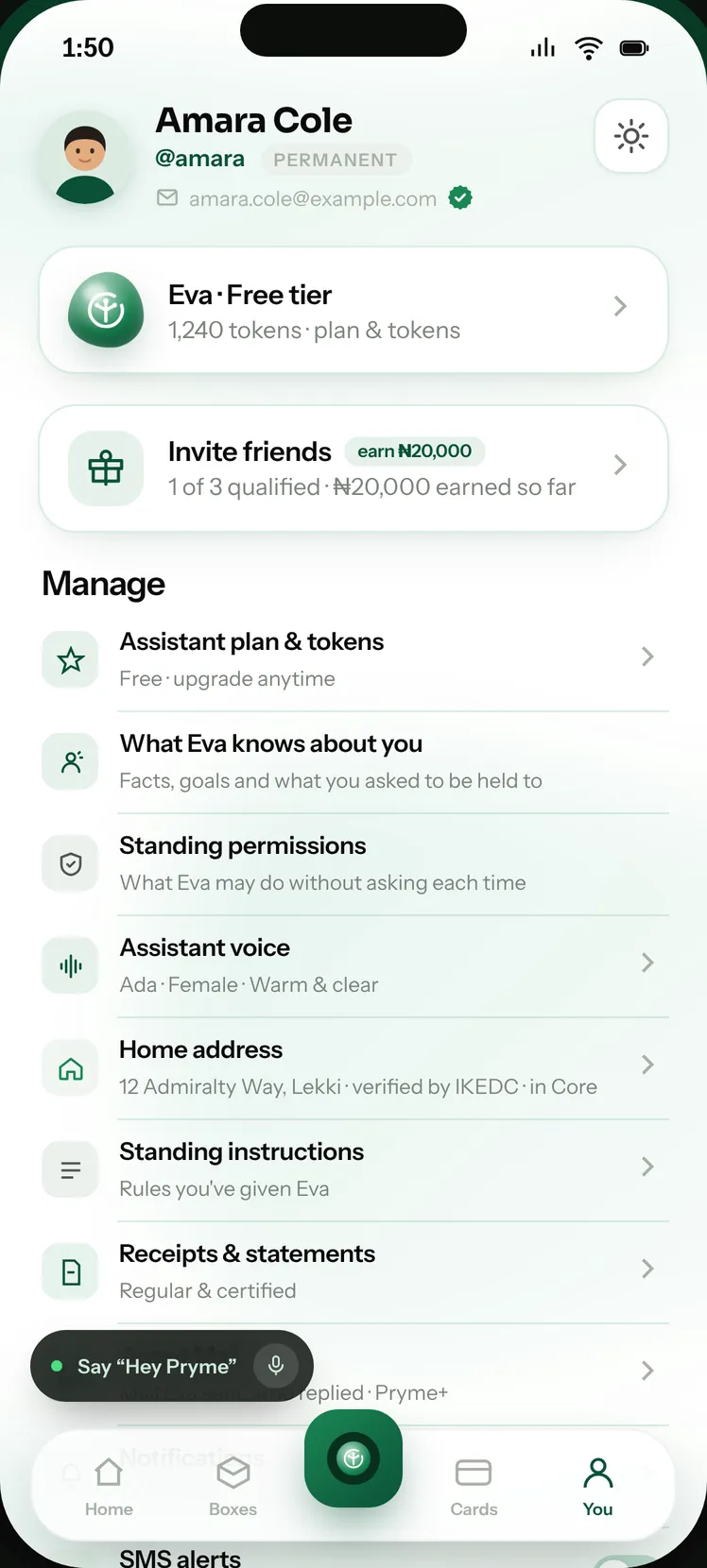
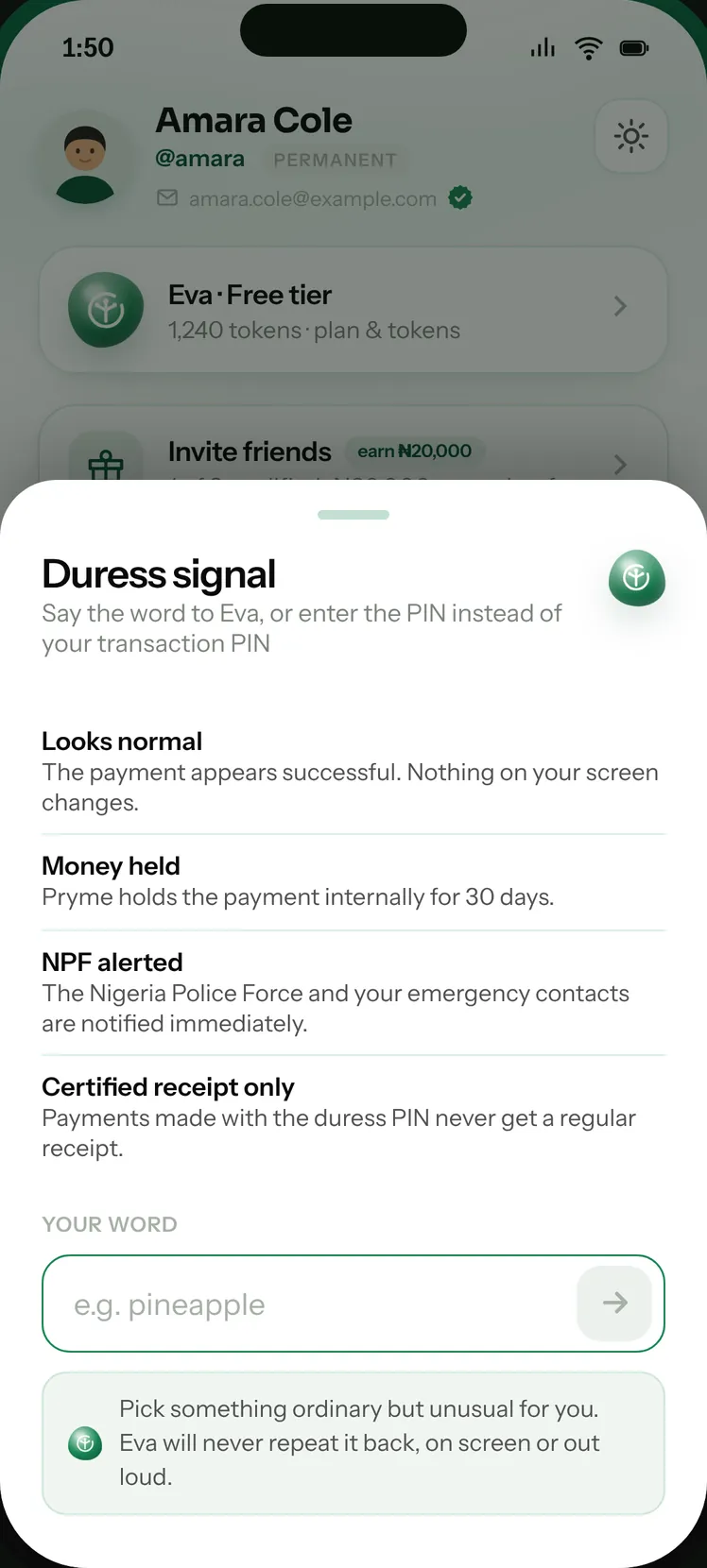
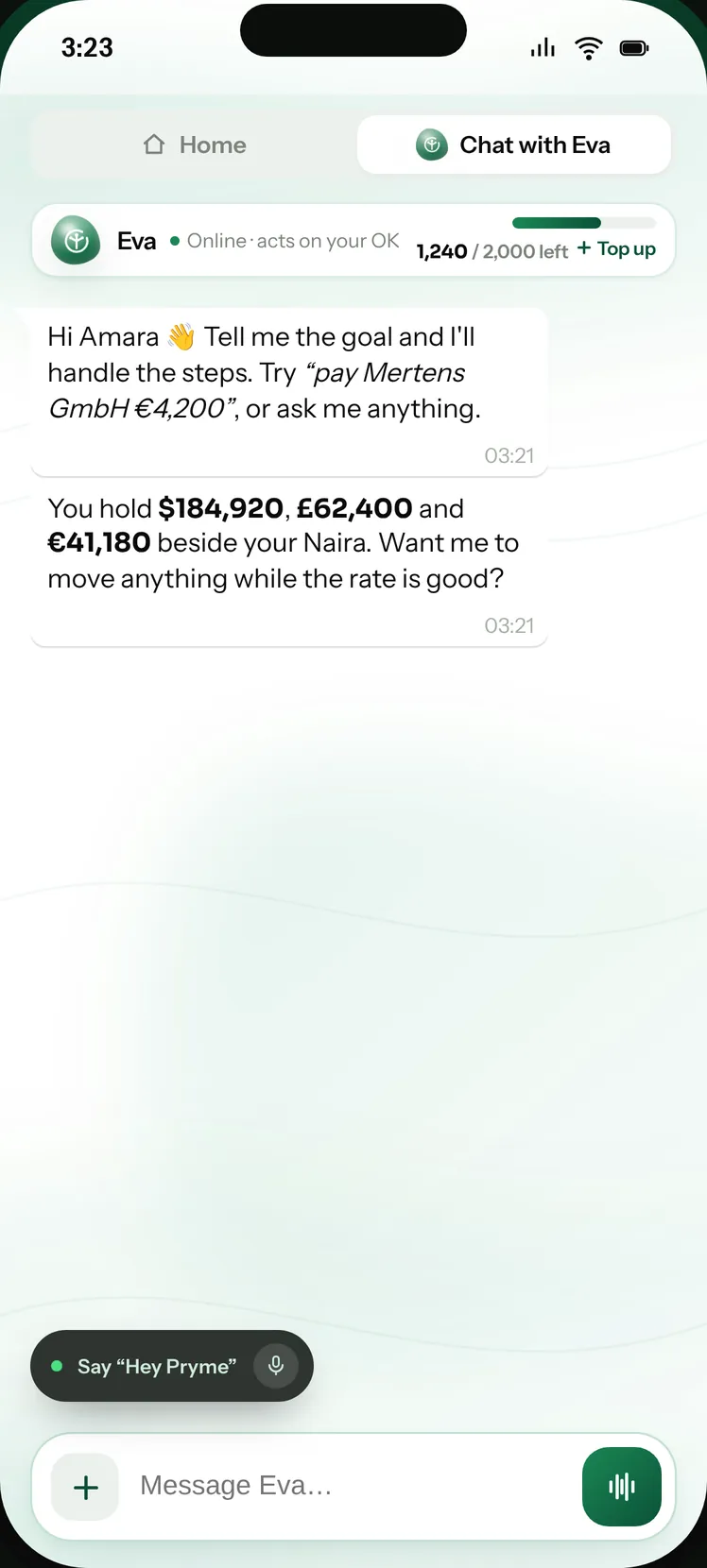
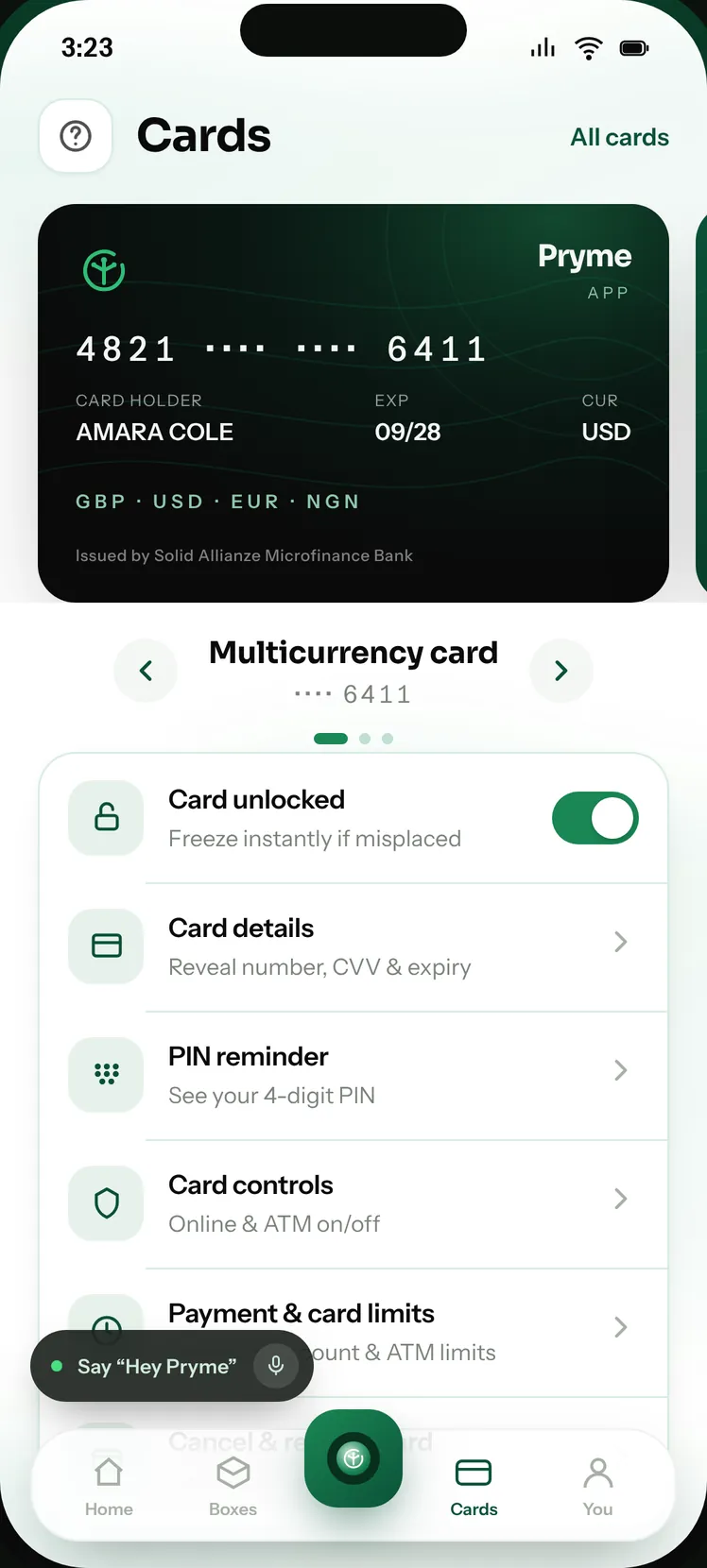
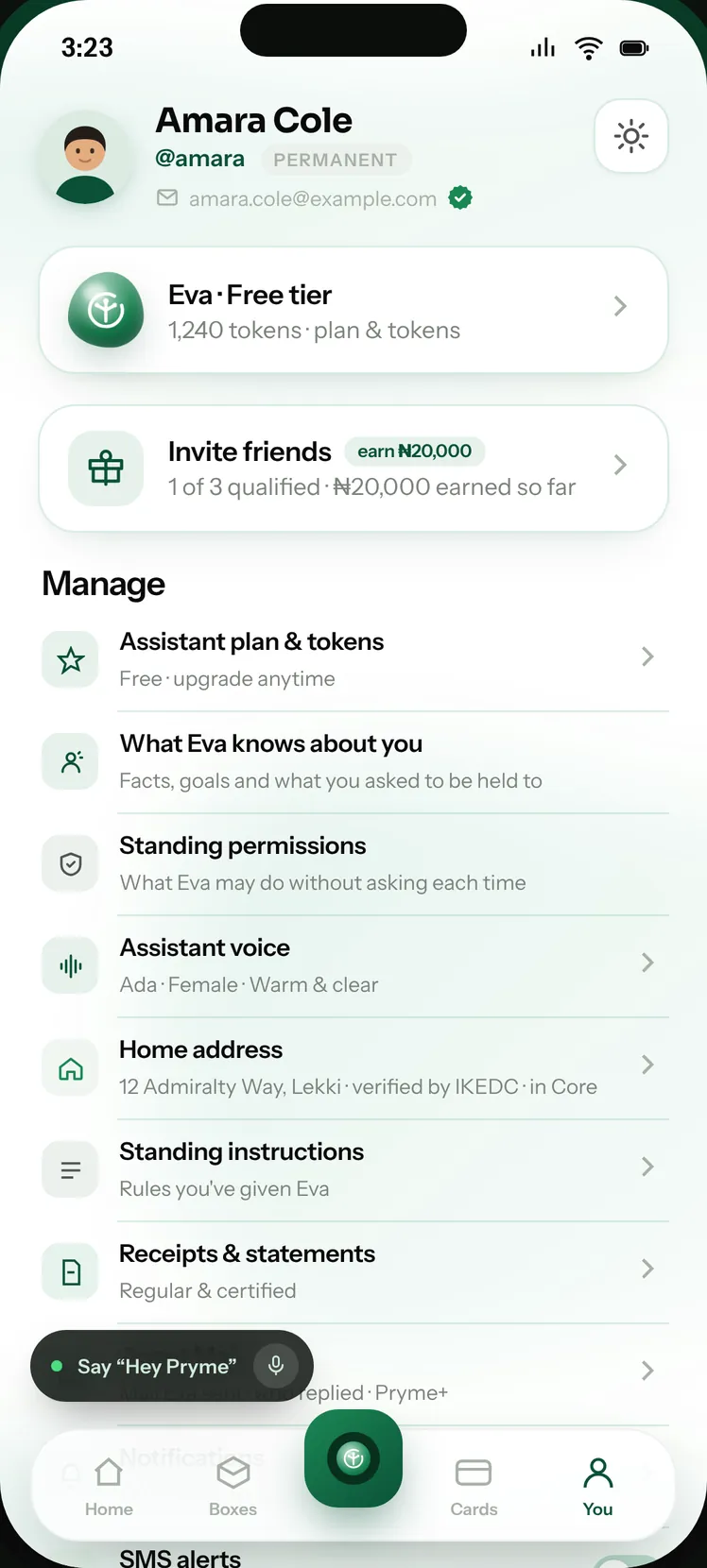
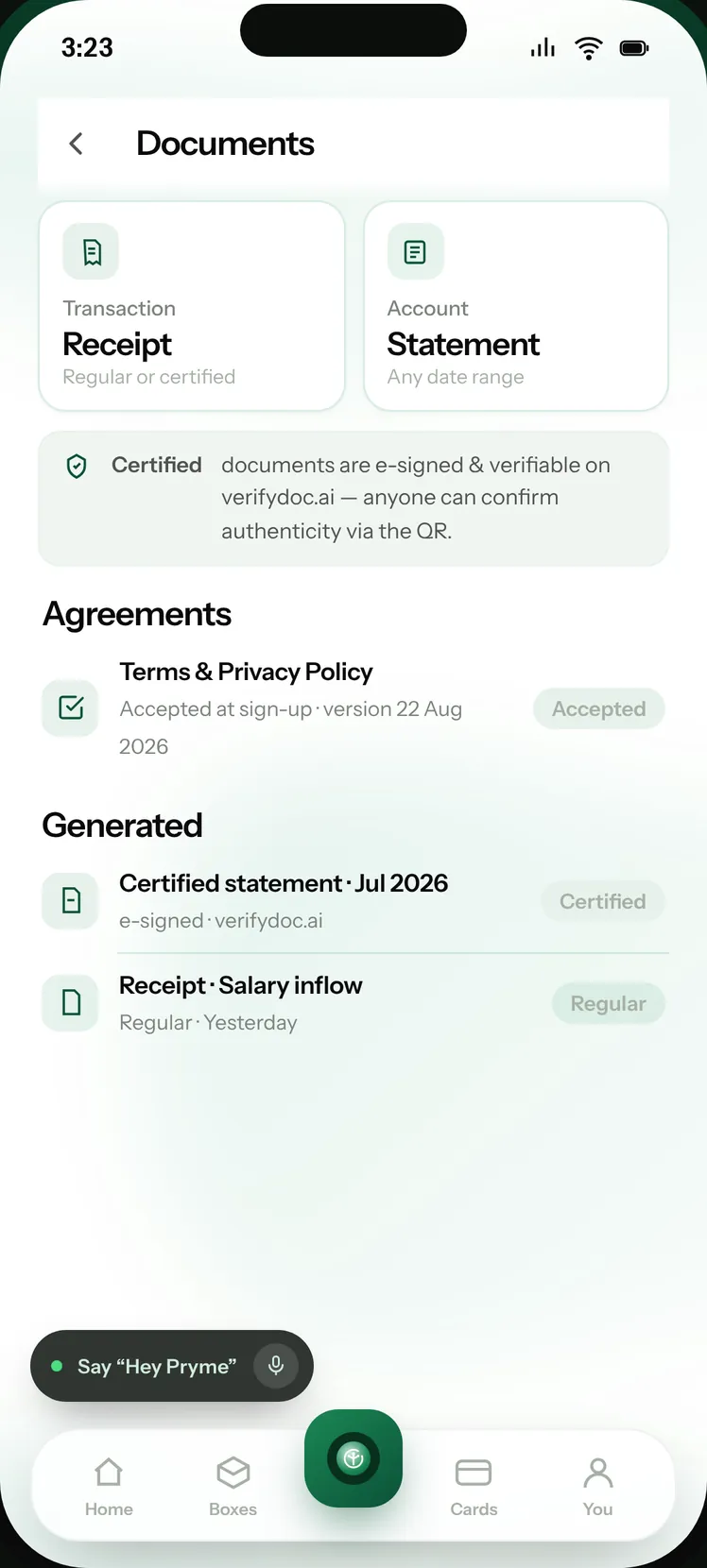
We give you a limit to spend at the shops and services you already use — and an account that works on your month while you get on with it. Dollars, pounds and euros sit beside your Naira, and an assistant handles the running of it, asking you first every single time.
One global account for your money and business. Move across currencies, automate everyday operations and put AI agents to work — with you in control of every important decision.



 Evayour assistant
 DanielChief of Staff
 BenFinance
 BruceCare
Your competitor down the road sells the same thing you sell. The difference is who walks in. We put money in people’s hands that can only be spent in businesses like yours — and then we point them at you.
You are not borrowing. You are selling to somebody who already has the money — and that money can only be spent with a business like yours.
₦100,000 from day one · agreement v2.1 · 12 Aug · View
Eva waits for your rate and asks before she moves anything.
No card, no OTP, nothing for the buyer to type in. They transfer from the bank app they already use, and the money lands in the same account your agents are running — already matched to the order, already in your books.
We give the buyer a one-time account number. They transfer to it from any bank app or by USSD — no card, no OTP, nothing to type in.
Get the account numberTo this account, from any bank app. We watch it, and the page updates itself.
₦26,767.50 from GTBank · John D., matched to order ORD‑1042.
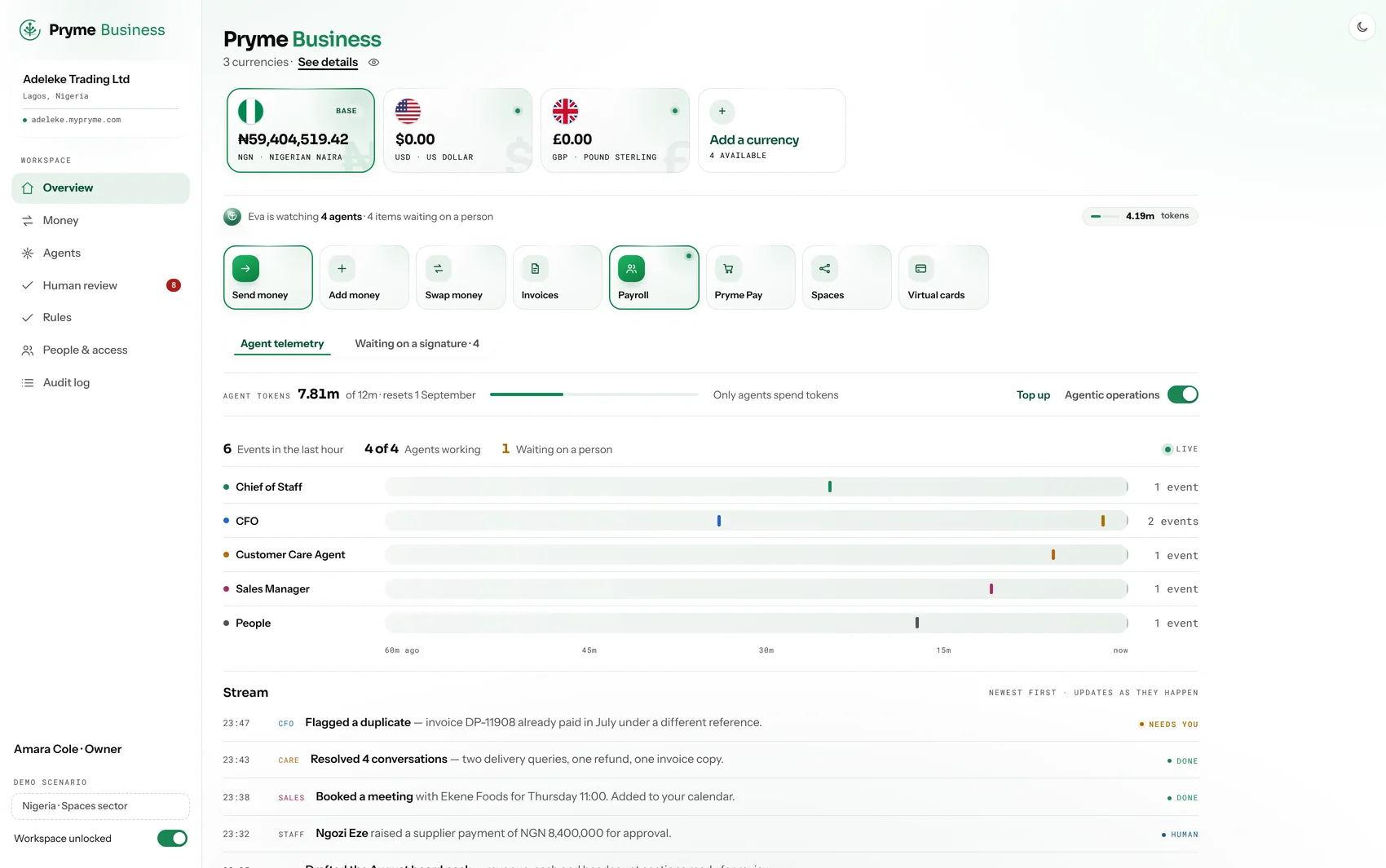
Five agents come with the account. Each one has a job description, a budget and a ceiling you set. They do the work and bring it to you — nothing leaves the account without your signature.
Knows what is stuck, who is waiting and what you promised — and keeps all three moving.
Booked a meeting with John Doe Foods for Thursday 11:00.Keeps the books as you trade and tells you the moment something does not add up.
Flagged a duplicate — invoice DP‑11908 was already paid in July.Holds every filing to its own clock and screens names and payments against your policy — and logs what it refuses.
Screened 412 payments overnight and refused two of them.Goes back to the buyers who went quiet, with the receipt already attached.
Recovered ₦410,000 across three overdue invoices.Replies, follows up on what they asked for and hands you only the ones that need you.
Resolved 4 conversations — two deliveries, one refund.Issue a dedicated Naira account number to each of your own customers, collect into it and reconcile against it. The same rails the Business Account runs on, with the licence behind them.
Dollars, pounds and euros beside a Naira account, on one ledger and one set of books. Five agents come with it and run the account — nothing leaves without your signature.
Five agents come with the account. Each has a job description, a budget and a ceiling you set. They do the work and bring it to you — they propose, you approve.
Knows what is stuck, who is waiting and what you promised, and keeps all three moving.
Booked the quarterly review with your auditor for Thursday.Keeps the books in every currency you hold and flags the moment something does not add up.
Flagged a duplicate — invoice DP‑11908 was already paid in July.Holds every filing to its own clock and screens names and payments against your policy — and logs what it refuses.
Screened 412 payments overnight and refused two of them.Goes back to the buyers who went quiet, with the invoice and the receipt already attached.
Recovered $12,400 across three overdue invoices.Replies, follows up on what they asked for and hands you only the ones that need you.
Resolved 4 conversations — two deliveries, one refund.The business has changed shape four times and never changed what it was rooted in. Each version was built out of what the last one could not do.
An online grocery store, built out of a faulty tab. Selling the food was the easy part — taking the money for it, and moving it, turned out to be the business.
A prepaid card. The first time the company issued rather than resold, and the first time it carried the obligations that come with holding somebody else’s money.
Solid Allianze acquired — an existing bank with an existing licence. The perimeter stopped being someone else’s to draw.
More than one currency on one balance, and the rebrand to Pryme. A Nigerian business could hold dollars without holding a second institution.
Accounts that do the work rather than only hold value. Five agents on the account, inside a policy you write — which is where the new mark starts.
Pryme is a financial technology company. It gives people and businesses in Nigeria one account that holds Naira alongside dollars, pounds and euros, and a set of agents that do the running of it — keeping the books, chasing what is owed, answering customers and paying bills. Nothing leaves an account without the owner’s approval.
Yes. A Pryme account holds Naira, US dollars, pounds sterling and euros side by side on one ledger, each with its own account details — a Nigerian account number, a US account number, a UK sort code and an IBAN for the euro area. You can swap between them at a rate you set, and every currency has its own statement.
Spaces is available in Nigeria. It gives a shopper money to spend that can only be spent with a participating business. The business is paid into its Naira account whether or not the shopper repays, because Pryme carries the credit. For the business it is free to join, there is nothing monthly, and the customer’s identity is never shown — only a reference and what it is worth.
Five agents come with the account. The Chief of Staff runs the week and keeps what is stuck moving. Finance watches the money and keeps the books as you trade. Compliance keeps the filings on time and screens what moves. Sales chases what you are owed. Customer Support answers your customers and follows up. Each has a job description, a budget and a ceiling you set, and each one proposes rather than acts — nothing leaves the account without your signature.
Pryme Pay takes payments on your own site or on a checkout page you control. The buyer is given a one-time account number and transfers to it from any bank app or by USSD — no card, no OTP, nothing to type in. The money lands in the same account your agents are running, already matched to the order and already in your books.
Savings Boxes are separate pots inside a Pryme account, held in Naira. Flexible Boxes can be withdrawn at any time, Fixed Boxes hold to a date, Investment Boxes hold for longer, and Interest-free Boxes earn nothing by design. A business can use them to ring-fence payroll and the tax it withholds, so that money cannot be spent by accident.
Pryme is a financial technology company, not a bank. Accounts and deposits are provided by Solid Allianze Microfinance Bank Limited, which is licensed by the Central Bank of Nigeria and is a member of the Nigeria Deposit Insurance Corporation.
Yes. Pryme Rails lets a platform issue a dedicated Naira account number to each of its own customers, collect into it and reconcile against it, over one API — the same rails the Pryme Business Account runs on.
Pryme is a financial technology company. It gives you one account that holds US dollars, pounds sterling and euros beside Naira, with an assistant that runs the account for you and asks before anything moves. Accounts are provided in Nigeria today, and further markets open as each licence lands.
Accounts are provided in Nigeria today, subject to verification and approval. Foreign-currency balances are held and converted inside that account, so you can hold, receive and swap dollars, pounds and euros wherever you are.
Naira, US dollars, pounds sterling and euros, side by side on one ledger. Each has its own details — a Nigerian account number, a US account number, a UK sort code and an IBAN for the euro area — and each has its own statement.
Swap at a rate you set rather than the rate of the day, then send to any Pryme username or to a Nigerian bank account. There is no fee to send to another Pryme account.
Eva is the assistant inside the Pryme app. She opens accounts, moves money, saves toward your goals, pays what is due and follows up what is owed to you — and asks you before anything moves.
Pryme Rails lets a platform issue a dedicated Naira account number to each of its own customers, collect into it and reconcile against it, over one API — the same rails the Pryme Business Account runs on.
Notes on money that does the work: what we are building, what the regulation actually says, and how we think about letting software act on money. Read the Ledger
What AI agents can do in bookkeeping, close, collections and compliance today, where a person must stay in charge, and how to judge a product.
How multi-currency business accounts work: local details vs SWIFT, payment rails, the real cost of FX, safeguarding vs deposit protection, and hedging.
How UK, US, Canadian and European firms pay Nigerian suppliers and get paid by Nigerian clients: FX, Form A and M, tax, compliance and payout routes.
What it really costs to send money to Nigeria from the UK, US, Canada and Europe: fees, exchange-rate margins, CBN naira rules, BVN, speed and scams.
What AI can and cannot do in day-to-day bookkeeping, how much time it saves on real numbers, and which jobs must stay with you or your accountant.
How to build a budget that survives a Nigerian month, using an assistant to do the sums, prepare savings on payday and warn you before a category runs out.
Budgeting with an AI assistant means you set the plan, and the assistant does the routine work: totalling what you spend, preparing savings moves on payday, reminding you of bills and telling you when a category is nearly used up. Start from your real spending, not an ideal one, pay yourself first, and review weekly. You approve every money movement.
Budgets fail for practical reasons. Writing the plan is easy; keeping track is tedious; and when the month gets hard, no one notices the plan has slipped until it is too late. An assistant takes over the tedious parts. It adds up spending as it happens, reminds you on the right days and prepares the transfers that put money where the plan says. What it cannot do is decide your priorities or say no to a request from family. That part stays with you.
A budget built on wishes collapses in a fortnight. Before setting any limits, look at two or three months of actual spending by category. If you have not been tracking, ask the assistant to total your recent transactions, or follow how to track spending with an AI assistant for a month first.
Expect the real numbers to be uncomfortable. Most people underestimate food, transport and small personal spending by a wide margin. That is fine: the point of the first look is to see the month as it is, so the plan you build can actually be kept.
General rules such as 50/30/20 are a starting point, but rent and family support often take a larger share in Nigerian cities than those rules expect. Adjust the shares to your life rather than the other way round.
Example only. Ifeoma, a teacher in Enugu, takes home ₦350,000. After three months of tracking, she sets this plan:
| Line | Monthly (example) | How the assistant helps |
|---|---|---|
| Rent savings | ₦60,000 | Prepares a move to the rent pot on payday |
| Emergency fund | ₦25,000 | Prepares a move on payday |
| Transport | ₦45,000 | Totals weekly; warns at 80% |
| Food | ₦90,000 | Weekly limit of ₦22,500 |
| Electricity, airtime, data | ₦35,000 | Reminders and prepared bill payments |
| Family support | ₦40,000 | Monthly reminder to send to parents |
| Church and giving | ₦15,000 | Monthly reminder |
| Personal | ₦40,000 | Weekly limit of ₦10,000 |
On payday, her assistant prepares the two savings moves and the family transfer. She approves them before doing anything else. During the month, she asks "how much food money is left this week?" when shopping. When transport passes 80% by the 20th, the assistant tells her, and she switches two trips to shared rides. The plan holds because the reminders and totals arrive when she needs them.
Traders, freelancers and commission earners should budget on a low month, not an average one. Save the surplus from good months into a buffer pot, and pay yourself a fixed amount from it. See the guide for traders.
Agree a yearly family amount with yourself and keep a family pot. When a request comes, the question becomes "is there room in the family pot?" rather than a choice between rent and guilt.
When prices move quickly, last quarter's food figure becomes too low. Review category limits every three months against real spending, and raise them openly rather than quietly overspending.
Couples and families who share costs do better with one shared plan and clear owners. Decide who pays which bills, which pots are joint and which are personal, and what size of spending each person can make without checking with the other. A monthly review together keeps it honest without daily arguments.
| Mistake | Fix |
|---|---|
| Saving whatever is left at month end | Move savings on payday, before spending |
| One big "miscellaneous" line | Split it into Personal and Family, with limits |
| Budgeting on your best month | Budget on a typical or low month |
| No room for fun | Plan a small personal amount so the plan survives |
| Never revisiting the plan | Review limits quarterly against real spending |
The common thread is that a budget is a plan you keep adjusting, not a rule you set once. An assistant helps you keep to it day to day; your monthly and quarterly reviews keep it realistic.
A Pryme Personal Assistant, named Eva by default, can prepare savings moves into Savings Boxes on payday, set bill and family reminders, and prepare transfers and bill payments. It prepares; nothing moves until you approve. Rates for Boxes are shown in the app. Pair the plan with a month-end review.
An assistant can suggest a budget from your past spending and help you keep to it, but the choices about priorities are yours to make.
Start from your actual spending, put fixed commitments and savings first, plan a figure for family support, and limit personal spending weekly. Shares vary by city and household.
It is a useful starting point, but rent and family support often take more than the rule assumes. Adjust the percentages to your circumstances.
Set a planned monthly or yearly family amount and keep it in its own pot. Meeting requests from that pot protects rent and savings.
This article is general information, not financial, legal or tax advice. Products described are provided under the terms on this site and are subject to regulation and eligibility.
A plan for Nigerian parents juggling school fees, feeding, allowances and bills, with a money assistant handling reminders and routine payments.
How Nigerians can find the streaming, app, cable and data plans quietly charging them each month, decide which to keep and cancel the rest properly.
The real risks of AI money assistants in Nigeria, the safeguards that matter, and a checklist to decide whether a service deserves your trust.
You can add the other type later — many of our customers hold both.
The business first, then you. Nothing is submitted until you review it.
Ideal customer profiles
Generated from your website by VerifiedLead.ai
Pick the ones that look right. Your Sales agent works these first, and you can change them at any time after opening.
We ask this because you have not given us a website. It helps us set the right limits from day one.
Which of these represents you?
Officers listed against this company on the UK register.
We have sent a six-digit code to your email address. Enter it below to confirm the address is yours.
Wrong address? Go back and change it — nothing is created until this step passes. We never ask for a code by phone or email; anyone who does is not us.
Last step. Each time you sign in we email you a six-digit code — we never send codes by SMS.