AI agents for business finance: what they can and can't do
What AI agents can do in bookkeeping, close, collections and compliance today, where a person must stay in charge, and how to judge a product.
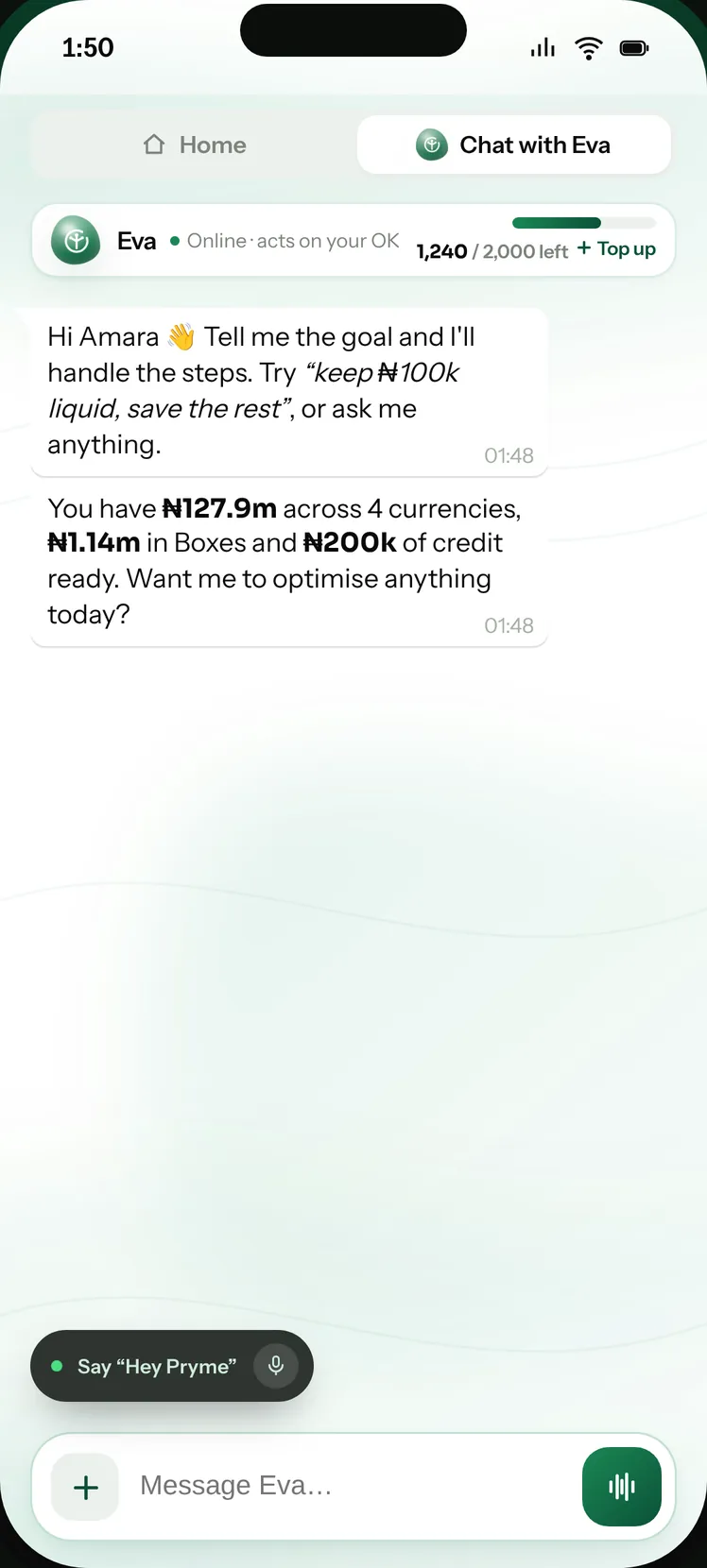
Meet Eva, the assistant inside the Pryme app. She opens accounts, moves money, saves toward your goals and follows up. Nothing leaves your account without your approval.
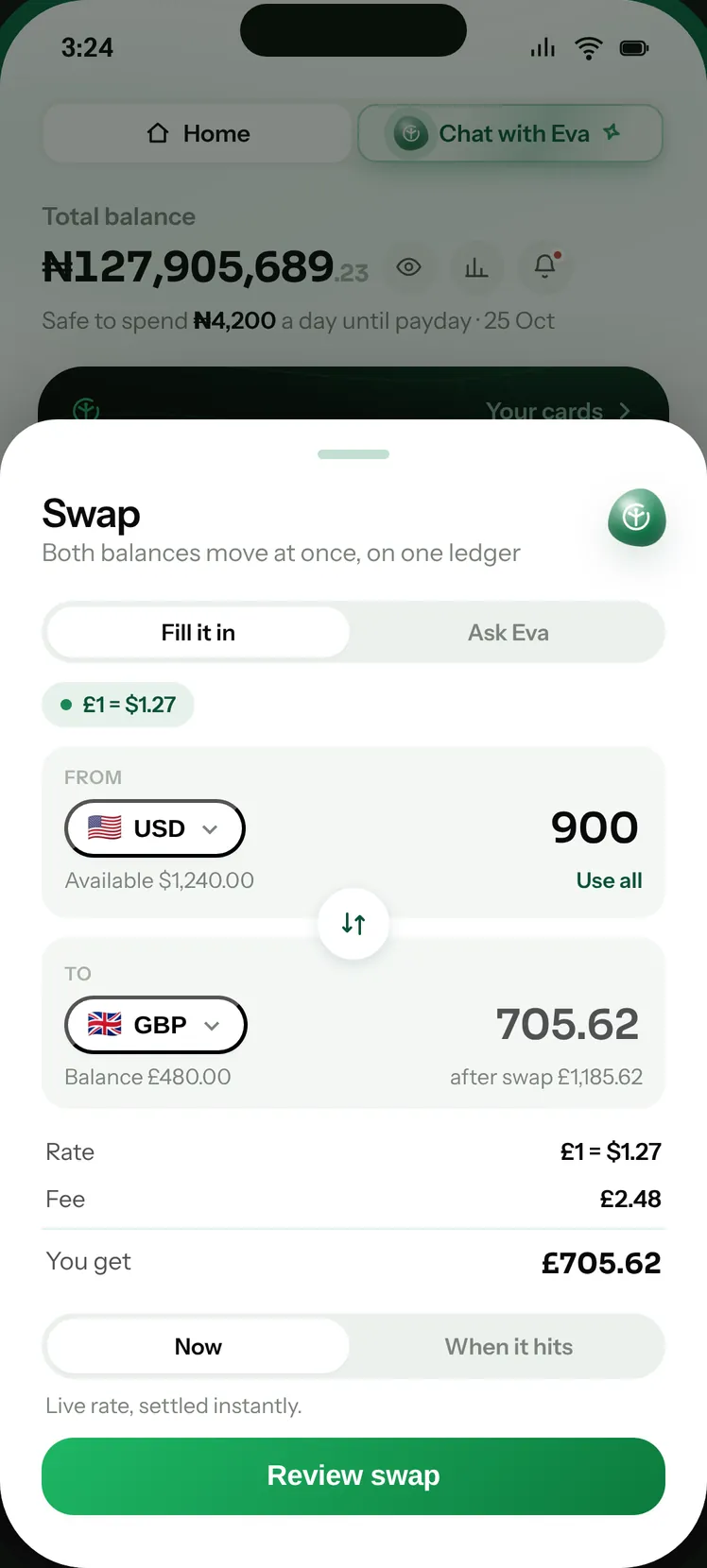
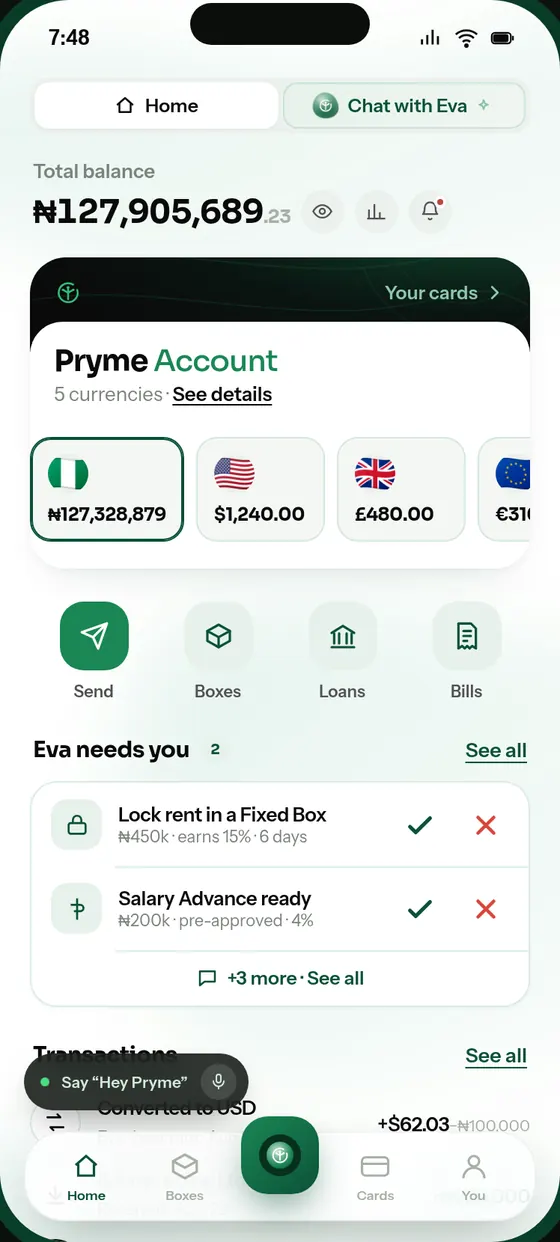
Meet Eva, the assistant inside the Pryme app. She holds dollars, pounds, euros and Naira side by side, swaps at a locked rate, pays bills in any of them and sends anywhere, asking before anything moves.
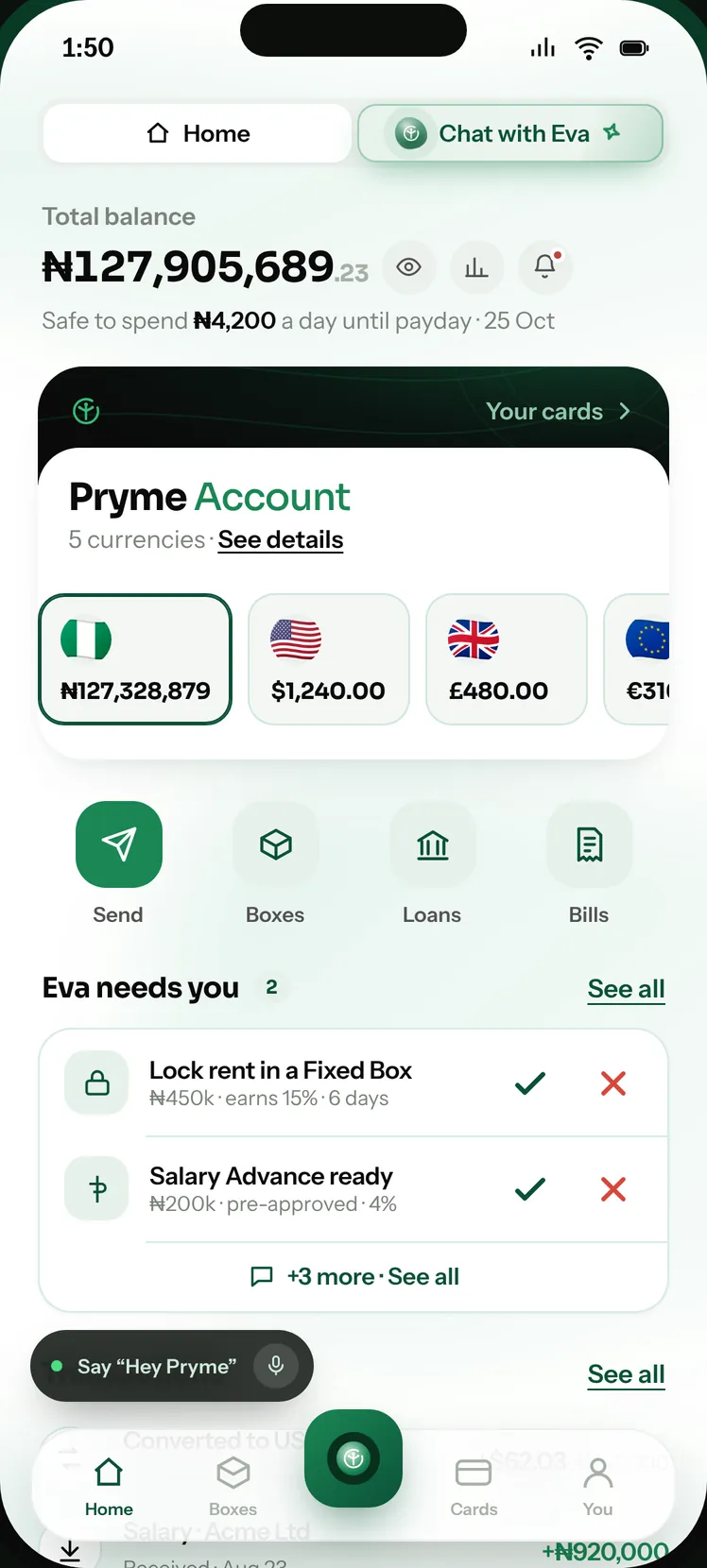
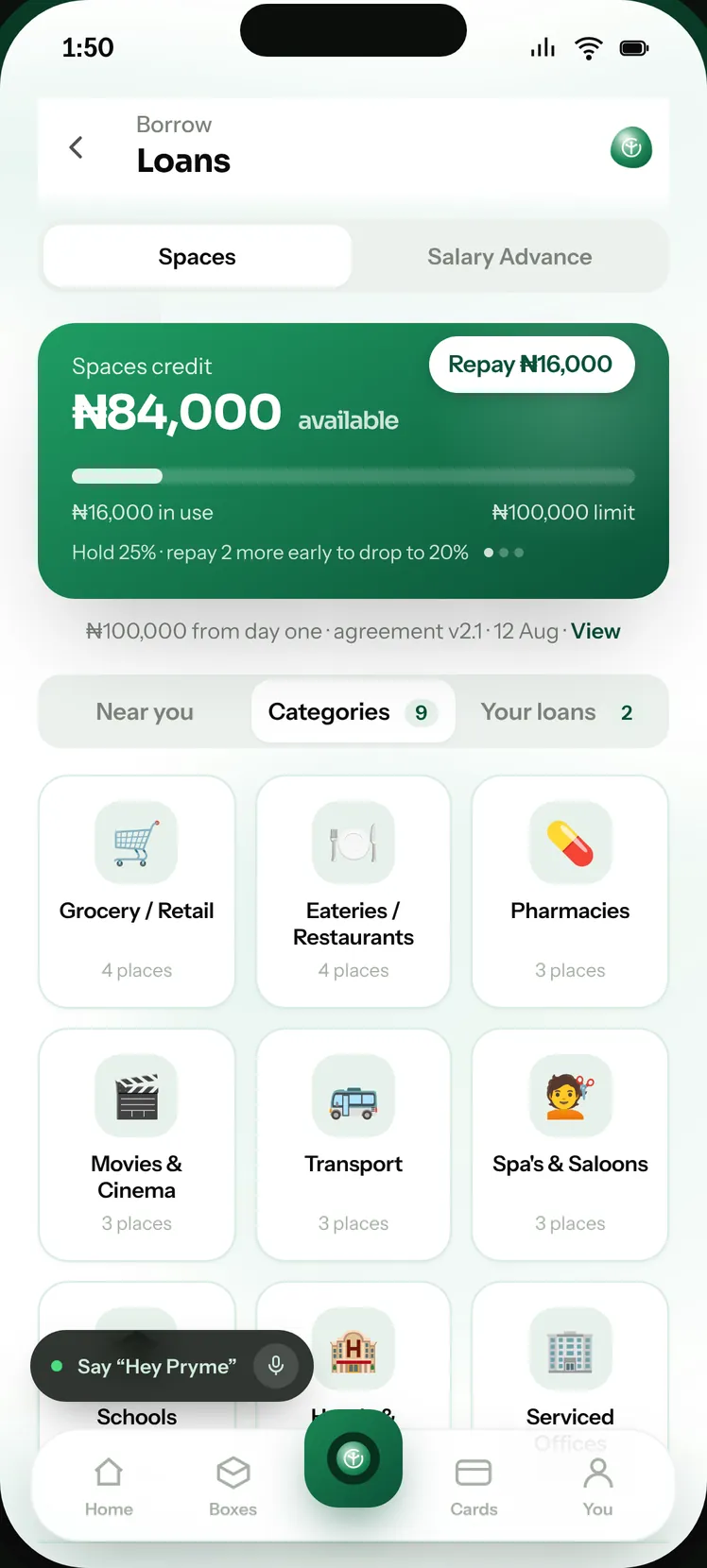
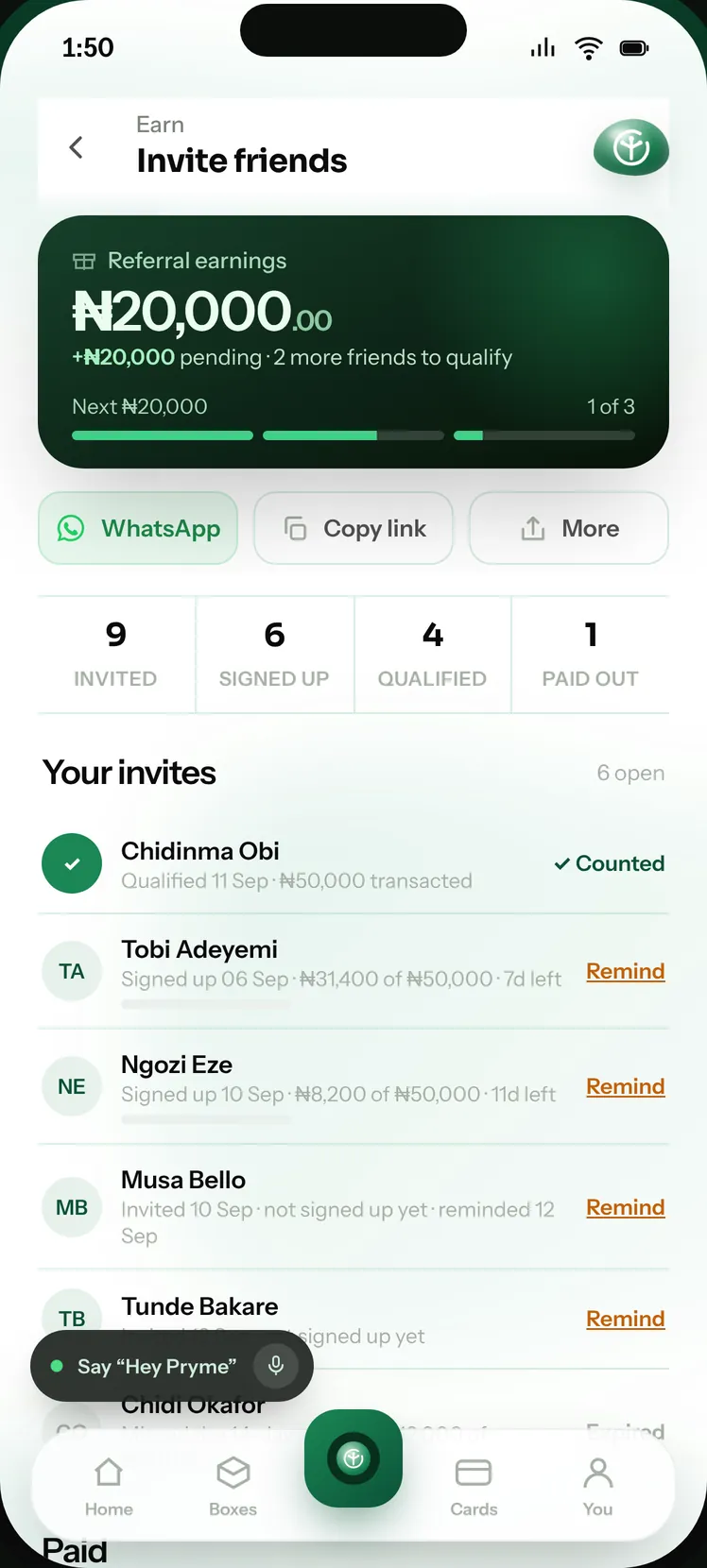
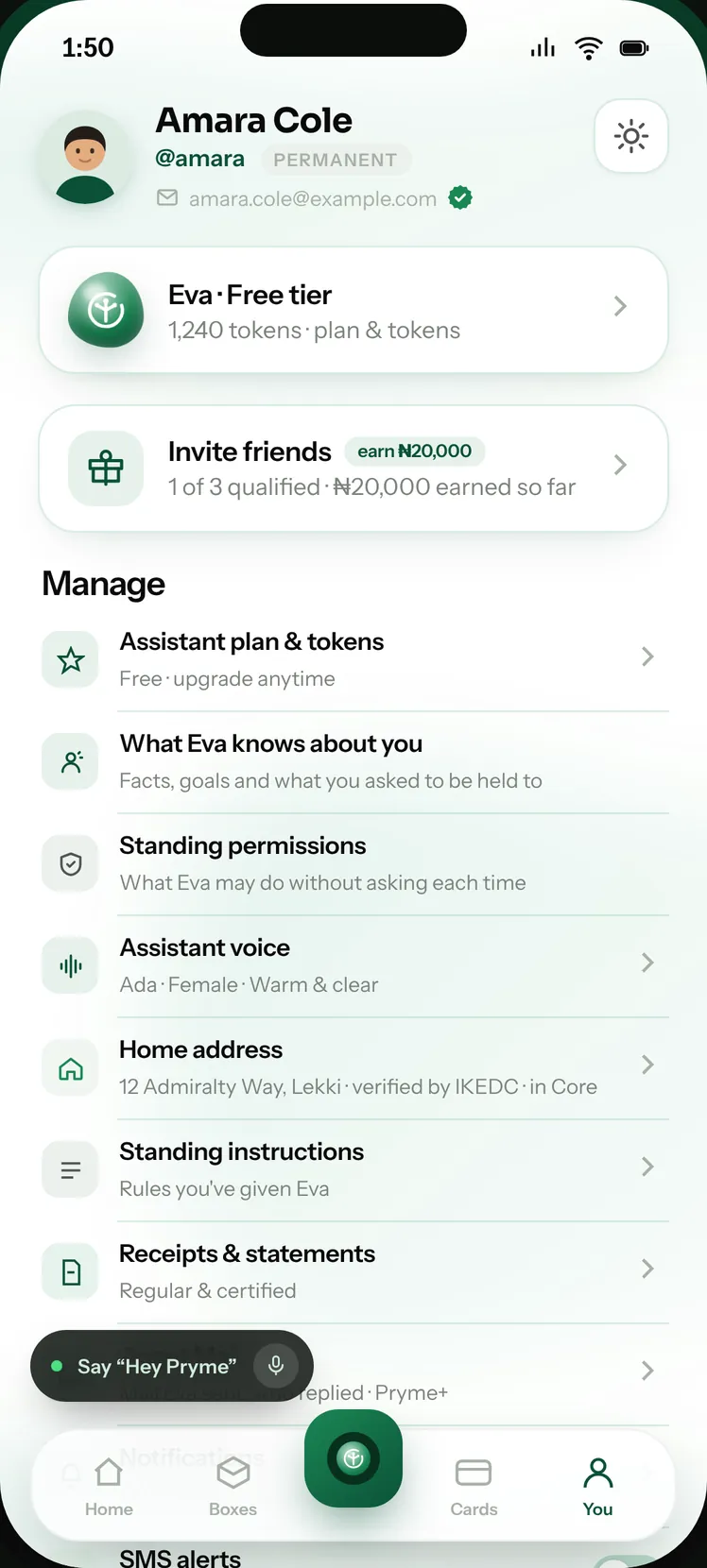
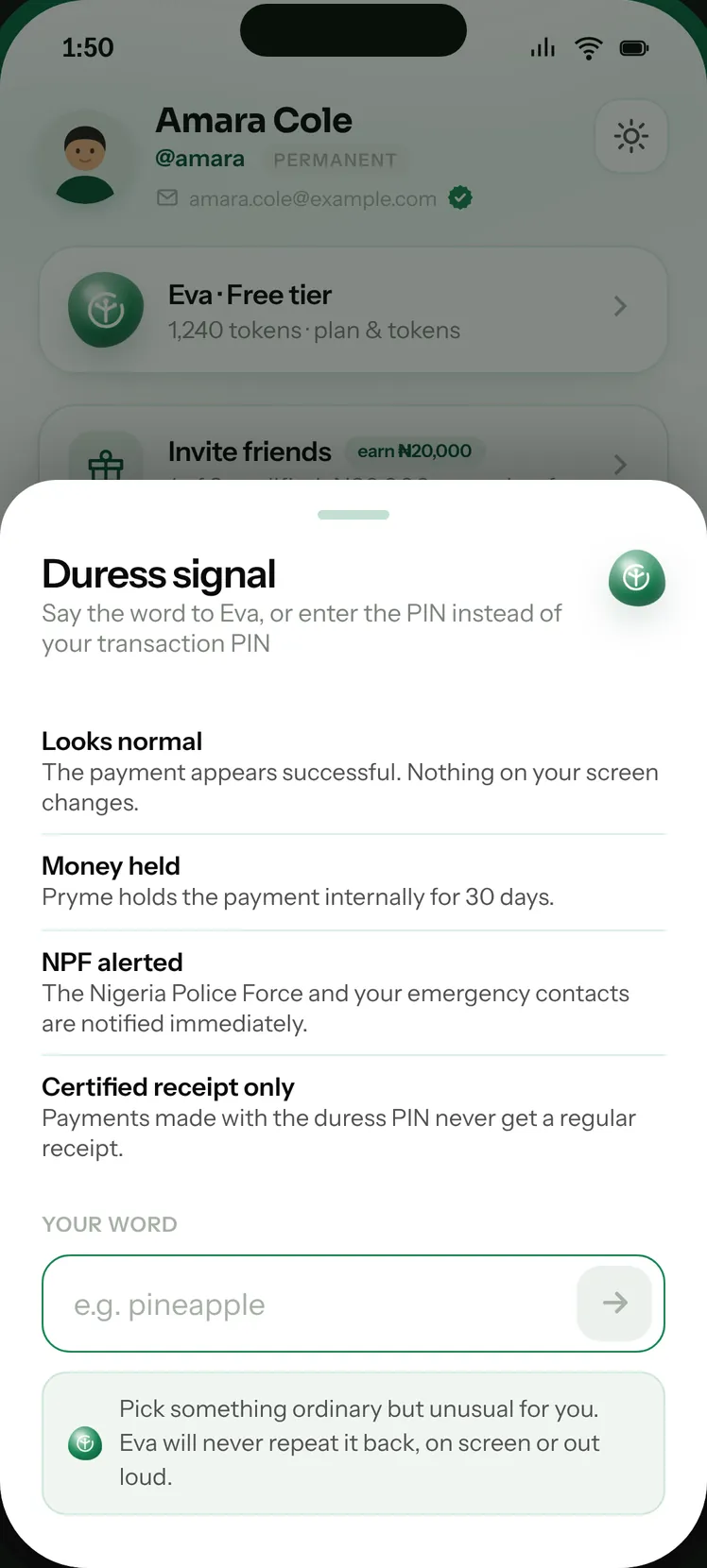
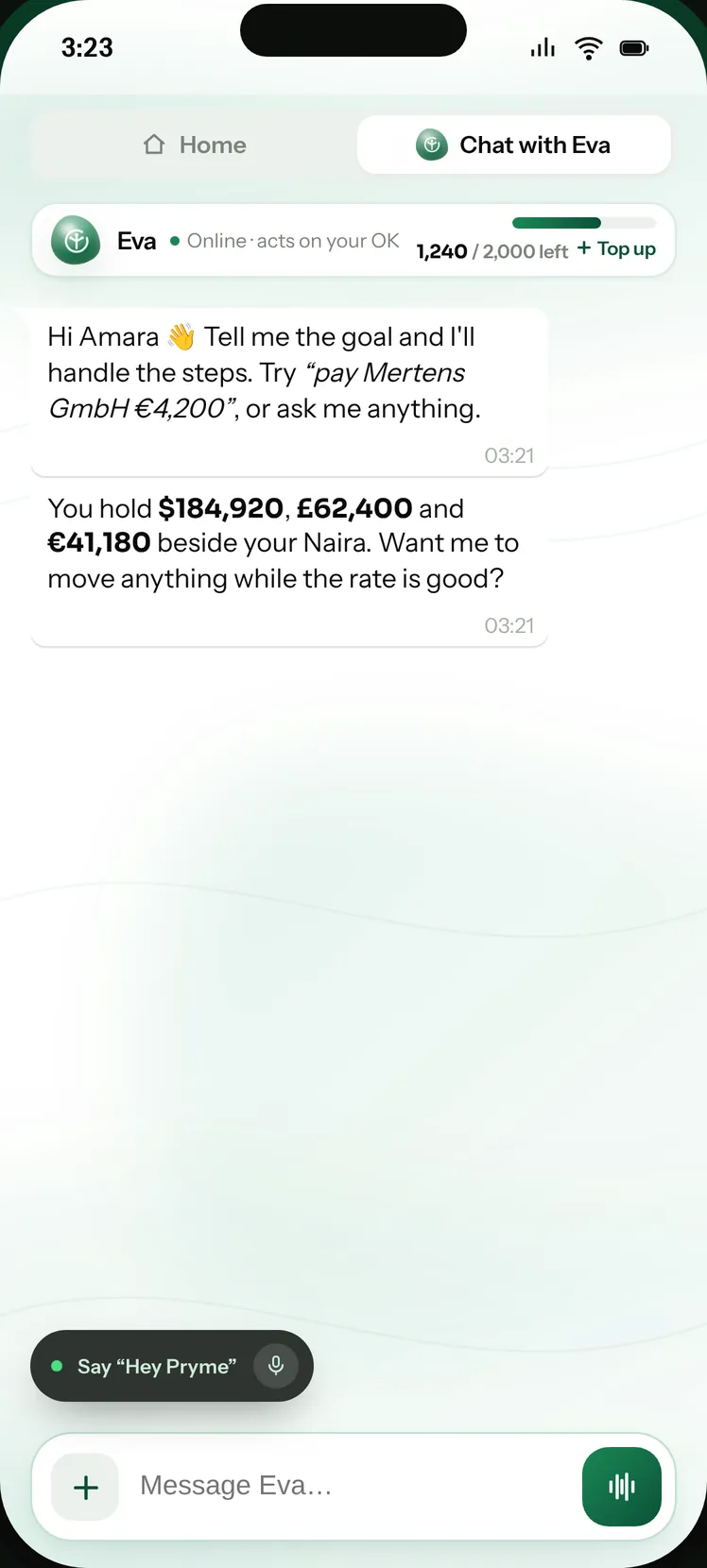
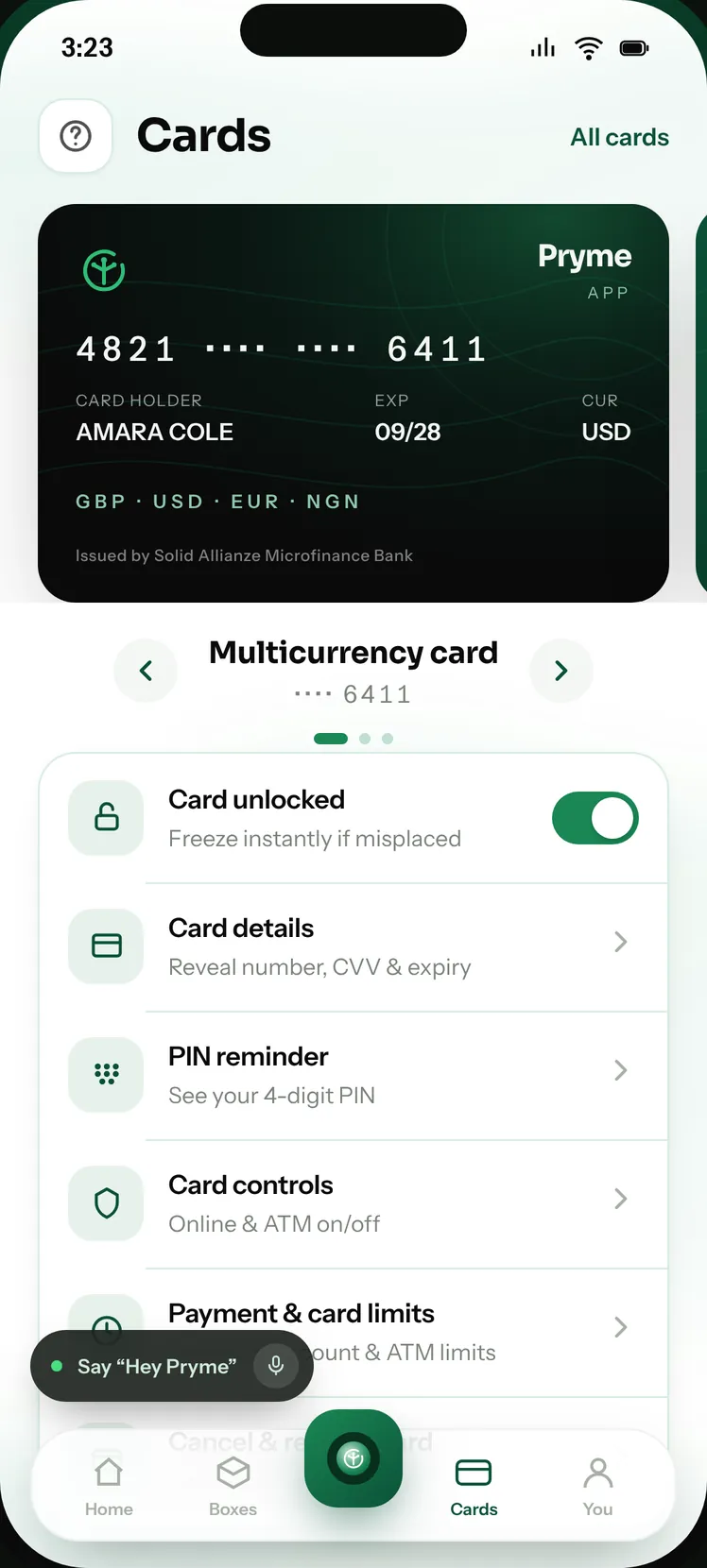
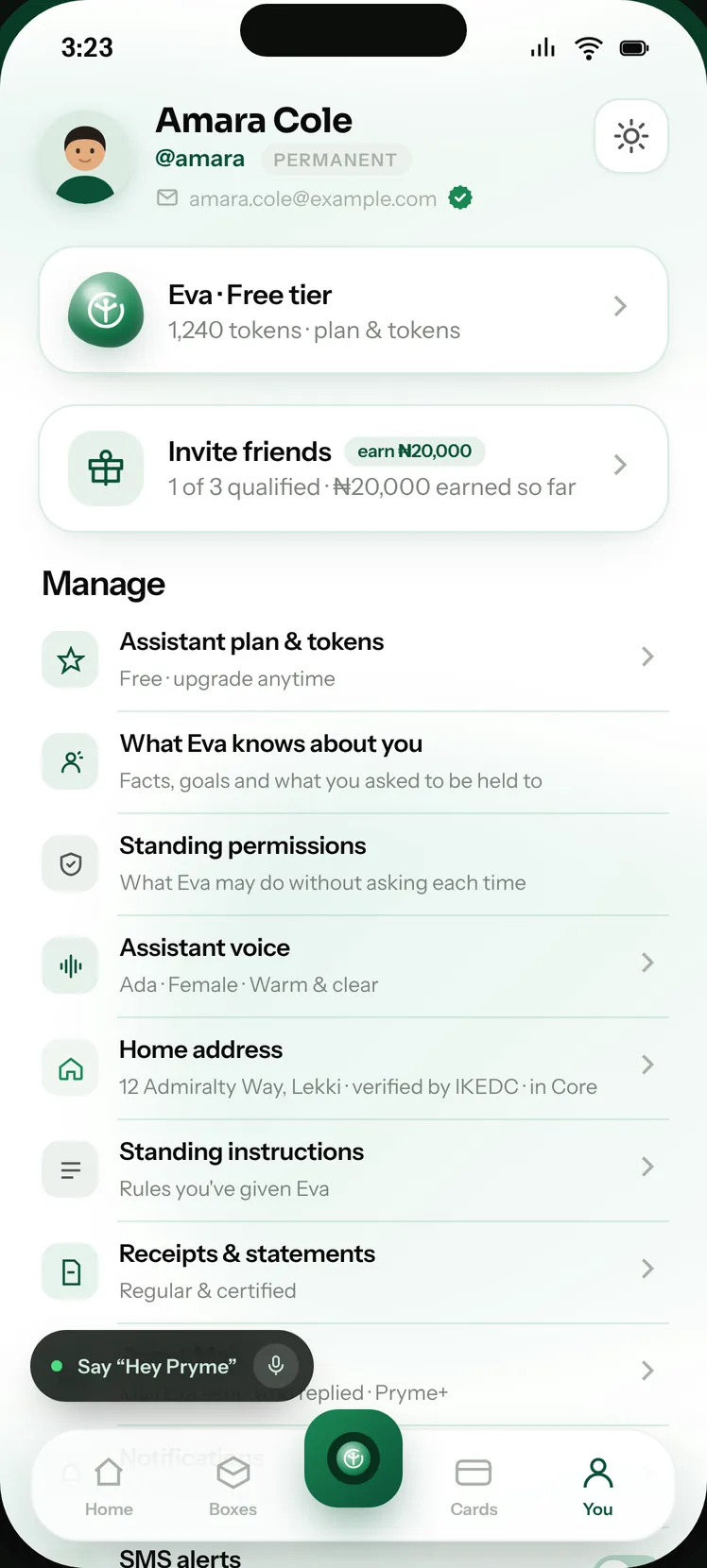
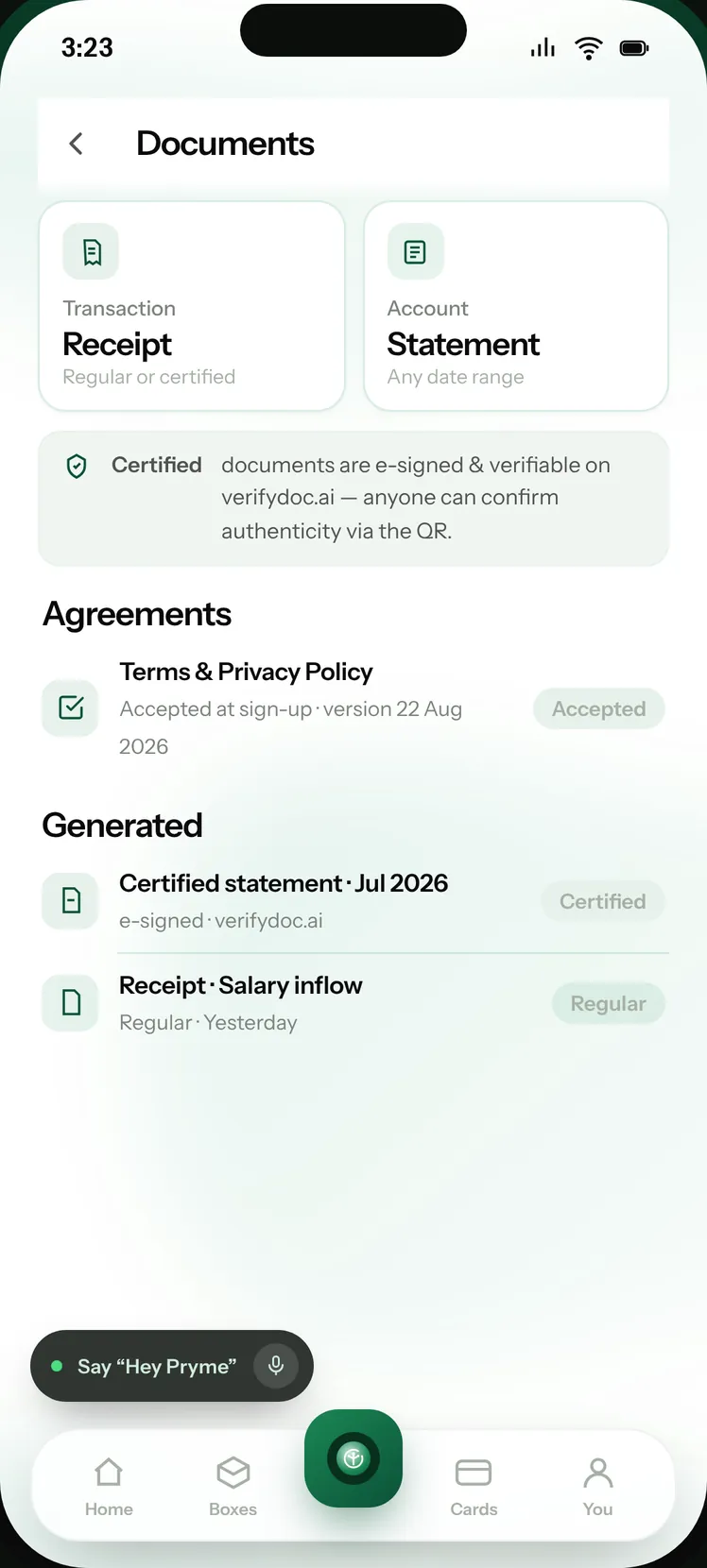
We give you a limit to spend at the shops and services you already use — and an account that works on your month while you get on with it. Dollars, pounds and euros sit beside your Naira, and an assistant handles the running of it, asking you first every single time.
One global account for your money and business. Move across currencies, automate everyday operations and put AI agents to work — with you in control of every important decision.


 Evayour assistant
 DanielChief of Staff
 BenFinance
 BruceCare
Your competitor down the road sells the same thing you sell. The difference is who walks in. We put money in people’s hands that can only be spent in businesses like yours — and then we point them at you.
You are not borrowing. You are selling to somebody who already has the money — and that money can only be spent with a business like yours.
₦100,000 from day one · agreement v2.1 · 12 Aug · View
Eva waits for your rate and asks before she moves anything.
No card, no OTP, nothing for the buyer to type in. They transfer from the bank app they already use, and the money lands in the same account your agents are running — already matched to the order, already in your books.
We give the buyer a one-time account number. They transfer to it from any bank app or by USSD — no card, no OTP, nothing to type in.
Get the account numberTo this account, from any bank app. We watch it, and the page updates itself.
₦26,767.50 from GTBank · John D., matched to order ORD‑1042.
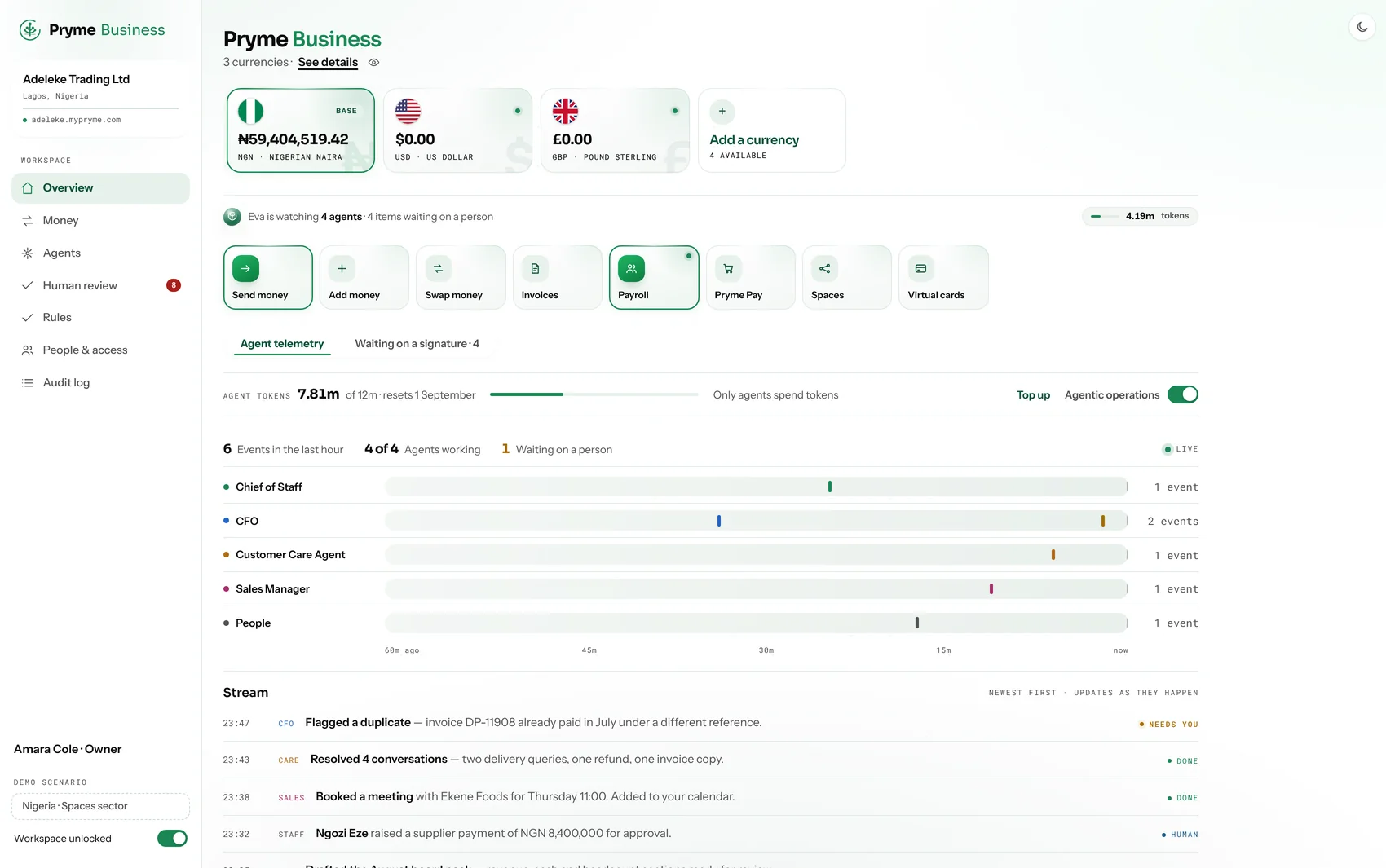
Five agents come with the account. Each one has a job description, a budget and a ceiling you set. They do the work and bring it to you — nothing leaves the account without your signature.
Knows what is stuck, who is waiting and what you promised — and keeps all three moving.
Booked a meeting with John Doe Foods for Thursday 11:00.Keeps the books as you trade and tells you the moment something does not add up.
Flagged a duplicate — invoice DP‑11908 was already paid in July.Holds every filing to its own clock and screens names and payments against your policy — and logs what it refuses.
Screened 412 payments overnight and refused two of them.Goes back to the buyers who went quiet, with the receipt already attached.
Recovered ₦410,000 across three overdue invoices.Replies, follows up on what they asked for and hands you only the ones that need you.
Resolved 4 conversations — two deliveries, one refund.Issue a dedicated Naira account number to each of your own customers, collect into it and reconcile against it. The same rails the Business Account runs on, with the licence behind them.
Dollars, pounds and euros beside a Naira account, on one ledger and one set of books. Five agents come with it and run the account — nothing leaves without your signature.
Five agents come with the account. Each has a job description, a budget and a ceiling you set. They do the work and bring it to you — they propose, you approve.
Knows what is stuck, who is waiting and what you promised, and keeps all three moving.
Booked the quarterly review with your auditor for Thursday.Keeps the books in every currency you hold and flags the moment something does not add up.
Flagged a duplicate — invoice DP‑11908 was already paid in July.Holds every filing to its own clock and screens names and payments against your policy — and logs what it refuses.
Screened 412 payments overnight and refused two of them.Goes back to the buyers who went quiet, with the invoice and the receipt already attached.
Recovered $12,400 across three overdue invoices.Replies, follows up on what they asked for and hands you only the ones that need you.
Resolved 4 conversations — two deliveries, one refund.The business has changed shape four times and never changed what it was rooted in. Each version was built out of what the last one could not do.
An online grocery store, built out of a faulty tab. Selling the food was the easy part — taking the money for it, and moving it, turned out to be the business.
A prepaid card. The first time the company issued rather than resold, and the first time it carried the obligations that come with holding somebody else’s money.
Solid Allianze acquired — an existing bank with an existing licence. The perimeter stopped being someone else’s to draw.
More than one currency on one balance, and the rebrand to Pryme. A Nigerian business could hold dollars without holding a second institution.
Accounts that do the work rather than only hold value. Five agents on the account, inside a policy you write — which is where the new mark starts.
Pryme is a financial technology company. It gives people and businesses in Nigeria one account that holds Naira alongside dollars, pounds and euros, and a set of agents that do the running of it — keeping the books, chasing what is owed, answering customers and paying bills. Nothing leaves an account without the owner’s approval.
Yes. A Pryme account holds Naira, US dollars, pounds sterling and euros side by side on one ledger, each with its own account details — a Nigerian account number, a US account number, a UK sort code and an IBAN for the euro area. You can swap between them at a rate you set, and every currency has its own statement.
Spaces is available in Nigeria. It gives a shopper money to spend that can only be spent with a participating business. The business is paid into its Naira account whether or not the shopper repays, because Pryme carries the credit. For the business it is free to join, there is nothing monthly, and the customer’s identity is never shown — only a reference and what it is worth.
Five agents come with the account. The Chief of Staff runs the week and keeps what is stuck moving. Finance watches the money and keeps the books as you trade. Compliance keeps the filings on time and screens what moves. Sales chases what you are owed. Customer Support answers your customers and follows up. Each has a job description, a budget and a ceiling you set, and each one proposes rather than acts — nothing leaves the account without your signature.
Pryme Pay takes payments on your own site or on a checkout page you control. The buyer is given a one-time account number and transfers to it from any bank app or by USSD — no card, no OTP, nothing to type in. The money lands in the same account your agents are running, already matched to the order and already in your books.
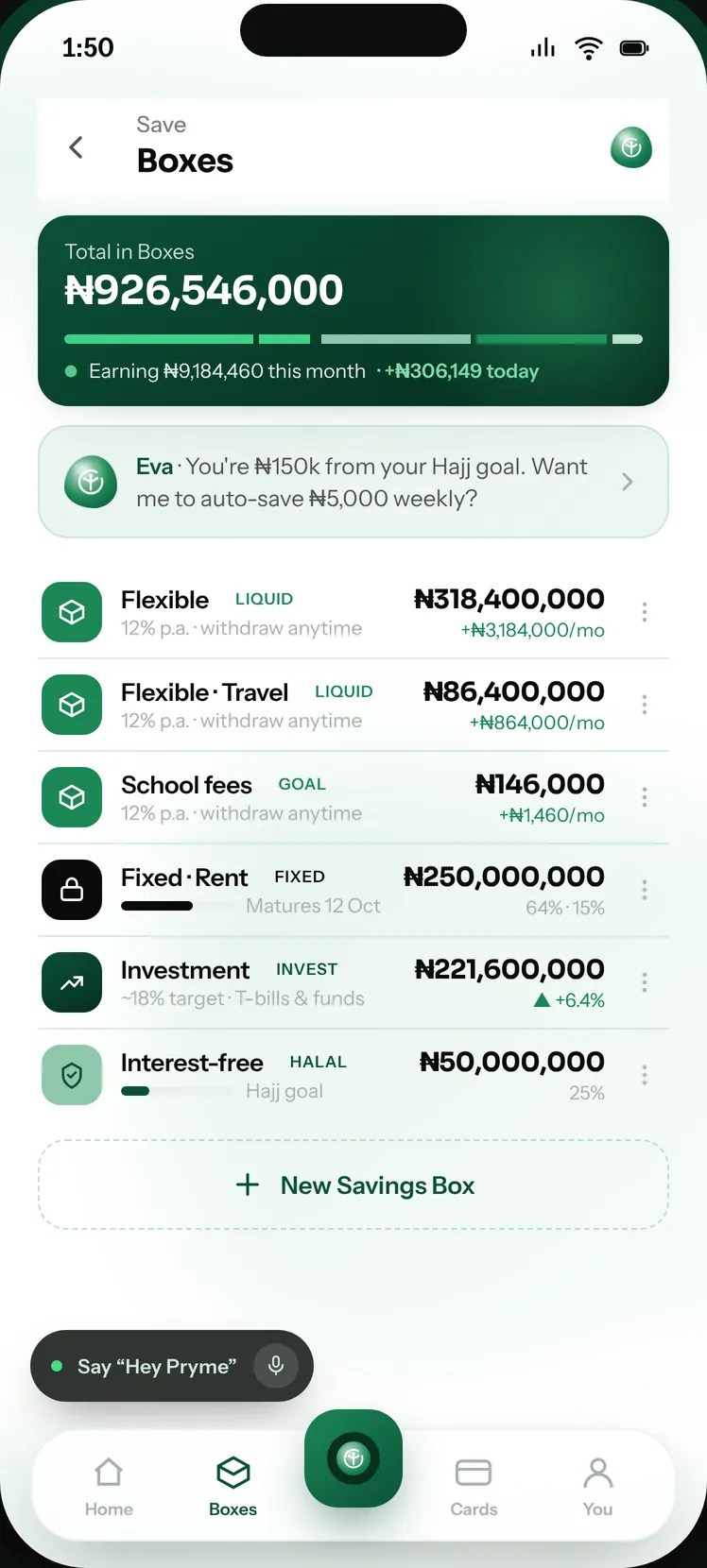
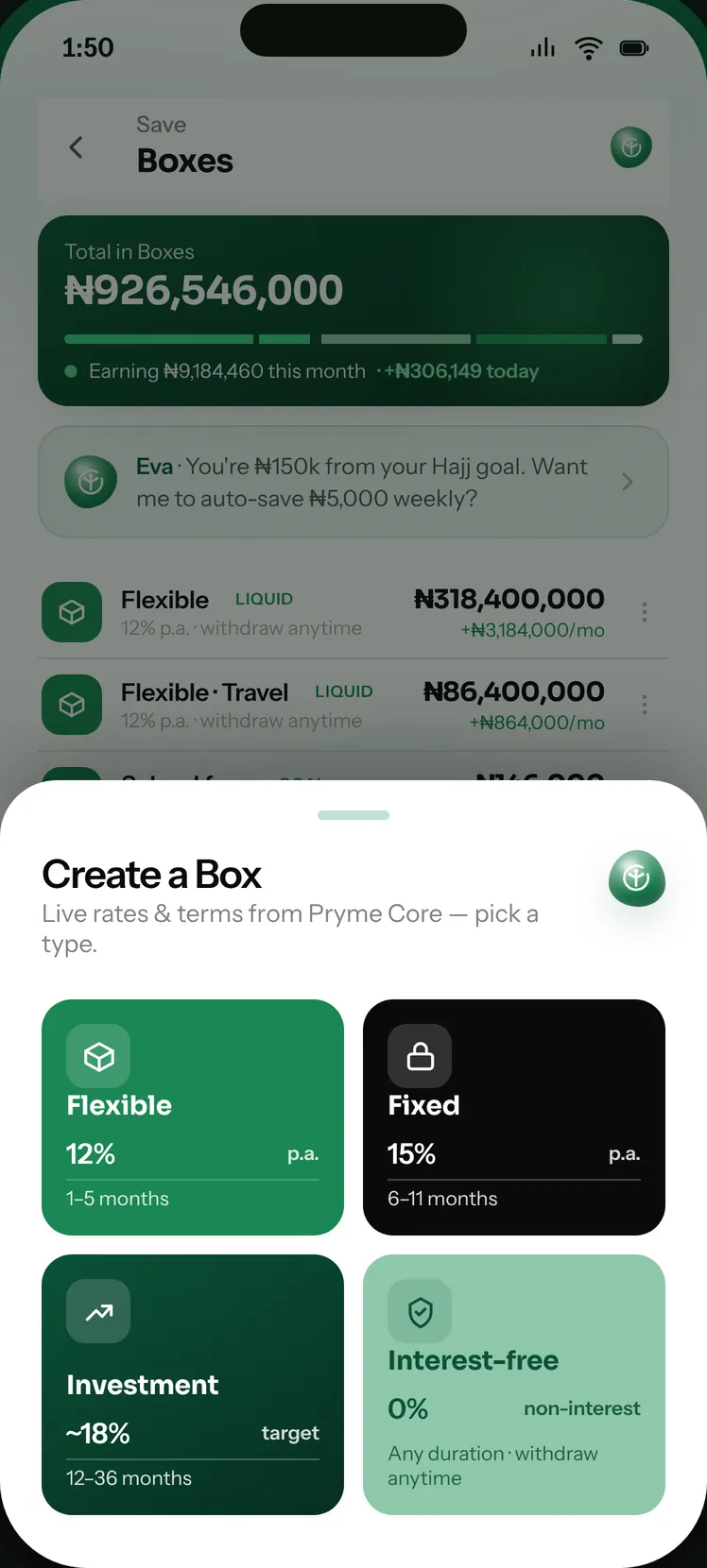
Savings Boxes are separate pots inside a Pryme account, held in Naira. Flexible Boxes can be withdrawn at any time, Fixed Boxes hold to a date, Investment Boxes hold for longer, and Interest-free Boxes earn nothing by design. A business can use them to ring-fence payroll and the tax it withholds, so that money cannot be spent by accident.
Pryme is a financial technology company, not a bank. Accounts and deposits are provided by Solid Allianze Microfinance Bank Limited, which is licensed by the Central Bank of Nigeria and is a member of the Nigeria Deposit Insurance Corporation.
Yes. Pryme Rails lets a platform issue a dedicated Naira account number to each of its own customers, collect into it and reconcile against it, over one API — the same rails the Pryme Business Account runs on.
Pryme is a financial technology company. It gives you one account that holds US dollars, pounds sterling and euros beside Naira, with an assistant that runs the account for you and asks before anything moves. Accounts are provided in Nigeria today, and further markets open as each licence lands.
Accounts are provided in Nigeria today, subject to verification and approval. Foreign-currency balances are held and converted inside that account, so you can hold, receive and swap dollars, pounds and euros wherever you are.
Naira, US dollars, pounds sterling and euros, side by side on one ledger. Each has its own details — a Nigerian account number, a US account number, a UK sort code and an IBAN for the euro area — and each has its own statement.
Swap at a rate you set rather than the rate of the day, then send to any Pryme username or to a Nigerian bank account. There is no fee to send to another Pryme account.
Eva is the assistant inside the Pryme app. She opens accounts, moves money, saves toward your goals, pays what is due and follows up what is owed to you — and asks you before anything moves.
Pryme Rails lets a platform issue a dedicated Naira account number to each of its own customers, collect into it and reconcile against it, over one API — the same rails the Pryme Business Account runs on.
Notes on money that does the work: what we are building, what the regulation actually says, and how we think about letting software act on money. Read the Ledger
What AI agents can do in bookkeeping, close, collections and compliance today, where a person must stay in charge, and how to judge a product.
How multi-currency business accounts work: local details vs SWIFT, payment rails, the real cost of FX, safeguarding vs deposit protection, and hedging.
How UK, US, Canadian and European firms pay Nigerian suppliers and get paid by Nigerian clients: FX, Form A and M, tax, compliance and payout routes.
What it really costs to send money to Nigeria from the UK, US, Canada and Europe: fees, exchange-rate margins, CBN naira rules, BVN, speed and scams.
What AI can and cannot do in day-to-day bookkeeping, how much time it saves on real numbers, and which jobs must stay with you or your accountant.
How upfront interest changes what a fixed deposit really earns, why it depends on how the bank calculates it, and a worked example of both methods.
With interest at maturity you receive principal plus interest at the end; with upfront interest you receive the interest on day one and only the principal at the end. If the bank pays the full interest upfront, the effective yield is higher because less of your money is tied up, but if the provider discounts the upfront interest, it can be worth less than interest at maturity.
Most Nigerian fixed deposits pay interest when the deposit matures. Some providers, and some negotiated deals, offer to pay interest at the start instead. It sounds like a clear win: money in your hand now. Whether it is depends entirely on how the upfront amount is calculated. This article shows both methods with numbers.
Among the banks' own pages we checked, Sterling Bank says its fixed deposit pays interest at maturity, and Access Bank's 1 Year Fixed Rate Deposit form refers to payment at maturity alongside a quarterly option. Neither lists an upfront option, so if you want one, ask, and get the calculation in writing.
Illustrative figures: ₦1,000,000 for one year (365 days) at a quoted 20%, with 10% WHT.
| At maturity | Upfront, full interest | Upfront, discounted | |
|---|---|---|---|
| Gross interest | ₦200,000 at the end | ₦200,000 on day one | ₦166,666.67 on day one |
| WHT at 10% | ₦20,000 | ₦20,000 | ₦16,666.67 |
| Net interest received | ₦180,000 at the end | ₦180,000 on day one | ₦150,000 on day one |
| Your money actually tied up | ₦1,000,000 | ₦820,000 | ₦850,000 |
| Effective net yield | 18.0% | about 21.95% | about 17.65% |
So the question to ask is not "do you pay upfront?" but "how much will you pay upfront, and how is it calculated?" Then compute the effective yield as net interest divided by principal minus net interest.
Upfront interest only helps if you use it well. If it sits in a current account earning nothing, the cash-flow benefit is real but the return benefit is not. If you place it in another deposit, you earn interest on interest. If you spend it, you have in effect borrowed against your own deposit, which can be sensible for a planned expense such as school fees.
If you break an upfront-interest deposit early, the bank has already paid you interest for days you did not complete. Expect it to recover that, usually by deducting it from the principal it returns, possibly with an extra charge. Get the early termination rule in writing before you agree. Our article on breaking a fixed deposit early covers typical approaches.
When withholding tax is taken from an upfront payment, the deduction falls in the month the deposit starts, not when it ends. If you keep records for your own tax position, note the date and amount of the deduction from the bank's advice; our explainer on withholding tax on interest covers how deductions are recorded. If the deposit spans two tax years, ask the bank how it reports the interest, because the timing on its statement may differ from the period the interest covers. This does not change the arithmetic above, but it matters if you later need to show what tax was deducted, or if you are a company claiming the deduction as a credit.
Upfront interest suits someone who has a known expense now and money that is not needed for a year: a parent paying a term's fees today from a deposit that will be needed only next year, for example, provided the upfront amount is the full interest. It suits less well someone who would simply leave the upfront cash idle, or who may need to break the deposit, because recovering paid interest makes early exit more expensive.
For the basic arithmetic see how fixed deposit interest is calculated, and for regular income see fixed deposits that pay monthly.
Pryme's Fixed and Investment Boxes show the current rate in the app before you commit, so you can run the same comparison against a bank's offer. Boxes are naira only. See Savings Boxes.
Only if the bank pays the full interest upfront. If it discounts the upfront interest, you can end up earning less than with interest at maturity.
Either as the full interest for the term, or as a discounted present value, for example ₦200,000 ÷ 1.20 on a one-year 20% deposit. Ask the bank which method it uses.
The bank pages we checked did not list an upfront option; Sterling says it pays at maturity. Ask your bank whether it offers one on your amount and tenor.
The bank will usually recover interest already paid for days not completed, often from the principal. Get the rule in writing first.
This article is general information, not financial, legal or tax advice. Products described are provided under the terms on this site and are subject to regulation and eligibility.
Nigeria's Investments and Securities Act 2025 treats digital assets, stablecoins included, as securities under SEC oversight. What that means for USDT.
How voluntary RSA contributions are set up, the one-third of pay limit, the five-year tax rule on income withdrawn early, and contingent VC for housing.
Wema's branch fixed deposit and ALAT's locked goals are booked differently and neither publishes full terms. How to compare them and exit early.
You can add the other type later — many of our customers hold both.
The business first, then you. Nothing is submitted until you review it.
Ideal customer profiles
Generated from your website by VerifiedLead.ai
Pick the ones that look right. Your Sales agent works these first, and you can change them at any time after opening.
We ask this because you have not given us a website. It helps us set the right limits from day one.
Which of these represents you?
Officers listed against this company on the UK register.
We have sent a six-digit code to your email address. Enter it below to confirm the address is yours.
Wrong address? Go back and change it — nothing is created until this step passes. We never ask for a code by phone or email; anyone who does is not us.
Last step. Each time you sign in we email you a six-digit code — we never send codes by SMS.