AI agents for business finance: what they can and can't do
What AI agents can do in bookkeeping, close, collections and compliance today, where a person must stay in charge, and how to judge a product.
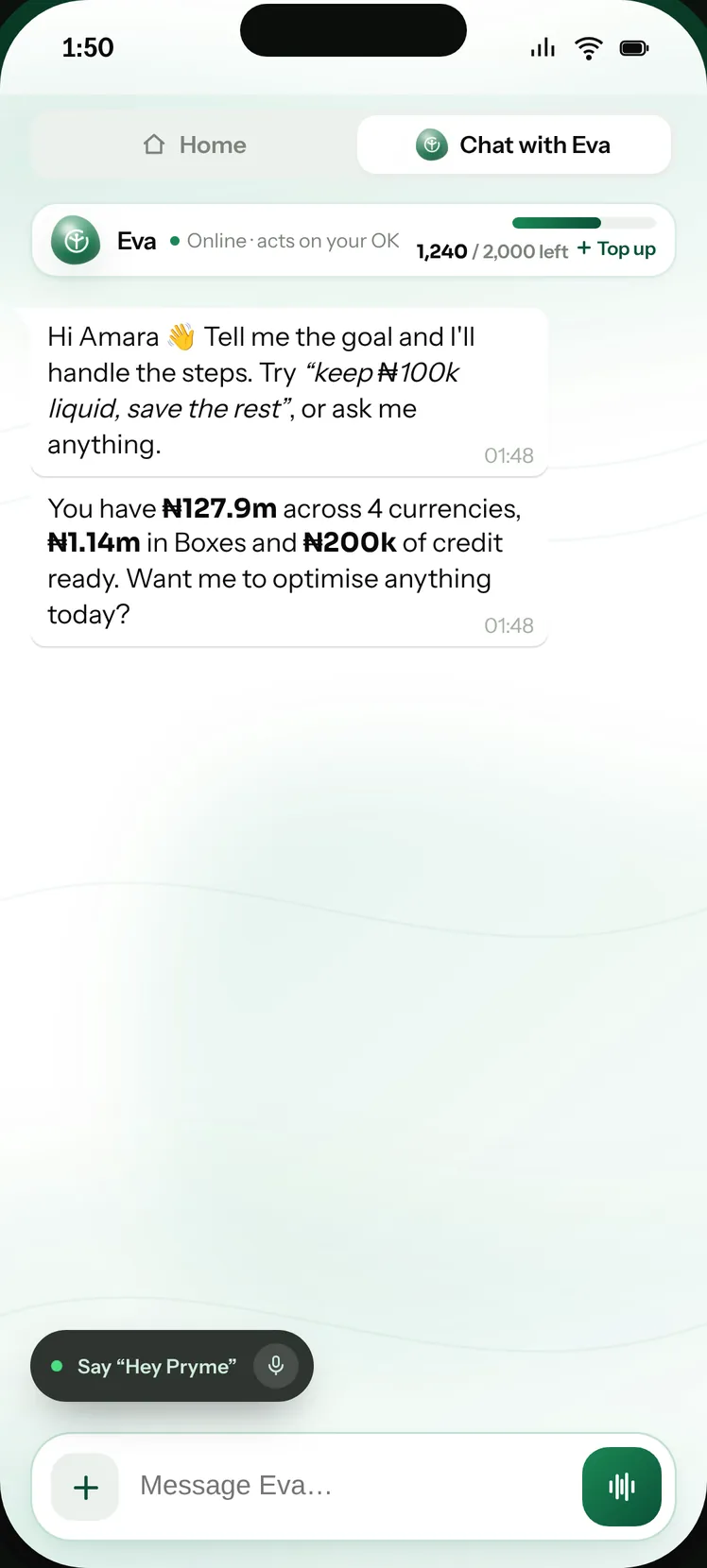
Meet Eva, the assistant inside the Pryme app. She opens accounts, moves money, saves toward your goals and follows up. Nothing leaves your account without your approval.
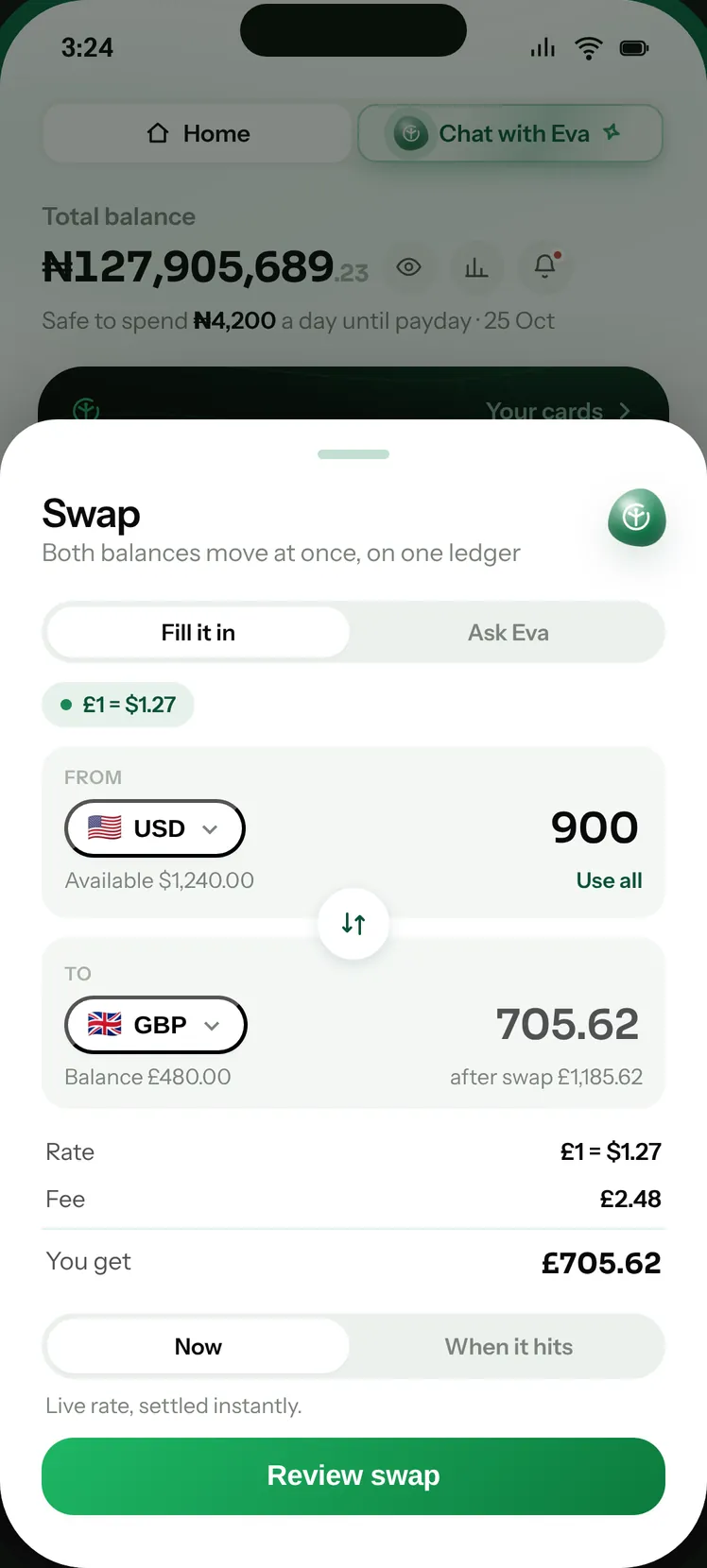
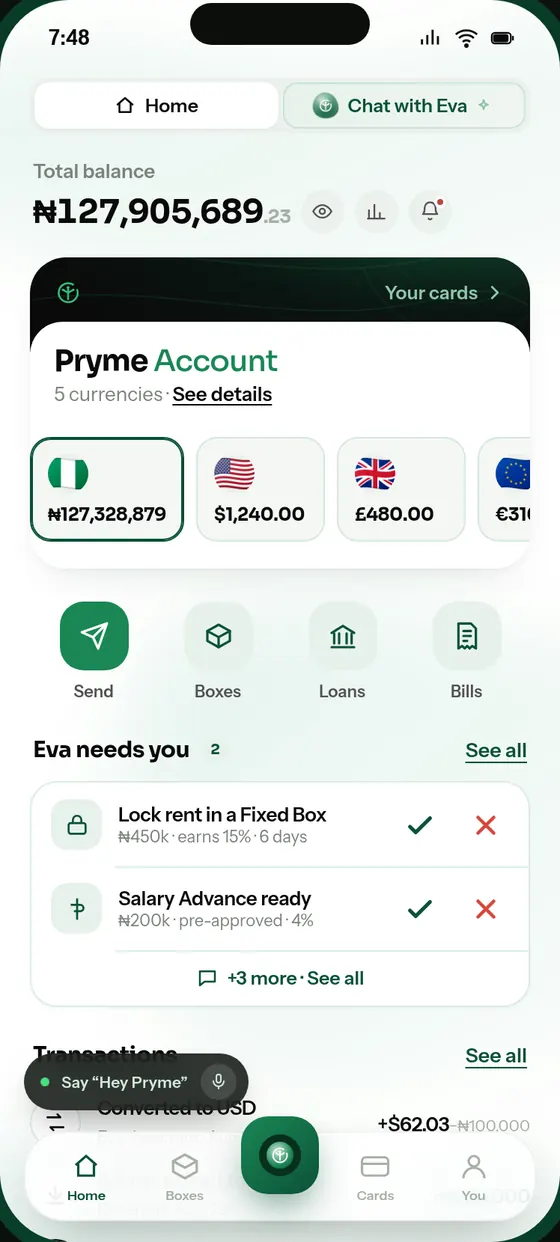
Meet Eva, the assistant inside the Pryme app. She holds dollars, pounds, euros and Naira side by side, swaps at a locked rate, pays bills in any of them and sends anywhere, asking before anything moves.
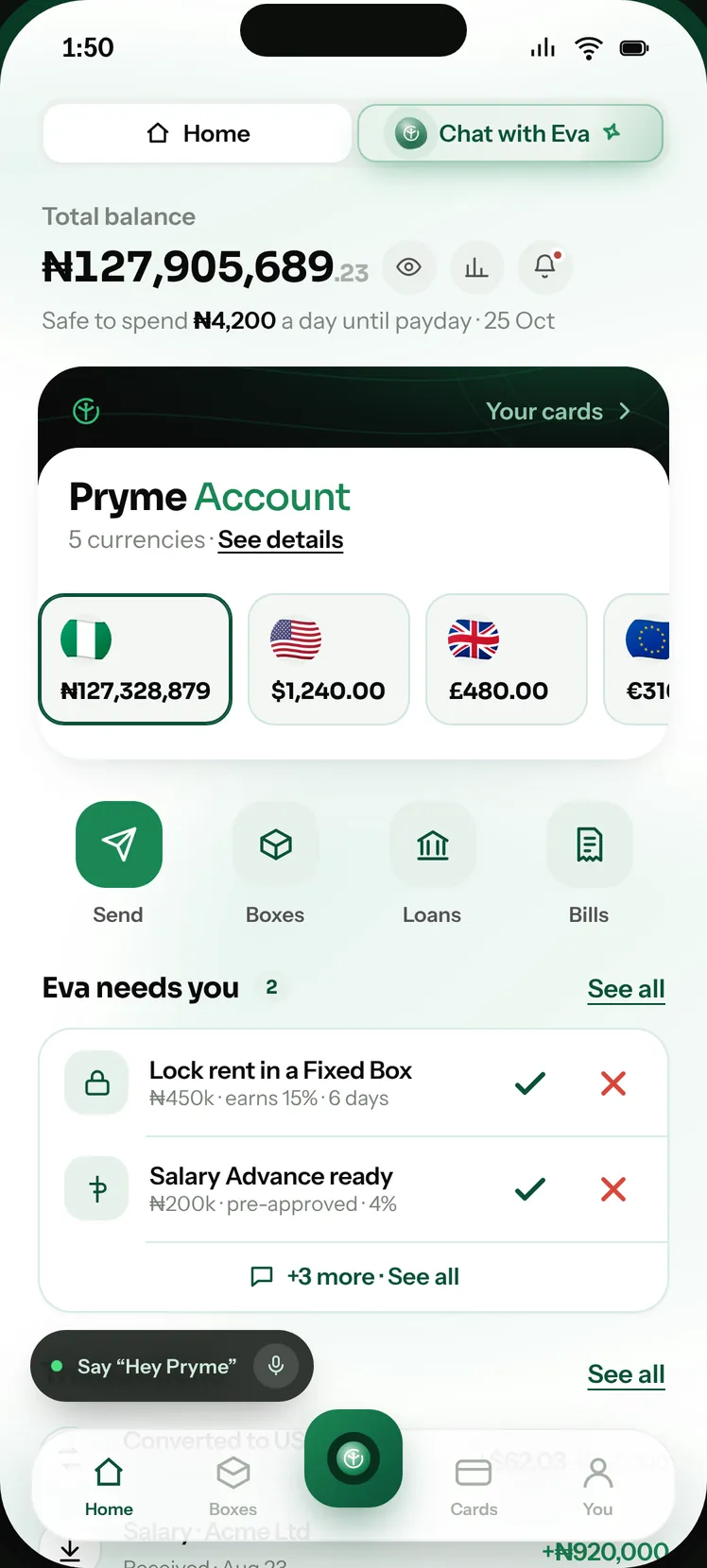
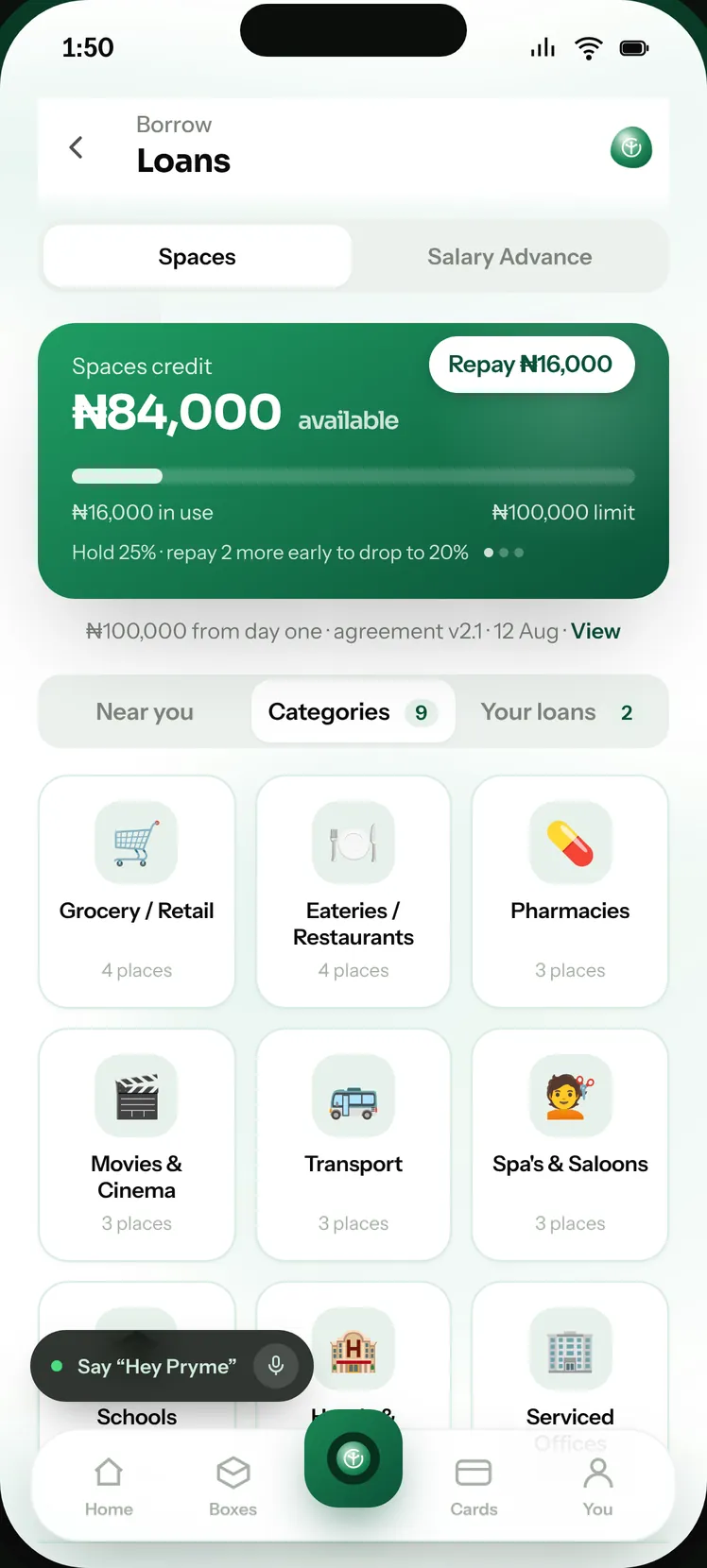
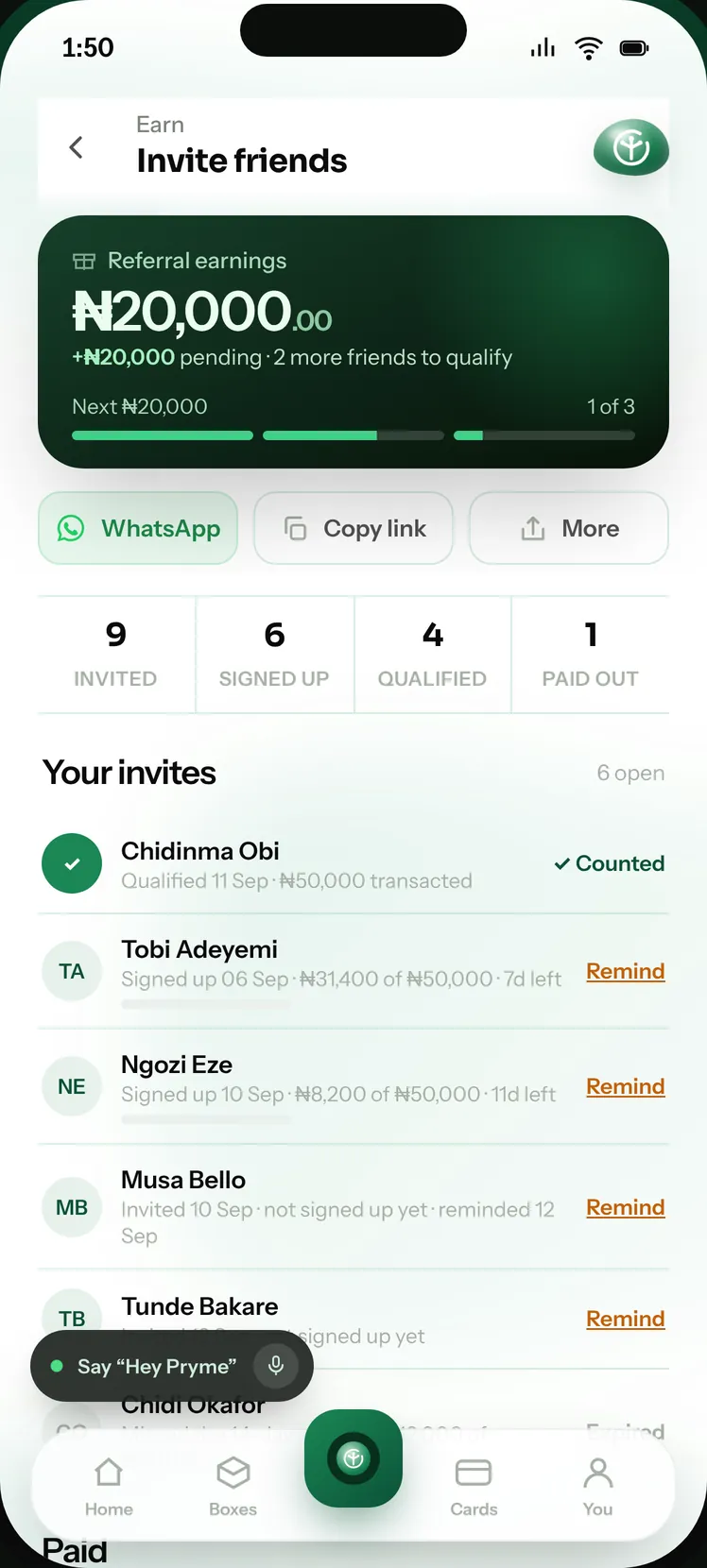
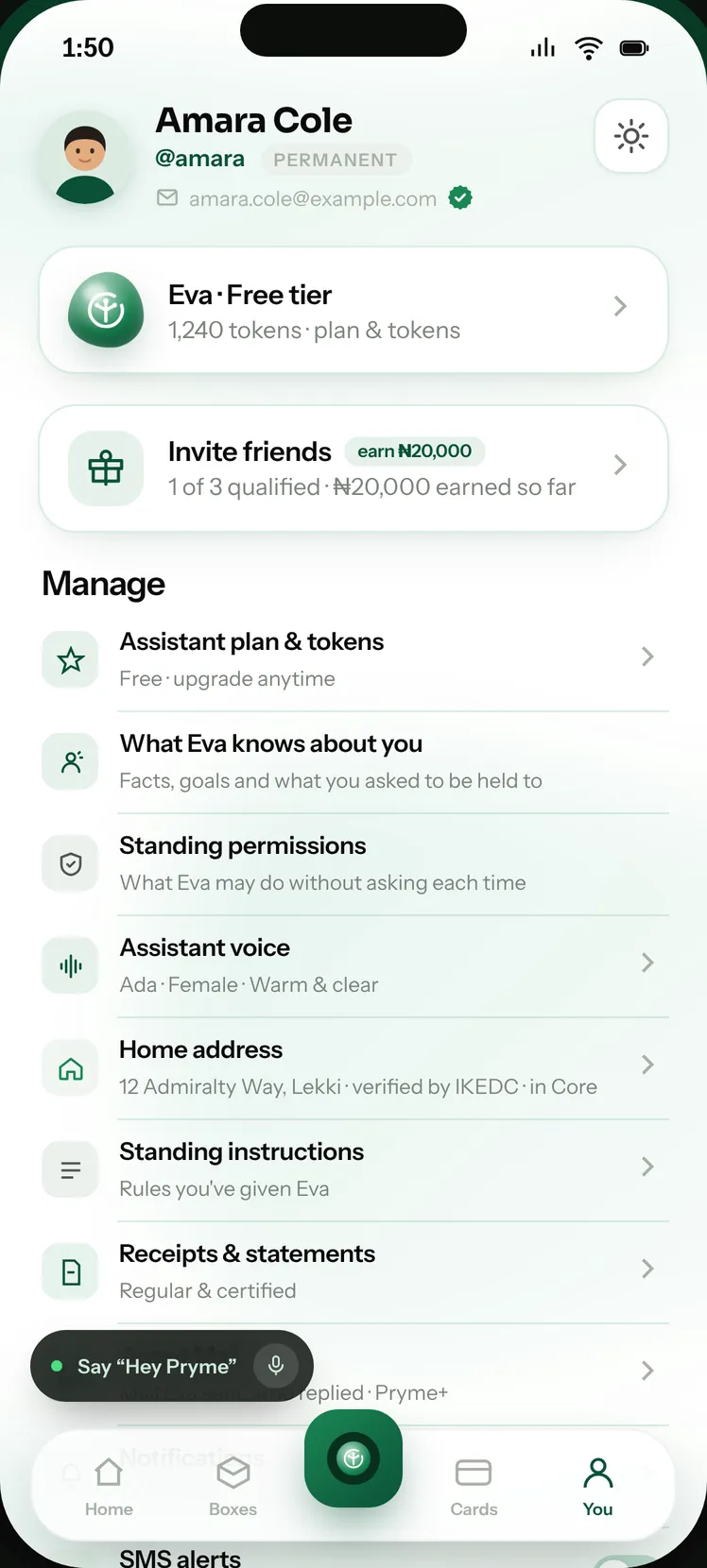
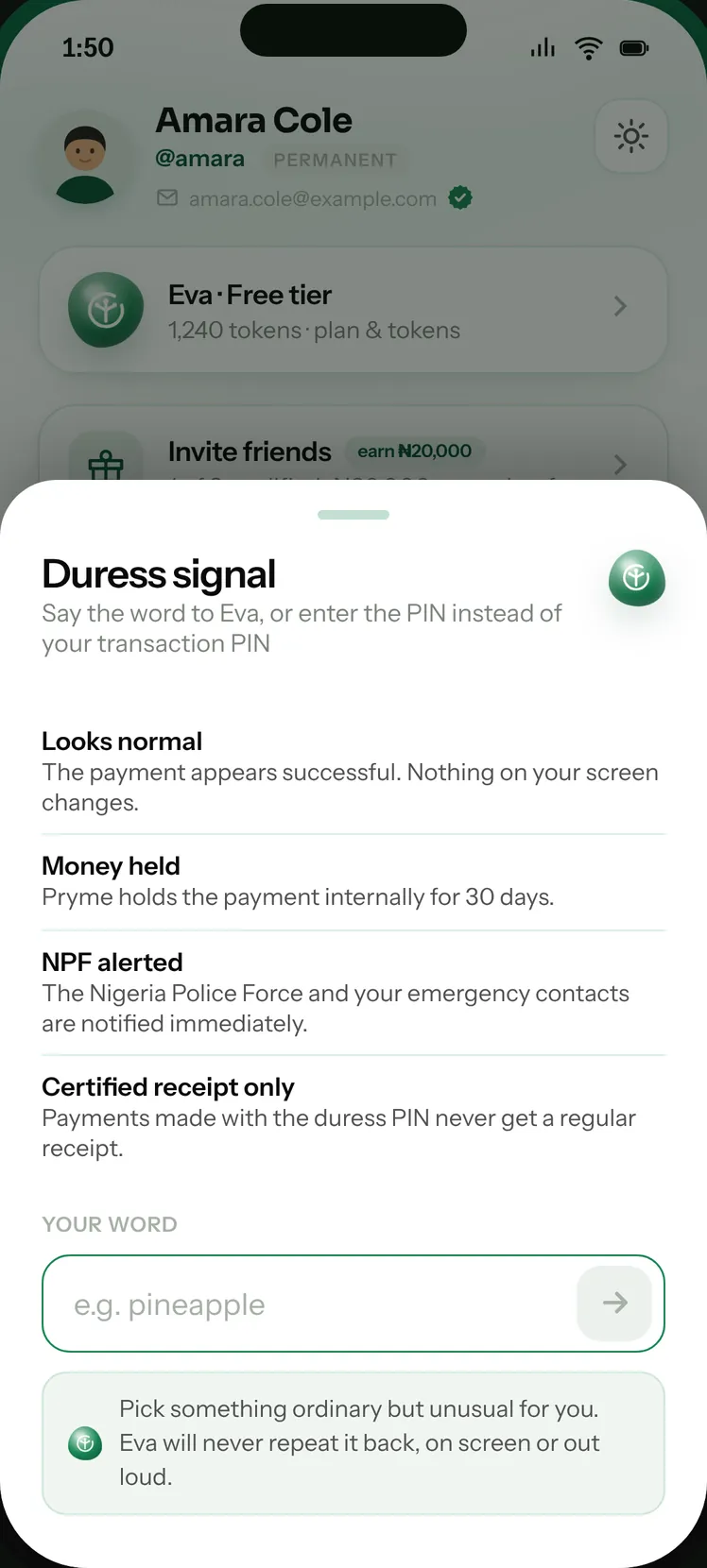
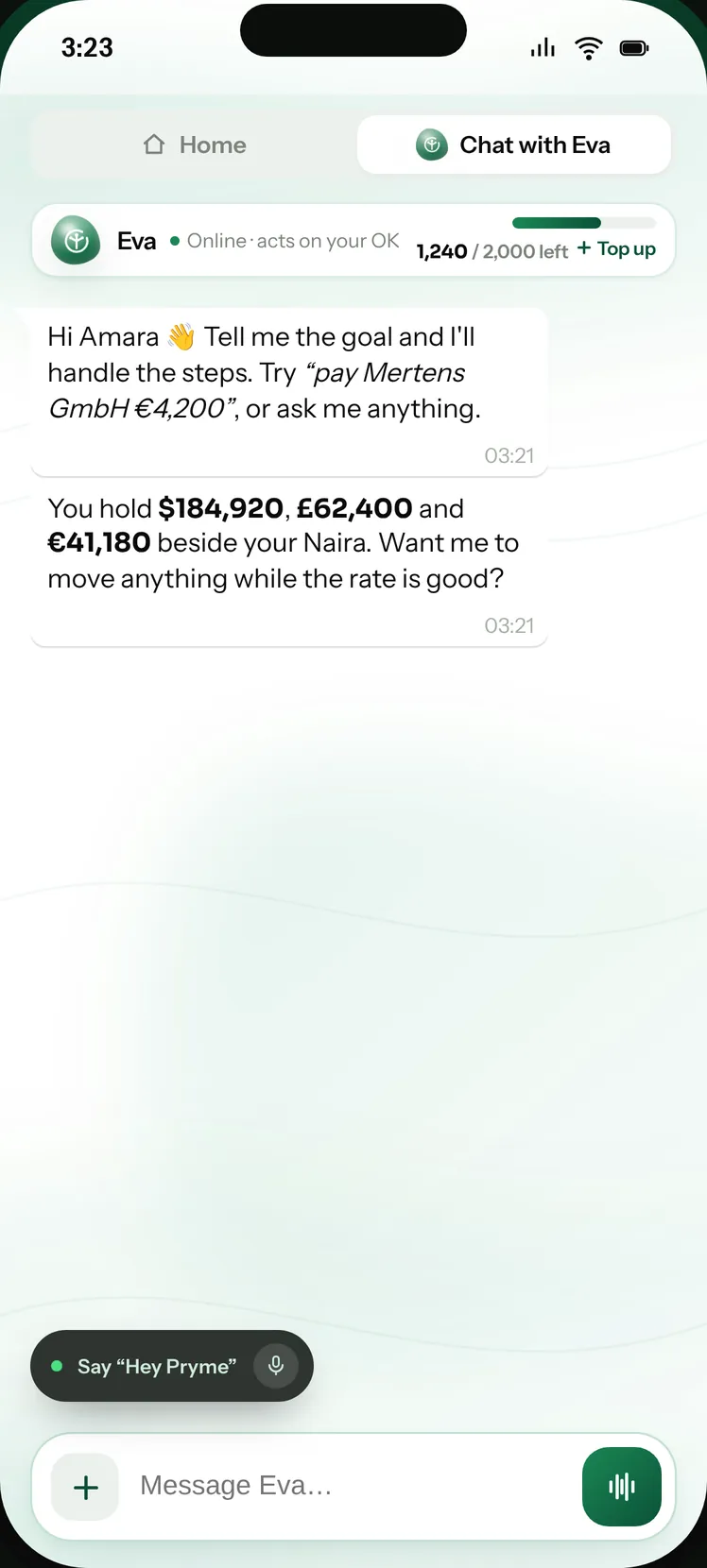
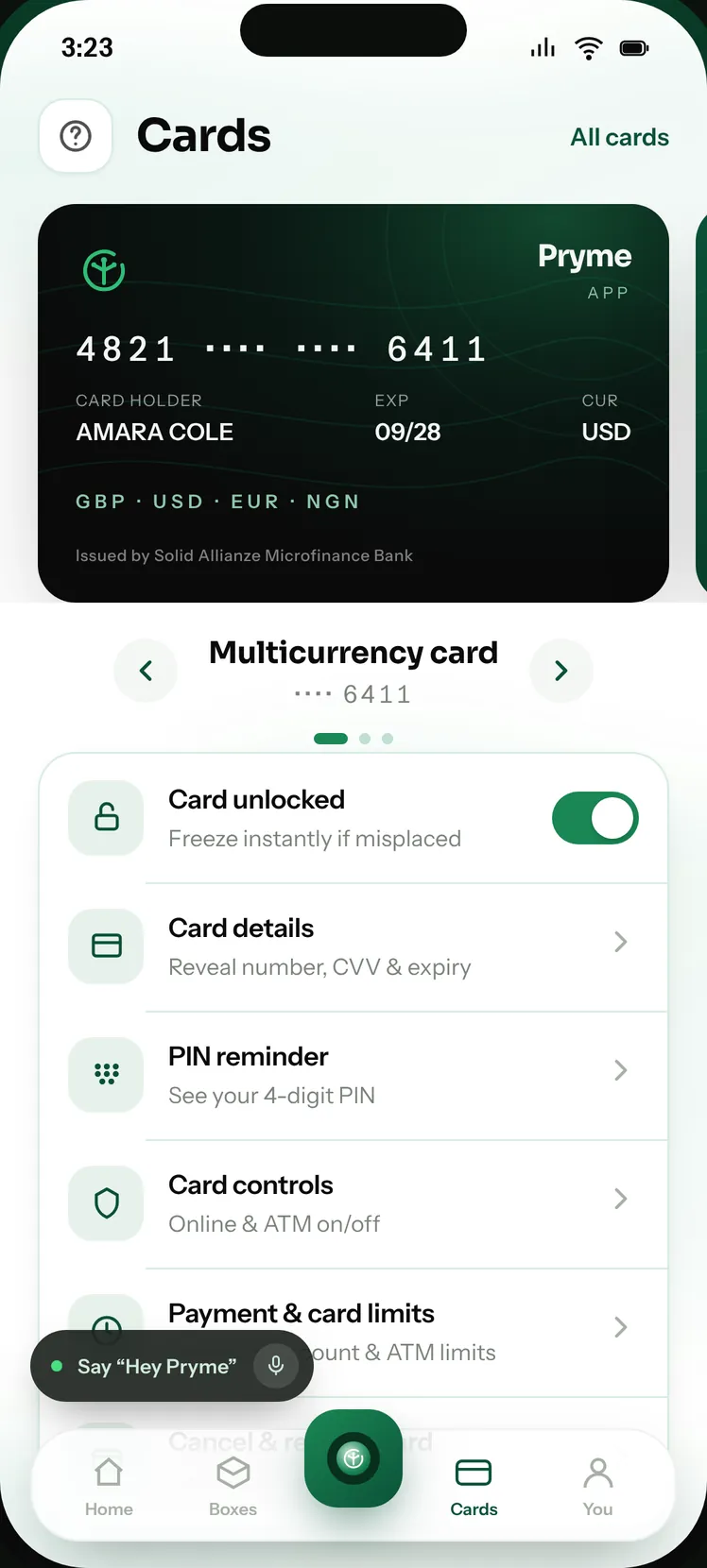
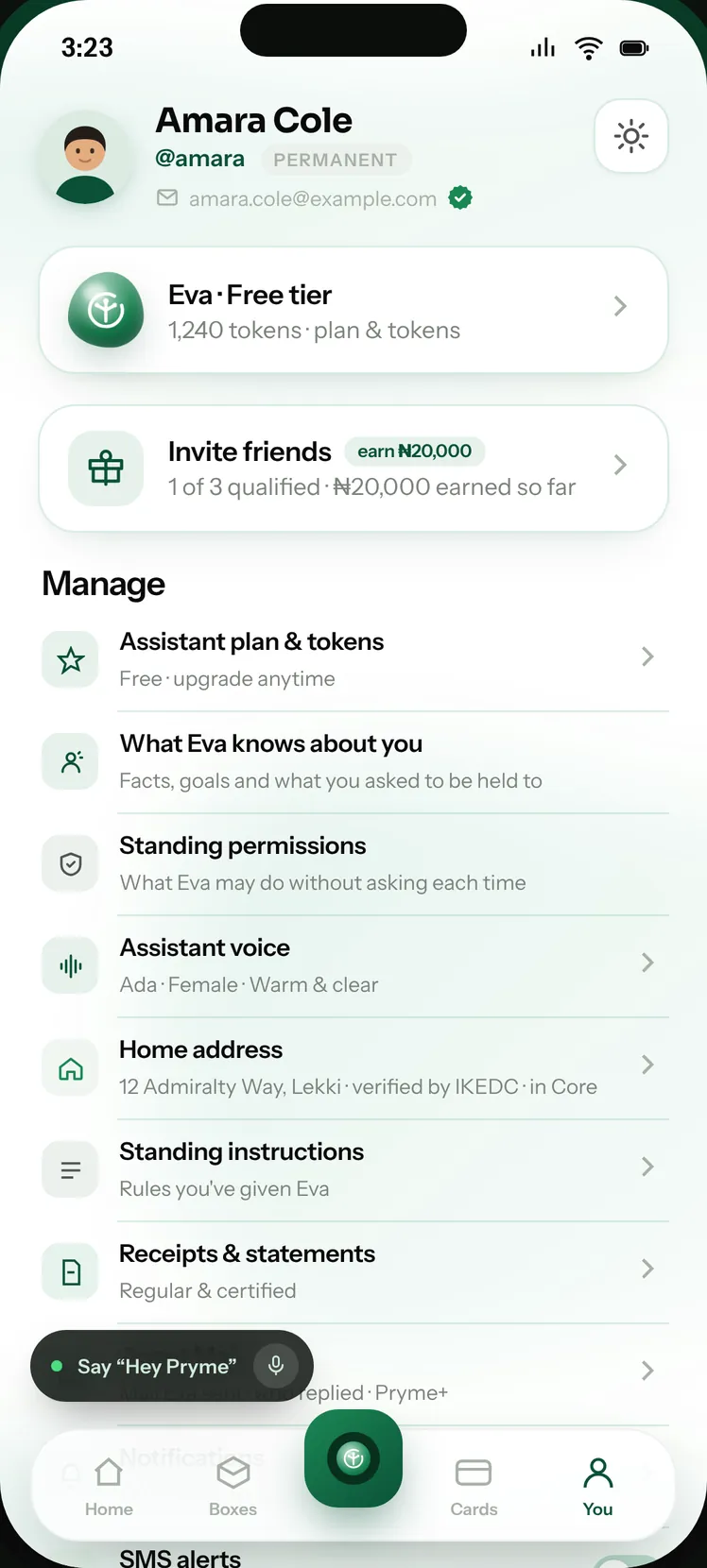
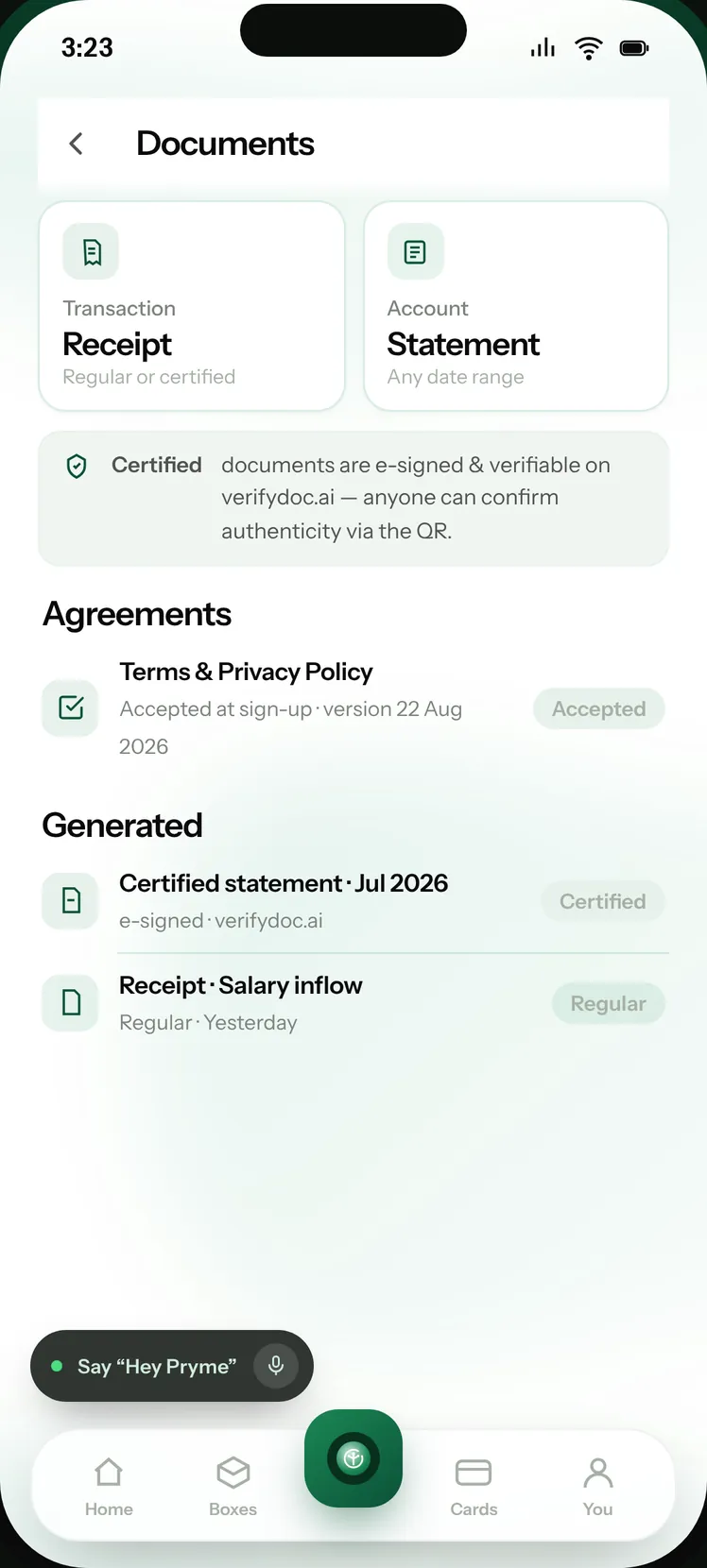
We give you a limit to spend at the shops and services you already use — and an account that works on your month while you get on with it. Dollars, pounds and euros sit beside your Naira, and an assistant handles the running of it, asking you first every single time.
One global account for your money and business. Move across currencies, automate everyday operations and put AI agents to work — with you in control of every important decision.


 Evayour assistant
 DanielChief of Staff
 BenFinance
 BruceCare
Your competitor down the road sells the same thing you sell. The difference is who walks in. We put money in people’s hands that can only be spent in businesses like yours — and then we point them at you.
You are not borrowing. You are selling to somebody who already has the money — and that money can only be spent with a business like yours.
₦100,000 from day one · agreement v2.1 · 12 Aug · View
Eva waits for your rate and asks before she moves anything.
No card, no OTP, nothing for the buyer to type in. They transfer from the bank app they already use, and the money lands in the same account your agents are running — already matched to the order, already in your books.
We give the buyer a one-time account number. They transfer to it from any bank app or by USSD — no card, no OTP, nothing to type in.
Get the account numberTo this account, from any bank app. We watch it, and the page updates itself.
₦26,767.50 from GTBank · John D., matched to order ORD‑1042.
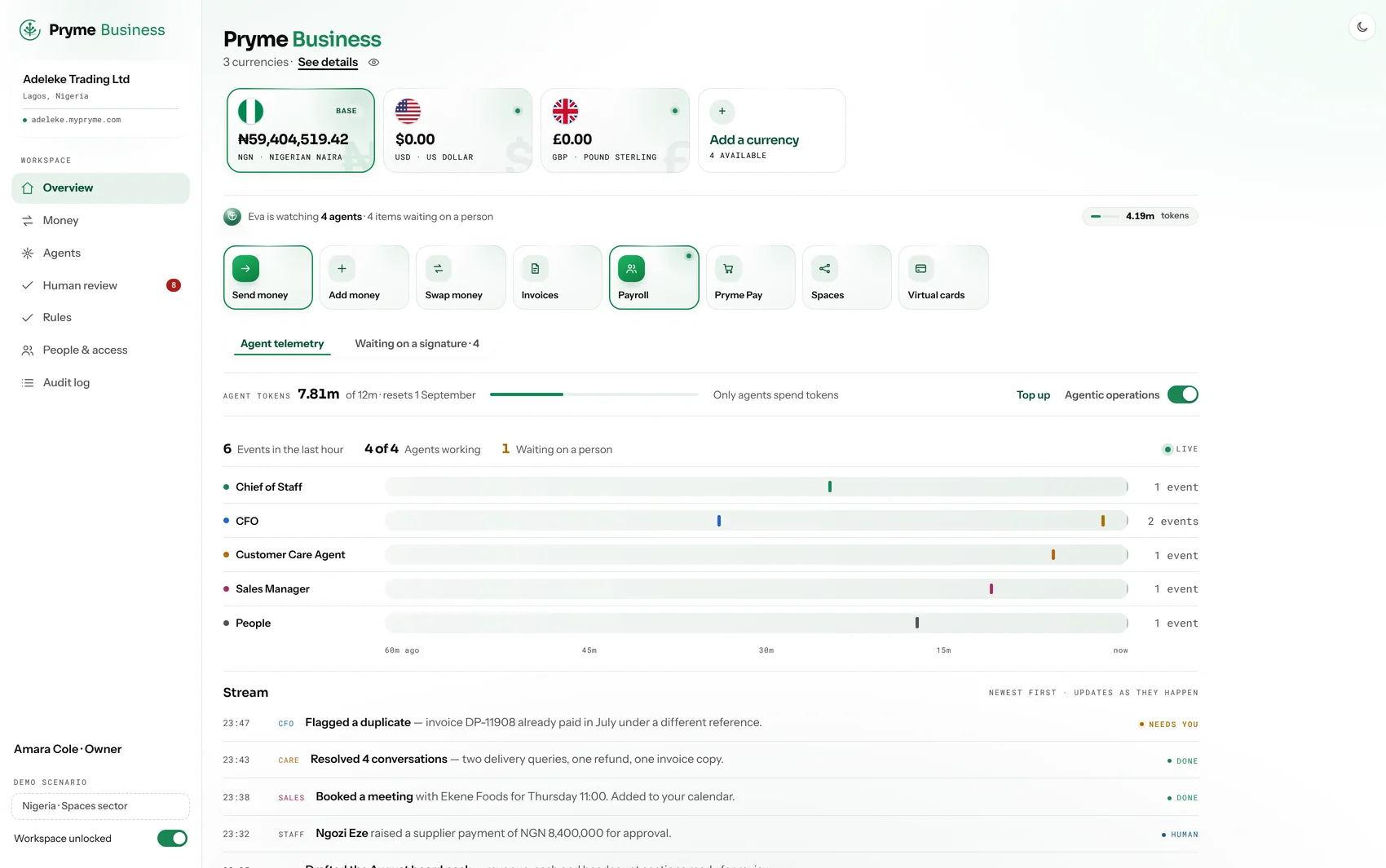
Five agents come with the account. Each one has a job description, a budget and a ceiling you set. They do the work and bring it to you — nothing leaves the account without your signature.
Knows what is stuck, who is waiting and what you promised — and keeps all three moving.
Booked a meeting with John Doe Foods for Thursday 11:00.Keeps the books as you trade and tells you the moment something does not add up.
Flagged a duplicate — invoice DP‑11908 was already paid in July.Holds every filing to its own clock and screens names and payments against your policy — and logs what it refuses.
Screened 412 payments overnight and refused two of them.Goes back to the buyers who went quiet, with the receipt already attached.
Recovered ₦410,000 across three overdue invoices.Replies, follows up on what they asked for and hands you only the ones that need you.
Resolved 4 conversations — two deliveries, one refund.Issue a dedicated Naira account number to each of your own customers, collect into it and reconcile against it. The same rails the Business Account runs on, with the licence behind them.
Dollars, pounds and euros beside a Naira account, on one ledger and one set of books. Five agents come with it and run the account — nothing leaves without your signature.
Five agents come with the account. Each has a job description, a budget and a ceiling you set. They do the work and bring it to you — they propose, you approve.
Knows what is stuck, who is waiting and what you promised, and keeps all three moving.
Booked the quarterly review with your auditor for Thursday.Keeps the books in every currency you hold and flags the moment something does not add up.
Flagged a duplicate — invoice DP‑11908 was already paid in July.Holds every filing to its own clock and screens names and payments against your policy — and logs what it refuses.
Screened 412 payments overnight and refused two of them.Goes back to the buyers who went quiet, with the invoice and the receipt already attached.
Recovered $12,400 across three overdue invoices.Replies, follows up on what they asked for and hands you only the ones that need you.
Resolved 4 conversations — two deliveries, one refund.The business has changed shape four times and never changed what it was rooted in. Each version was built out of what the last one could not do.
An online grocery store, built out of a faulty tab. Selling the food was the easy part — taking the money for it, and moving it, turned out to be the business.
A prepaid card. The first time the company issued rather than resold, and the first time it carried the obligations that come with holding somebody else’s money.
Solid Allianze acquired — an existing bank with an existing licence. The perimeter stopped being someone else’s to draw.
More than one currency on one balance, and the rebrand to Pryme. A Nigerian business could hold dollars without holding a second institution.
Accounts that do the work rather than only hold value. Five agents on the account, inside a policy you write — which is where the new mark starts.
Pryme is a financial technology company. It gives people and businesses in Nigeria one account that holds Naira alongside dollars, pounds and euros, and a set of agents that do the running of it — keeping the books, chasing what is owed, answering customers and paying bills. Nothing leaves an account without the owner’s approval.
Yes. A Pryme account holds Naira, US dollars, pounds sterling and euros side by side on one ledger, each with its own account details — a Nigerian account number, a US account number, a UK sort code and an IBAN for the euro area. You can swap between them at a rate you set, and every currency has its own statement.
Spaces is available in Nigeria. It gives a shopper money to spend that can only be spent with a participating business. The business is paid into its Naira account whether or not the shopper repays, because Pryme carries the credit. For the business it is free to join, there is nothing monthly, and the customer’s identity is never shown — only a reference and what it is worth.
Five agents come with the account. The Chief of Staff runs the week and keeps what is stuck moving. Finance watches the money and keeps the books as you trade. Compliance keeps the filings on time and screens what moves. Sales chases what you are owed. Customer Support answers your customers and follows up. Each has a job description, a budget and a ceiling you set, and each one proposes rather than acts — nothing leaves the account without your signature.
Pryme Pay takes payments on your own site or on a checkout page you control. The buyer is given a one-time account number and transfers to it from any bank app or by USSD — no card, no OTP, nothing to type in. The money lands in the same account your agents are running, already matched to the order and already in your books.
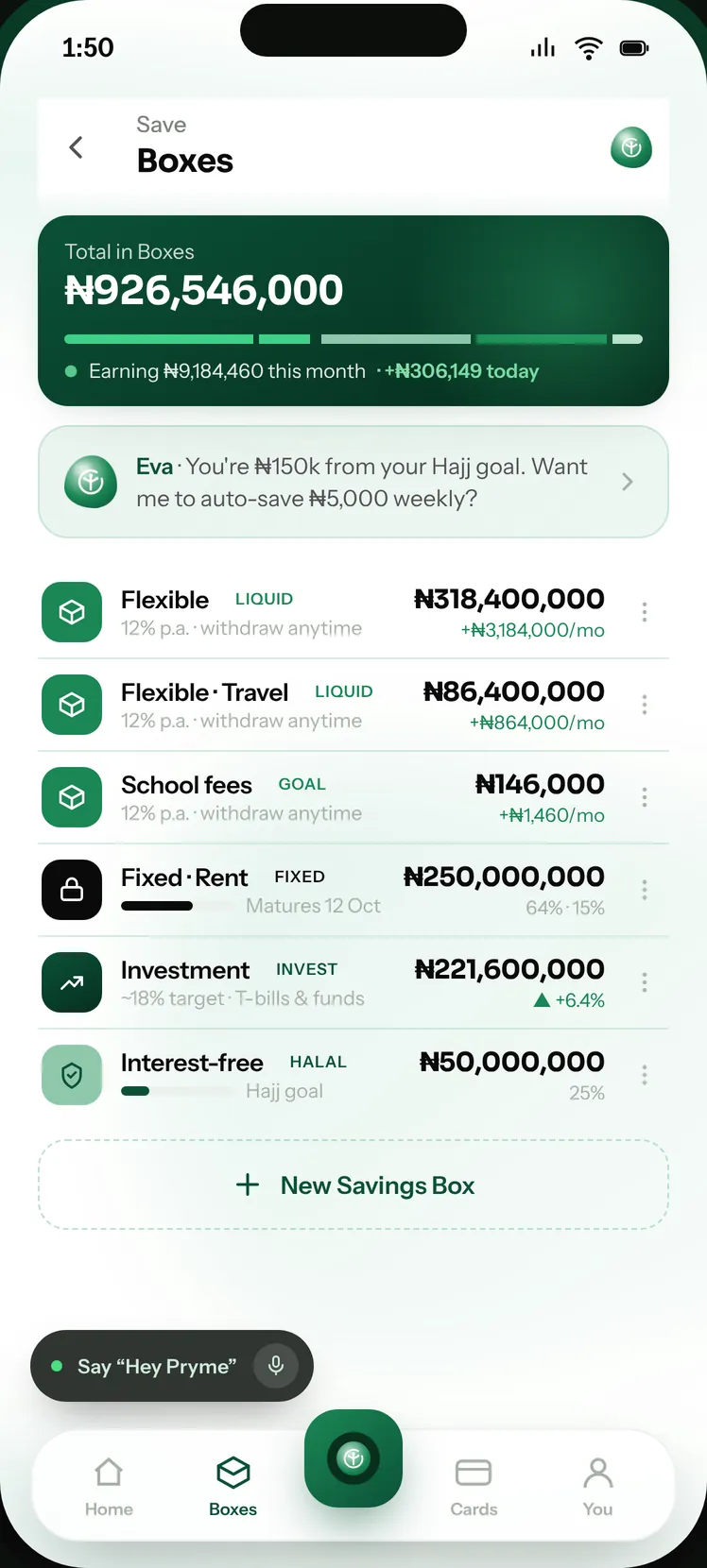
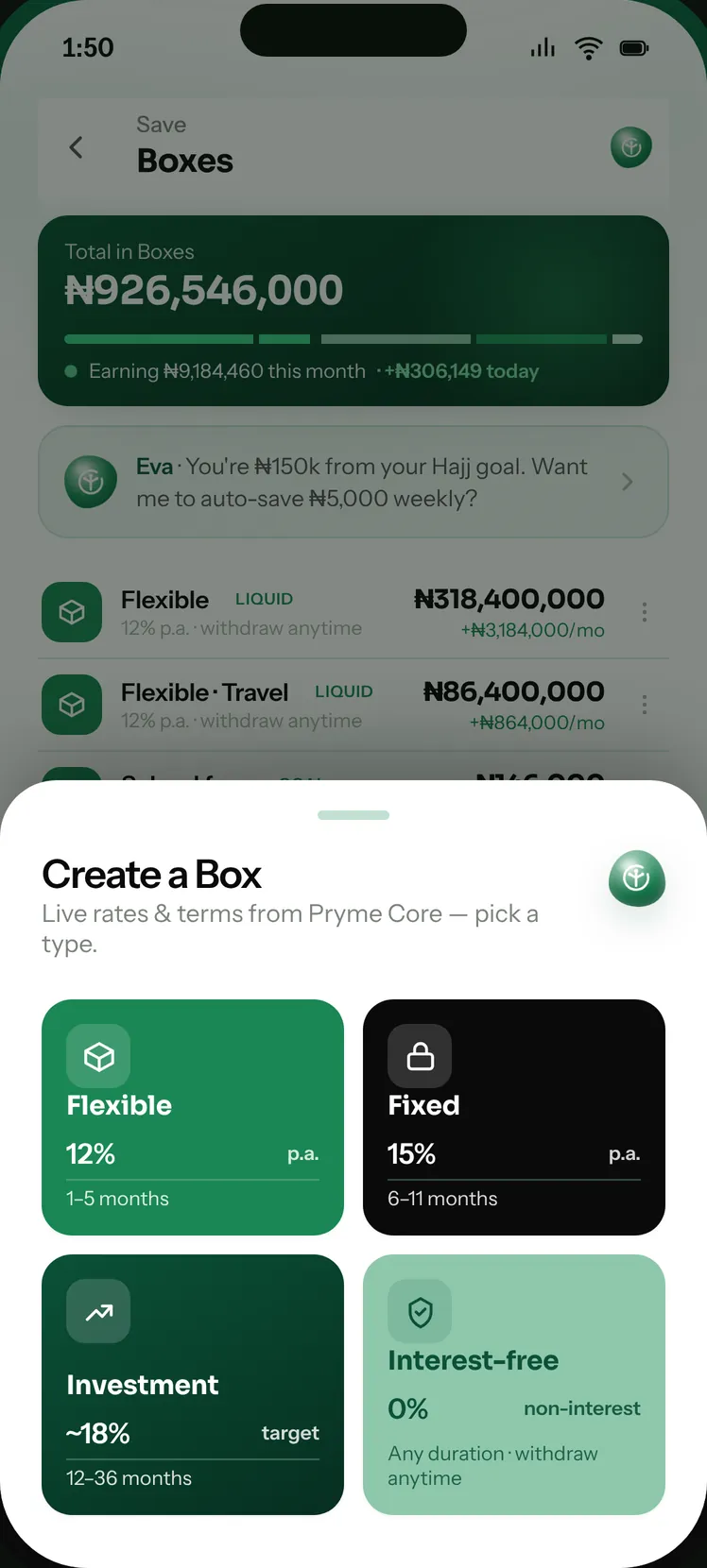
Savings Boxes are separate pots inside a Pryme account, held in Naira. Flexible Boxes can be withdrawn at any time, Fixed Boxes hold to a date, Investment Boxes hold for longer, and Interest-free Boxes earn nothing by design. A business can use them to ring-fence payroll and the tax it withholds, so that money cannot be spent by accident.
Pryme is a financial technology company, not a bank. Accounts and deposits are provided by Solid Allianze Microfinance Bank Limited, which is licensed by the Central Bank of Nigeria and is a member of the Nigeria Deposit Insurance Corporation.
Yes. Pryme Rails lets a platform issue a dedicated Naira account number to each of its own customers, collect into it and reconcile against it, over one API — the same rails the Pryme Business Account runs on.
Pryme is a financial technology company. It gives you one account that holds US dollars, pounds sterling and euros beside Naira, with an assistant that runs the account for you and asks before anything moves. Accounts are provided in Nigeria today, and further markets open as each licence lands.
Accounts are provided in Nigeria today, subject to verification and approval. Foreign-currency balances are held and converted inside that account, so you can hold, receive and swap dollars, pounds and euros wherever you are.
Naira, US dollars, pounds sterling and euros, side by side on one ledger. Each has its own details — a Nigerian account number, a US account number, a UK sort code and an IBAN for the euro area — and each has its own statement.
Swap at a rate you set rather than the rate of the day, then send to any Pryme username or to a Nigerian bank account. There is no fee to send to another Pryme account.
Eva is the assistant inside the Pryme app. She opens accounts, moves money, saves toward your goals, pays what is due and follows up what is owed to you — and asks you before anything moves.
Pryme Rails lets a platform issue a dedicated Naira account number to each of its own customers, collect into it and reconcile against it, over one API — the same rails the Pryme Business Account runs on.
Notes on money that does the work: what we are building, what the regulation actually says, and how we think about letting software act on money. Read the Ledger
What AI agents can do in bookkeeping, close, collections and compliance today, where a person must stay in charge, and how to judge a product.
How multi-currency business accounts work: local details vs SWIFT, payment rails, the real cost of FX, safeguarding vs deposit protection, and hedging.
How UK, US, Canadian and European firms pay Nigerian suppliers and get paid by Nigerian clients: FX, Form A and M, tax, compliance and payout routes.
What it really costs to send money to Nigeria from the UK, US, Canada and Europe: fees, exchange-rate margins, CBN naira rules, BVN, speed and scams.
What AI can and cannot do in day-to-day bookkeeping, how much time it saves on real numbers, and which jobs must stay with you or your accountant.
The main figures from Nigeria's 2024 fraud reporting: ₦52.26bn lost, 70,111 cases, the ₦30bn internal case and how identity fraud was used.
Nigerian financial institutions reported ₦52.26 billion of fraud losses in 2024, up ₦34.59 billion on 2023, from 70,111 reported cases, according to the NIBSS fraud report released in February 2025. Attempted fraud rose 338% year on year, and the CBN later attributed most of the rise to a single ₦30 billion internal case.
NIBSS said the rise in attempted and actual losses came mainly from incidents at certain institutions caused by system vulnerabilities. The CBN was more specific when it restated the numbers: the jump was "primarily due to a major internal case involving ₦30 billion". In other words, more than half of all 2024 losses came from one case inside the system rather than from the many smaller scams that reach customers by phone or text.
That distinction matters for anyone quoting the figure. The 2024 total is a record, but it is not evidence that everyday scams tripled. Taking the ₦30 billion case out leaves about ₦22.26 billion (our calculation), roughly 26% above 2023. The number of reported cases actually fell, and 2025 losses then dropped back to ₦25.85 billion.
The report said attempts and actual losses rose sharply in the second and third quarters of 2024 compared with the quarter before, then declined in the fourth quarter. It did not publish quarterly values in the coverage we could verify. For the first quarter, earlier NIBSS data put losses at ₦3.007 billion from 20,638 attempts, down about 45% from ₦5.47 billion in the fourth quarter of 2023.
The 2024 report gave several case examples. They show how much fraud now relies on opening or controlling accounts, rather than only tricking existing customers.
| Method described in the report | Figure reported |
|---|---|
| Accounts opened with stolen identities, including those of senior citizens, verified with a selfie | About ₦400 million moved through such accounts |
| Fraud proceeds received into a fraudulent oil and gas corporate account on 30 July 2024 | ₦335 million, all recovered |
| Accounts in the names of minors, with BVNs registered by compromised bank staff and an agent | About ₦495.3 million through one enterprise account and ₦507 million through a bakery enterprise account |
| Accounts operated from abroad, with log-in locations in Hong Kong across at least three institutions | Value not stated |
| Forged documents and a company registration number taken from the internet | Value not stated |
| Proceeds moved to unlicensed bureau de change operators | Value not stated |
The report noted that people aged 40 and above were the main targets in 2023, as in 2022, and that the number of unique fraud victims fell 4%, from 84,130 in 2022 to 80,658 in 2023. Web fraud incidents rose 169% in 2024, according to the CBN's restatement.
Set against the full CBN series, 2024 is an outlier in both directions. It had the highest losses and the highest attempted value on record, yet fewer reported cases than 2020. The following year, losses fell by half and attempts fell by more than half, which is consistent with a single exceptional event inflating 2024 rather than a lasting change in the scale of everyday fraud.
| Year | Losses (₦ billion) | Attempted (₦ billion) | Losses as % of attempted (our calculation) |
|---|---|---|---|
| 2023 | 17.67 | not published in our sources | n/a |
| 2024 | 52.26 | 86.36 | about 61% |
| 2025 | 25.85 | 37.57 | about 69% |
One reading of the falling share of attempts in 2024 is that more attempts were stopped, but because the attempted total includes the very large internal case, the ratio is easily skewed. Quote the ratio with that caveat, or not at all. For researchers, the more robust comparison over time is the number of reported cases (101,624 in 2020, 70,111 in 2024) alongside losses, because a single case can move the naira total far more than it moves the count.
The fraud-to-transaction-value ratio rose from 0.0022% in 2023 to 0.0040% in 2024. Even at that level, fraud equalled about four naira in every hundred thousand naira of payments. That is small at system level, but the money is concentrated on relatively few victims, which is why individual cases can be devastating.
We used press coverage of the NIBSS fraud report published in February 2025 by The Guardian, Blueprint and 21st Century Chronicle, cross-checked against the CBN's 2020 to 2025 series reported by Nairametrics in June 2026. We could not open the NIBSS document directly. Where outlets gave a percentage that did not match the figures, we used the figures. The first-quarter numbers come from TechCabal's May 2024 report on NIBSS quarterly data. Values are nominal naira.
For the full time series see Nigeria bank fraud losses by year. If someone has used your identity or BVN, read is it safe to share your BVN and how to report fraud to the police and EFCC.
₦52.26 billion, according to the NIBSS fraud report, from ₦86.36 billion of attempted fraud. It was the highest annual figure on record.
The CBN said it was mainly one internal case of about ₦30 billion. NIBSS pointed to system vulnerabilities at certain institutions.
70,111 cases, down from 101,624 in 2020. Fewer cases but higher losses means each successful fraud took more on average.
The 2024 report described accounts opened with stolen identities, including those of older people, and BVNs registered for minors by compromised staff and an agent.
This article is general information, not financial, legal or tax advice. Products described are provided under the terms on this site and are subject to regulation and eligibility.
Headline NIBSS figures in one place: BVNs issued, annual NIP volume, total payment value, National Payment Stack early data and fraud ratios.
Annual fraud losses in Nigeria's banks and payment firms from 2020 to 2025, with attempted fraud, case counts and the data sources.
How Nigeria's electronic payments changed between 2019 and 2025: NIP, POS and mobile channels compared, with nominal growth and the caveats.
You can add the other type later — many of our customers hold both.
The business first, then you. Nothing is submitted until you review it.
Ideal customer profiles
Generated from your website by VerifiedLead.ai
Pick the ones that look right. Your Sales agent works these first, and you can change them at any time after opening.
We ask this because you have not given us a website. It helps us set the right limits from day one.
Which of these represents you?
Officers listed against this company on the UK register.
We have sent a six-digit code to your email address. Enter it below to confirm the address is yours.
Wrong address? Go back and change it — nothing is created until this step passes. We never ask for a code by phone or email; anyone who does is not us.
Last step. Each time you sign in we email you a six-digit code — we never send codes by SMS.